Global bubble tea market surges as customization, flavor innovation, and RTD expansion drive mainstream adoption across developed and emerging markets.
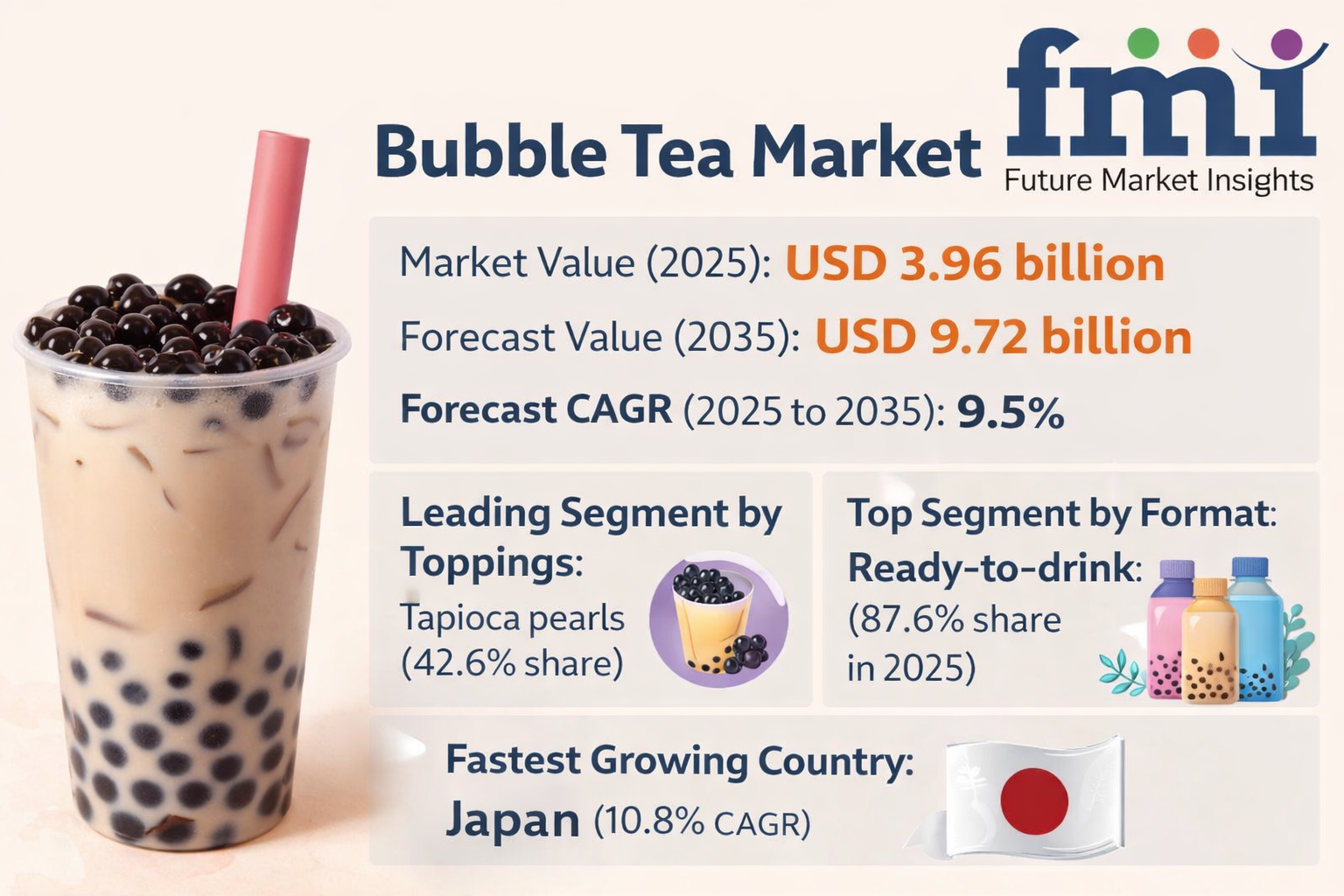
NEWARK, DELAWARE / ACCESS Newswire / February 18, 2026 / The global bubble tea market is entering a high-growth expansion phase, valued at USD 3.96 billion in 2025 and projected to reach USD 9.72 billion by 2035, registering a strong CAGR of 9.5%. According to Future Market Insights, accelerating demand for customizable beverages, continuous flavor innovation, premium ingredient upgrades, and the rapid expansion of ready-to-drink formats are transforming bubble tea from a niche East Asian specialty into a mainstream global lifestyle drink.
Once rooted primarily in East Asian communities, bubble tea has evolved into a global lifestyle beverage. Growth is being fueled not only by café expansion but also by ready-to-drink (RTD) innovation, premium ingredient upgrades, and the launch of healthier, low-sugar variants tailored to modern consumer preferences.
Quick Market Snapshot (2025-2035)
Metric |
Value |
Industry Size (2025E) |
USD 3.96 Billion |
Industry Value (2035F) |
USD 9.72 Billion |
CAGR (2025-2035) |
9.5% |
Leading Topping |
Tapioca Pearls (42.6% Share) |
Dominant Format |
Ready-to-Drink (87.6% Share) |
Fastest Growing Country |
Japan (10.8% CAGR) |
Get Access to the Full Report Sample: Explore detailed forecasts, segment insights, and competitive analysis. https://www.futuremarketinsights.com/reports/sample/rep-gb-12310
The Customization Economy: From Niche Drink to Lifestyle Staple
Bubble tea's rapid ascent reflects a broader "customization economy" shaping the global foodservice landscape. Consumers increasingly expect control over sweetness levels, milk bases, toppings, and flavor combinations.
Per capita consumption is steadily rising across developed and emerging markets. In East Asia, North America, and Europe, bubble tea has become integrated into café culture. Meanwhile, South Asia, Latin America, and Southeast Asia are experiencing accelerated adoption driven by urbanization, youth demographics, and expanding franchise networks.
The beverage's visual appeal and shareability on platforms like Instagram and TikTok continue to amplify demand among Gen Z and millennials.
Tapioca Pearls: The Iconic Growth Engine
Among toppings, tapioca pearls command a 42.6% share in 2025, maintaining their status as the defining ingredient of traditional bubble tea. Their chewy texture and ability to complement milk-based and fruit teas continue to anchor consumer loyalty.
Manufacturers are introducing flavored and colored pearl variants to attract experimental consumers while preserving authenticity. The segment's growth is supported by availability across specialty outlets, supermarkets, and RTD formats.
Ready-to-Drink Dominance: Convenience as a Catalyst
The RTD segment accounts for 87.6% of market share in 2025, underscoring consumer preference for convenience and portability. Supermarkets, hypermarkets, and online platforms are expanding shelf space for canned and bottled bubble tea.
Busy urban lifestyles in North America, Europe, and Asia-Pacific are accelerating demand for grab-and-go formats. Collaborations with retail chains and promotional end-cap placements are driving impulse purchases and broadening mainstream acceptance.
Flavor Innovation Accelerates Growth
The flavored segment is projected to grow at a 10.3% CAGR through 2035, outpacing traditional variants. Matcha, taro, mango, lychee, pumpkin spice, and cherry blossom are among the high-performing flavors.
Seasonal SKUs, crossovers with alcoholic beverages, and fusion blends with coffee, smoothies, and energy drinks are reshaping the category. DIY kits and instant mixes are also gaining traction as consumers experiment at home.
Online Retail: The Fastest Expanding Channel
Online retail is forecast to expand at an 11.2% CAGR between 2025 and 2035. Dedicated brand websites and partnerships with major e-commerce platforms are driving direct-to-consumer growth.
Foodservice remains dominant, but indirect channels-including supermarkets and convenience stores-continue expanding RTD visibility. E-commerce growth is particularly strong in urban centers where home delivery demand is high.
Trade Landscape: Asia as the Supply Hub
The international trade ecosystem for bubble tea ingredients is expanding significantly. Countries such as Taiwan, Thailand, and Vietnam remain key exporters of tapioca pearls, syrups, tea bases, and machinery.
North America and Europe are major importing regions, alongside rapidly expanding Southeast Asian and South Asian markets. Franchise expansion and rising disposable incomes are strengthening cross-border supply chains.
Country-Wise Outlook: Japan Leads Acceleration
Japan (10.8% CAGR): The fastest-growing market, integrating bubble tea into a mature tea culture with matcha and sakura flavors. Vending-machine RTD distribution and anime collaborations enhance consumer engagement.
United States (8.7% CAGR): Growth driven by social media virality, plant-based milk options, and functional add-ins like collagen and probiotics.
United Kingdom (9.1% CAGR): Over 1,400 dedicated outlets reflect strong adoption, supported by multicultural cuisine acceptance and high monthly search volumes.
Germany (8.4% CAGR): Wellness-driven demand for low-sugar and organic variants.
France (8.9% CAGR): Premium boutique cafés and aesthetic presentation elevate perceived value.
Industry Structure: Global Chains vs. Local Innovators
The competitive landscape features two dominant cohorts. International franchised chains such as CoCo Fresh Tea & Juice, Gong Cha, and Quickly command significant market share through standardized operations and global franchise agreements.
Leading Bubble Tea Brands are 7 Leaves Café, Boba Guys, Boba Loca, Bubbleology, CoCo Fresh Tea & Juice, DaBoba, Del Monte Foods Inc., Gong Cha, Happy Lemon Bubble Tea, J Way Foods, Jazen Tea, Kung Fu Tea, La Kaffa International Co., Quickly, Sharetea, Tapioca Express, Ten Ren Tea Co., Ltd., Tiger Sugar, Yifang USA Inc.
Simultaneously, boutique cafés and regional players differentiate through hyper-local flavors, seasonal offerings, and social media collaborations. Automation technologies, cup-sealing robots, loyalty apps, and recyclable packaging innovations are becoming strategic priorities.
Recent developments underscore continued innovation. In April 2025, Chatime Australia introduced espresso-based beverages to expand demographic reach. Meanwhile, Gong Cha Korea launched limited-edition taro beverages inspired by K-pop collaborations, reinforcing youth appeal.
Outlook: From Trend to Structural Beverage Category
By 2035, bubble tea is poised to transition from trend-driven novelty to an established global beverage category. Its combination of customization, sensory texture, premium positioning, and RTD scalability positions it strongly within the evolving beverage landscape.
As premiumization intensifies, healthier formulations expand, and online retail accelerates distribution, bubble tea is expected to secure a permanent role in global café culture and retail beverage aisles alike.
For a comprehensive analysis of market dynamics, segmentation, regional forecasts, and competitive benchmarking through 2035, visit: https://www.futuremarketinsights.com/reports/bubble-tea-market
Related Reports:
Bubble Tea Industry Analysis in USA: https://www.futuremarketinsights.com/reports/usa-bubble-tea-market
Bubble Tea Market Share Analysis: https://www.futuremarketinsights.com/reports/bubble-tea-market-share-analysis
UK Bubble Tea Market: https://www.futuremarketinsights.com/reports/united-kingdom-bubble-tea-market
Europe Bubble Tea Market: https://www.futuremarketinsights.com/reports/europe-bubble-tea-market
Australia Bubble Tea Market: https://www.futuremarketinsights.com/reports/australia-bubble-tea-market
About Future Market Insights (FMI)
Future Market Insights (FMI) is a leading provider of market intelligence and consulting services, serving clients in over 150 countries. Headquartered in Delaware, USA, with a global delivery center in India and offices in the UK and UAE, FMI delivers actionable insights to businesses across industries including automotive, technology, consumer products, manufacturing, energy, and chemicals.
An ESOMAR-certified research organization, FMI provides custom and syndicated market reports and consulting services, supporting both Fortune 1,000 companies and SMEs. Its team of 300+ experienced analysts ensures credible, data-driven insights to help clients navigate global markets and identify growth opportunities.
For Press & Corporate Inquiries
Rahul Singh
AVP - Marketing and Growth Strategy
Future Market Insights, Inc.
+91 8600020075
For Sales - sales@futuremarketinsights.com
For Media - Rahul.singh@futuremarketinsights.com
For web - https://www.futuremarketinsights.com/
SOURCE: Future Market Insights, Inc.
View the original press release on ACCESS Newswire