Ultra-Fast Charging Deployment, Smart Grid Integration, and Expanding Private Charging Networks Accelerate Global EV Infrastructure Growth
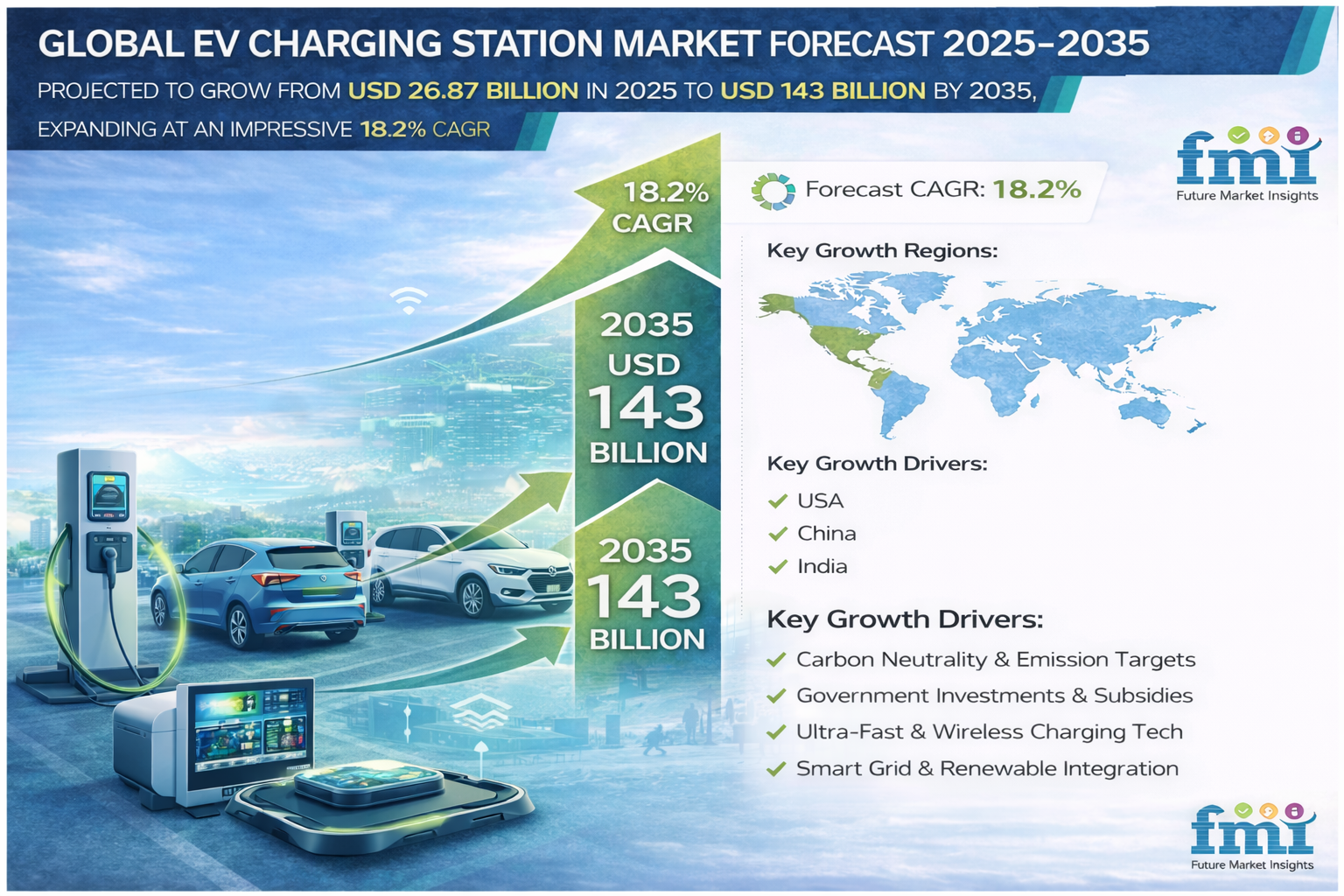
NEWARK, DE / ACCESS Newswire / February 18, 2026 / The global electric vehicle (EV) charging station market is entering a phase of exponential expansion, transforming the backbone of sustainable mobility worldwide. Valued at USD 26.87 billion in 2025, the market is projected to reach an impressive USD 143 billion by 2035, registering a robust CAGR of 18.2%. This growth reflects a structural shift in global transportation, where charging infrastructure is no longer a supporting utility but a critical enabler of mass EV adoption and energy transition.
According to Future Market Insights (FMI), the charging ecosystem's rapid evolution is driven by aggressive carbon neutrality commitments, government infrastructure investments, and surging electric vehicle sales. As nations accelerate electrification strategies to reduce fossil fuel dependence and enhance energy security, EV charging infrastructure is becoming a cornerstone of future transport and energy systems.
Infrastructure Transformation: From Basic Chargers to Intelligent Energy Platforms
The EV charging station industry is undergoing a technological transformation, moving beyond conventional charging points to become intelligent, grid-integrated energy platforms. High-power charging systems capable of delivering 350 kW and above are significantly reducing vehicle charging times, enabling EVs to rival the convenience of traditional refueling.
Simultaneously, innovations such as wireless inductive charging, vehicle-to-grid (V2G) integration, and AI-enabled load balancing are redefining charging efficiency and grid interaction. These technologies allow EVs not only to consume energy but also to act as distributed energy storage assets, supporting grid stability during peak demand.
An industry analyst noted, "Charging infrastructure is evolving into a dynamic energy network. Market leaders are leveraging intelligent software, IoT connectivity, and predictive analytics to optimize performance, enhance reliability, and unlock new revenue streams."
Smart Connectivity and IoT: Enabling the Next Generation of Charging Networks
Digitalization is playing a decisive role in shaping the next generation of charging stations. IoT-enabled charging infrastructure allows operators to monitor performance in real time, predict equipment failures, and perform remote diagnostics, significantly reducing downtime and operational costs.
Advanced sensor systems monitor voltage, current, and temperature to ensure safe and efficient charging operations, especially during ultra-fast charging sessions. Smart connectivity enables dynamic pricing models, automated user authentication, and seamless integration with renewable energy sources.
Mobile app integration further enhances user experience by allowing EV owners to locate chargers, schedule charging sessions, and track charging progress remotely. These capabilities are transforming charging stations into fully connected digital service platforms.
Renewable Energy Integration: Advancing Sustainable Charging Ecosystems
Renewable energy integration is emerging as a defining feature of modern EV charging infrastructure. Charging operators are increasingly incorporating solar and wind energy sources to reduce carbon emissions and enhance operational sustainability.
Excess renewable energy generated during low-demand periods can be stored or fed back into the grid, improving energy efficiency and economic returns. This decentralized energy model strengthens grid resilience while aligning with global decarbonization targets.
The convergence of renewable energy and EV charging infrastructure is positioning charging stations as essential components of future smart cities and clean energy ecosystems.
Segment Spotlight: Private and Residential Charging Lead Market Expansion
Private charging stations are projected to dominate the market, accounting for over 97% of total installations in 2025 and maintaining leadership throughout the forecast period. This segment is expanding at an 18.3% CAGR, driven by technological advancements, cost incentives, and the convenience of home-based charging.
Residential charging infrastructure is also witnessing strong growth, supported by government incentives such as installation subsidies and tax credits. Home charging offers EV owners greater convenience and lower electricity costs during off-peak hours, reinforcing its widespread adoption.
Meanwhile, public fast-charging networks are expanding rapidly along highways, urban centers, and commercial hubs, addressing range anxiety and enabling long-distance EV travel.
Regional Powerhouses: Asia Pacific Leads, While North America and Europe Maintain Strong Momentum
While North America and Europe remain mature markets driven by policy support and technological innovation, Asia Pacific is emerging as the fastest-growing region.
China: China continues to dominate global EV infrastructure deployment, supported by its leadership in EV production and aggressive infrastructure expansion. The country holds the largest share of global fast charger installations and continues to invest heavily in nationwide charging coverage.
India: India is witnessing rapid charging network expansion, driven by urbanization, favorable government policies, and growing EV adoption. Major cities such as Delhi, Bangalore, and Mumbai are becoming hubs for charging infrastructure deployment through public-private partnerships.
United States: The United States remains a key growth market, supported by federal investments, including multi-billion-dollar funding initiatives aimed at expanding nationwide charging networks. Automakers and energy providers are also investing heavily in ultra-fast charging corridors.
Europe: European nations are advancing charging infrastructure through regulatory mandates, subsidies, and climate commitments, positioning the region as a global leader in sustainable mobility infrastructure.
Industry Innovation: Automakers and Energy Giants Expand Charging Networks
Automakers are increasingly entering the charging infrastructure market, recognizing its strategic importance in accelerating EV adoption. Leading automotive manufacturers are forming joint ventures to deploy high-speed charging networks across major transport corridors.
Energy companies and technology providers are also investing heavily in charging infrastructure, leveraging digital platforms, cloud connectivity, and predictive analytics to enhance operational efficiency.
Wireless charging technologies and autonomous charging systems are emerging as future growth drivers, offering enhanced convenience and reducing infrastructure complexity.
Market Metrics at a Glance (2025-2035)
Market Metric |
Value / Detail |
|---|---|
Market Value (2025) |
USD 26.87 Billion |
Projected Market Value (2035) |
USD 143 Billion |
CAGR (2025-2035) |
18.2% |
Dominant Segment |
Private Charging Stations |
Fastest-Growing Region |
Asia Pacific |
Key Technology Trends |
Ultra-Fast Charging, IoT Integration, Renewable Energy |
Dynamics of the Decade: Intelligent, Sustainable, and Connected Charging Infrastructure
Looking ahead to 2035, several trends will shape the competitive landscape:
Ultra-Fast Charging Expansion: High-power charging systems will become standard, enabling rapid charging and reducing range anxiety.
Smart Grid Integration: Charging stations will increasingly integrate with smart grids to optimize energy distribution and improve efficiency.
Wireless Charging Adoption: Inductive charging technologies will enhance convenience and enable autonomous charging capabilities.
Renewable Energy Alignment: Solar- and wind-powered charging stations will become essential for achieving global sustainability goals.
Digital Platform Integration: Cloud-based software and predictive analytics will enhance infrastructure performance and user experience.
Competitive Landscape: Technology Leaders Drive Innovation
The EV charging station market is characterized by intense innovation and strategic expansion. Tier-1 companies, including Tesla, ABB, BYD, Siemens, Schneider Electric, and Shell, collectively account for a significant share of the market, leveraging their global presence and technological expertise.
Mid-tier players such as Delta Electronics, Webasto, and Wallbox are strengthening their regional presence through specialized solutions and strategic partnerships.
Charging infrastructure providers are focusing on expanding network coverage, improving charging speeds, and integrating advanced software platforms to maintain competitive advantage.
Future Outlook: Charging Infrastructure as the Backbone of Electrified Mobility
As electric vehicle adoption accelerates globally, charging infrastructure will play a decisive role in enabling sustainable transportation. The convergence of advanced charging technologies, renewable energy integration, and intelligent digital platforms is transforming EV charging stations into critical components of the global energy and mobility ecosystem.
With strong government support, accelerating EV adoption, and continuous technological innovation, the EV charging station market is poised to become one of the fastest-growing infrastructure sectors worldwide, laying the foundation for the future of zero-emission transportation.
For an in-depth analysis of evolving formulation trends and to access the complete strategic outlook for the EV Charging Station Market through 2035, visit the official report page at: https://www.futuremarketinsights.com/reports/ev-charging-station-market
Related Reports:
EV Charging As A Service Market - https://www.futuremarketinsights.com/reports/ev-charging-as-a-service-market
EV Charging Cable Locks and Security Devices Market - https://www.futuremarketinsights.com/reports/ev-charging-cable-locks-and-security-devices-market
EV Charging Cable Management Accessories Market - https://www.futuremarketinsights.com/reports/ev-charging-cable-management-accessories-market
EV Charging Panelboard Market - https://www.futuremarketinsights.com/reports/ev-charging-panelboard-market
EV Charging Tester Market - https://www.futuremarketinsights.com/reports/ev-charging-tester-market
About Future Market Insights (FMI)
Future Market Insights (FMI) is a leading provider of market intelligence and consulting services, serving clients in over 150 countries. Headquartered in Delaware, USA, with a global delivery center in India and offices in the UK and UAE, FMI delivers actionable insights to businesses across industries including automotive, technology, consumer products, manufacturing, energy, and chemicals.
An ESOMAR-certified research organization, FMI provides custom and syndicated market reports and consulting services, supporting both Fortune 1,000 companies and SMEs. Its team of 300+ experienced analysts ensures credible, data-driven insights to help clients navigate global markets and identify growth opportunities.
For Press & Corporate Inquiries
Rahul Singh
AVP - Marketing and Growth Strategy
Future Market Insights, Inc.
+91 8600020075
For Sales - sales@futuremarketinsights.com
For Media - Rahul.singh@futuremarketinsights.com
For web - https://www.futuremarketinsights.com/
SOURCE: Future Market Insights, Inc.
View the original press release on ACCESS Newswire