By Finterra Research Team
Published: January 19, 2026
Introduction
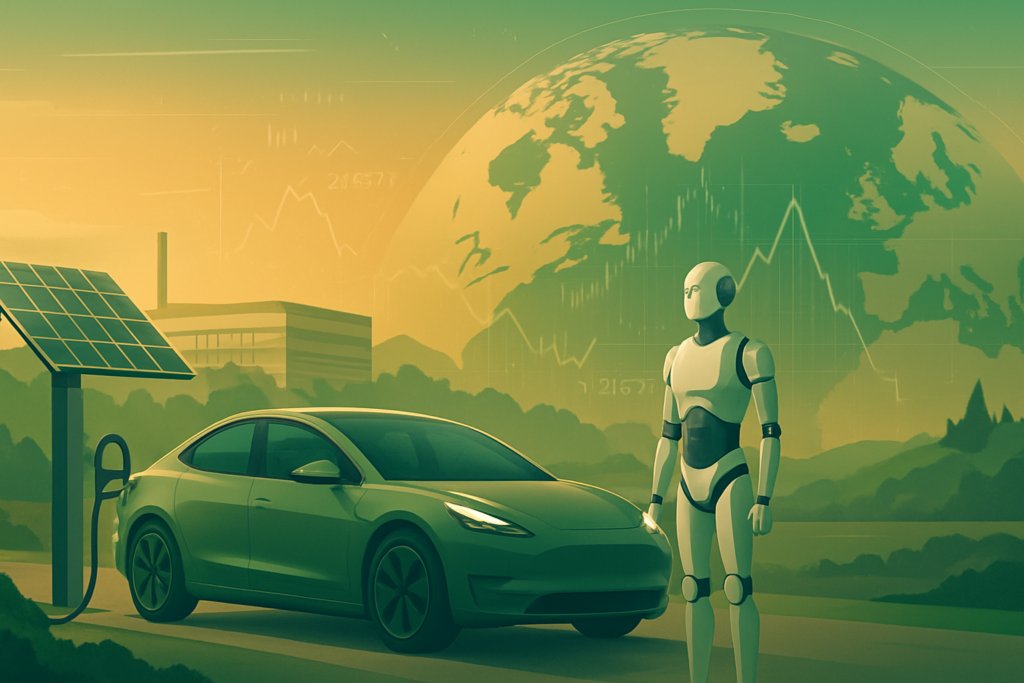
As of early 2026, Tesla, Inc. (NASDAQ: TSLA) stands at a defining crossroads. Once the undisputed champion of the electric vehicle (EV) revolution, the company has spent the last 18 months aggressively rebranding itself as an artificial intelligence and robotics powerhouse. This shift comes at a volatile moment: global EV demand has cooled significantly, and a brewing trade war between the United States and Northern Europe—centered on Greenland’s mineral wealth—threatens to upend the global battery supply chain. With a market capitalization hovering near $1.46 trillion, Tesla is no longer just a car company; it is a trillion-dollar bet on the future of autonomous labor and mobility.
Historical Background
Founded in 2003 and led by Elon Musk since its early stages, Tesla’s journey is one of the most storied in corporate history. From the niche Roadster to the mass-market Model 3 and Model Y, Tesla successfully proved that EVs could be both desirable and profitable. The 2020-2022 period saw the company’s valuation explode, reaching the $1 trillion mark as it scaled production across three continents.
However, the "Expansion Era" (2018–2023) has given way to the "Intelligence Era" (2024–Present). Following the global EV "price wars" of 2024, which eroded margins across the industry, Tesla pivoted focus toward the "Cyber" ecosystem—comprising the Cybertruck, the upcoming Cybercab (Robotaxi), and the Optimus humanoid robot. This transformation has tested investor patience, shifting the narrative from delivery volumes to software-driven recurring revenue.
Business Model
Tesla’s revenue model has evolved into a tripartite structure:
- Automotive: Sale and lease of the S3XY lineup and Cybertruck. While still the primary revenue driver, automotive gross margins have compressed to approximately 17% as of late 2025.
- Energy Generation and Storage: This segment—featuring Powerwall and Megapack—is Tesla’s fastest-growing business. In 2025, deployments reached a record 46.7 GWh, providing a critical buffer against slowing car sales.
- Services and AI Software: This includes Full Self-Driving (FSD) subscriptions, Supercharging revenue (now open to most OEMs), and the nascent Optimus-as-a-Service (OaaS) model.
Stock Performance Overview
Tesla’s stock performance has been a roller coaster for long-term holders.
- 1-Year Performance: Down roughly 8%, as the market digests the 2025 delivery miss and the uncertainty of the April 2026 Cybercab launch.
- 5-Year Performance: Up approximately 145%, significantly outperforming the S&P 500, though still well below its late-2021 highs.
- 10-Year Performance: Up over 1,800%, a testament to the company’s disruptive impact on the global automotive industry.
As of today, January 19, 2026, the stock trades at $437.50, reflecting a 9.5% pullback over the last 30 days.
Financial Performance
Tesla’s 2025 fiscal year was a period of consolidation. Total revenue for FY 2025 is estimated at $96.3 billion, a modest increase from 2024, hindered by a decline in annual deliveries (1.63 million units).
AI-Generated 2026 Estimates:
- Projected Revenue: $108.0 billion (+11% YoY).
- Estimated EPS: $2.10.
- Free Cash Flow: Forecasted at $4.1 billion, a decrease from previous years due to heavy CAPEX ($11.3 billion) allocated to Dojo supercomputing and Optimus manufacturing.
- Valuation: Tesla trades at a forward P/E of roughly 208x, a "growth tech" multiple that assumes the successful monetization of FSD and Robotics.
Leadership and Management
Elon Musk remains the central figure, serving as CEO and "Technoking." His focus, however, is increasingly split between Tesla, X (formerly Twitter), and the rapid expansion of SpaceX. This "key person risk" remains a primary concern for institutional investors. Below Musk, the leadership team has stabilized, with Tom Zhu overseeing global production and Ashok Elluswamy leading the AI/FSD divisions. The board of directors continues to face scrutiny regarding governance, particularly following the contentious 2024-2025 compensation debates.
Products, Services, and Innovations
Tesla’s current innovation pipeline is dominated by two pillars:
- Optimus (Gen 3): As of early 2026, Tesla has deployed over 1,000 Optimus units across its factories. The Gen 3 model, unveiled this month, features 50-actuator "V3 hands" capable of delicate assembly work.
- FSD v14.2: The latest software iteration utilizes "reasoning-based neural networks," moving closer to the "Unsupervised FSD" milestone Musk has promised for late 2026.
- Energy Storage: The Megapack has become the "gold standard" for utility-scale battery storage, with a multi-year backlog of orders from global grid operators.
Competitive Landscape
Tesla faces a two-front war:
- The EV Front: Chinese giants like BYD (OTC: BYDDY) and Xiaomi (OTC: XIACY) have flooded the global market (excluding the US) with high-quality, lower-cost EVs.
- The AI Front: In the race for autonomous driving, Tesla is competing with Waymo (owned by Alphabet; NASDAQ: GOOGL) and specialized AI hardware firms like Nvidia (NASDAQ: NVDA), which recently entered the autonomous software space.
Tesla’s advantage remains its massive fleet of vehicles, which provides a data flywheel for training AI that competitors struggle to replicate.
Industry and Market Trends
The global EV market has entered a "plateau phase" in 2026. High interest rates throughout 2025 and the sunsetting of various regional subsidies have slowed consumer adoption. Conversely, the "Industrial Automation" trend is accelerating. As labor costs rise globally, the demand for humanoid robots like Optimus is projected to grow at a CAGR of 35% through 2030.
Risks and Challenges
The most pressing risk is the Arctic Trade Crisis. The U.S. government’s recent 10% tariff on European goods (set to rise to 25% in June) has created a diplomatic rift with Denmark and the EU. Because Tesla still relies on European-made precision components and is eyeing Greenland’s untapped lithium and rare earth reserves for its future "North American Supply Chain," this geopolitical tension could increase COGS (Cost of Goods Sold) by 4-6% in 2026.
Opportunities and Catalysts
- Cybercab Launch (April 2026): If Tesla demonstrates a truly driverless vehicle with a viable per-mile cost model, it could trigger a massive re-rating of the stock.
- Optimus External Sales: Rumors suggest Tesla may begin taking external pre-orders for Optimus in H2 2026.
- Dojo as a Service: The potential to rent out Tesla’s proprietary supercomputing power for third-party AI training remains a "sleeper" catalyst.
Investor Sentiment and Analyst Coverage
Wall Street is deeply divided. "Bulls" like Ark Invest maintain a price target north of $2,000, viewing Tesla as a diversified AI play. "Bears" point to the trailing P/E and declining automotive market share, arguing the stock should be valued closer to traditional tech firms like Apple (NASDAQ: AAPL), implying a price near $150. Retail sentiment remains high but fragile, heavily tied to Musk's public persona.
Regulatory, Policy, and Geopolitical Factors
The Greenland/European Trade Tension is the "black swan" of 2026. The U.S. push to secure Greenland’s critical minerals—against the wishes of Denmark and the EU—has led to retaliatory threats. Tesla is caught in the middle: it needs the minerals to satisfy Inflation Reduction Act (IRA) domestic content requirements, but it cannot afford a trade war with its second-largest market (Europe). Any disruption in the "Greenland Pipeline" for graphite or neodymium would be a significant blow to Tesla’s battery cost-reduction roadmap.
Conclusion
Tesla in 2026 is no longer a simple story of selling cars; it is a complex, high-stakes gamble on the convergence of energy, transport, and artificial intelligence. While the "Greenland Tensions" and margin compression present real threats, Tesla’s lead in real-world AI and energy storage gives it a defensive moat that legacy automakers cannot match. Investors should watch the April 2026 Cybercab unveiling and the February tariff escalations as the two most critical indicators for the stock’s trajectory in the coming year.
This content is intended for informational purposes only and is not financial advice.