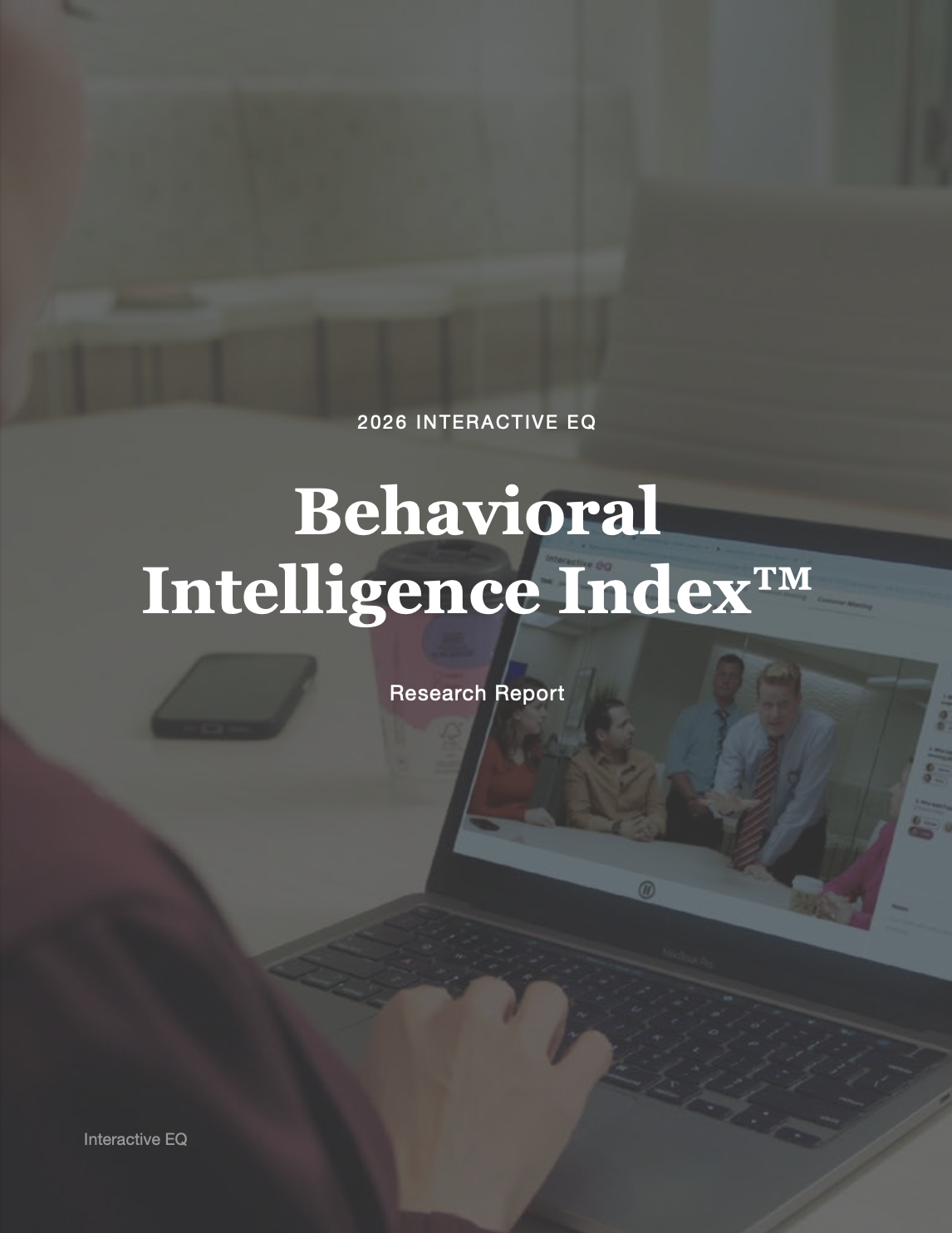
LOS ANGELES, Feb. 18, 2026 (GLOBE NEWSWIRE) -- Interactive EQ today released findings from its 2026 Behavioral Intelligence Index™, a first-of-its-kind simulation-based assessment platform designed to measure how employees think, decide, and act under real workplace pressure. Based on more than 5,000 immersive, role-based workplace scenarios conducted across 1,700+ professionals at 46 organizations, 40% of professionals struggle to demonstrate learning or ownership when asked to reflect on a past failure.
When Accountability Feels Risky, Learning Weakens
As perceived reputational or personal risk increases in the workplace, accountability drops sharply, limiting opportunities for reflection and learning. Rather than demonstrating ownership, participants were more likely to reframe events, externalize blame, or avoid ownership when feedback felt personally threatening.
These findings reveal a gap between how organizations measure performance and how people actually behave when authority, visibility, and risk collide, showing that execution breakdowns are driven by context, not capability, experience, or motivation. Within that gap, execution risk is measurable and predictable, yet largely invisible in traditional performance systems.
“Most traditional assessments measure who someone says they are, including personality traits, preferences, or how they believe they would respond to challenging workplace situations,” said Napoleon Rumteen, founder and CEO of Interactive EQ. “Identity, however, is not execution. Interactive EQ is grounded in a different belief: that performance must be measured behaviorally and in context, where decision-making and ownership can be observed, not assumed.”
Middle Management Absorbs Pressure First, and Hardest
The research also shows that middle managers perform well in structured, low-risk scenarios, but when simulations introduced high-pressure scenarios involving peer accountability, upward feedback, reputational exposure, or lateral conflict, performance dropped by as much as 70%. When authority became less clear, action gave way to escalation, eroding decision-making confidence, slowing response time, and weakening the link between strategy and frontline execution.
“Everyone talks about middle management being under pressure,” said Pam Perry, CEO and Founder of HR Equity and Advisor to Interactive EQ. “What’s new here is how sharply performance shifts when visibility and reputational risk increase. In those moments, decision-making narrows and escalation becomes more likely than resolution. That is where strategy begins to fracture.”
A Consistent Execution Pattern Emerges
Across organizations and industries, thousands of role-play scenarios revealed patterns with statistical consistency regardless of tenure, function, or seniority:
- Performance holds when authority is explicit and risk is low
- Performance degrades when authority becomes ambiguous
- Ownership collapses when feedback feels personally threatening
- Escalation replaces action when permission is unclear
Additional Key Findings from the IEQ Behavioral Intelligence Index™ Report
- Authority dependence is a measurable execution vulnerability: Roughly 1 in 4 professionals stall when authority disappears mid-stream, even when they know the correct course of action. The breakdown is not capability, but behavioral permission — a learned response reinforced in environments where unauthorized action carries more risk than delay.
- Accountability is contextual, not a trait: While accountability increases with seniority, even experienced leaders show measurable declines when perceived personal or reputational exposure rises.
- Frontline roles carry the greatest exposure: Executives act decisively more than 90% of the time, compared to 58-62% among those in frontline and customer-facing roles, even when delays worsened customer outcomes.
- Feedback sensitivity is widespread: In one simulation, a colleague’s question about a compromised process was perceived as a personal attack, leading to defensiveness and eroding trust among colleagues rather than encouraging understanding. In such high-stakes feedback scenarios, just 3-4% of participants were able to clearly separate critique of a decision from critique of a person.
According to Interactive EQ, these patterns rarely show up as overt failures. They surface as hesitation, unnecessary escalation, delayed action, and compounding execution gaps. Organizations that rely solely on traditional evaluation tools risk widening those gaps, increasing escalation load, slowing customer recovery, and accelerating middle-management fatigue.
Research Overview
Interactive EQ conducted more than 5,000 immersive simulations between April and December 2025. The research included more than 1,700 professionals across 46 organizations spanning automotive, SaaS, healthcare, hospitality, law, and manufacturing. Participants ranged from C-suite executives and senior leaders to middle management and frontline commercial, product, and engineering roles. Responses were evaluated using a human-authored scoring rubric, with AI-assisted analysis applied to open-ended, real-time responses under simulated pressure conditions.
To access the full 2026 Behavioral Intelligence Index report, visit here.
About Interactive EQ
Interactive EQ is the behavioral intelligence infrastructure layer for modern organizations. Positioned beneath traditional HR technology systems, the platform measures how professionals think, decide, and act under pressure, generating structured behavioral data that existing tools cannot capture. Through immersive, role-based simulations and AI-assisted analysis, Interactive EQ creates a persistent behavioral dataset that informs hiring, promotion, performance, and leadership decisions across the employee lifecycle. The Behavioral Intelligence Index™ aggregates findings across industries to identify structural execution patterns and performance risk signals that remain invisible in résumé-based or survey-based systems. Learn more at interactiveeq.com.
Contact:
Andrea Oliveira
Email: andrea@oliveirahousepr.com
A photo accompanying this announcement is available at https://www.globenewswire.com/NewsRoom/AttachmentNg/6a4b1ce8-5bb6-4e71-9306-0a0123f35180