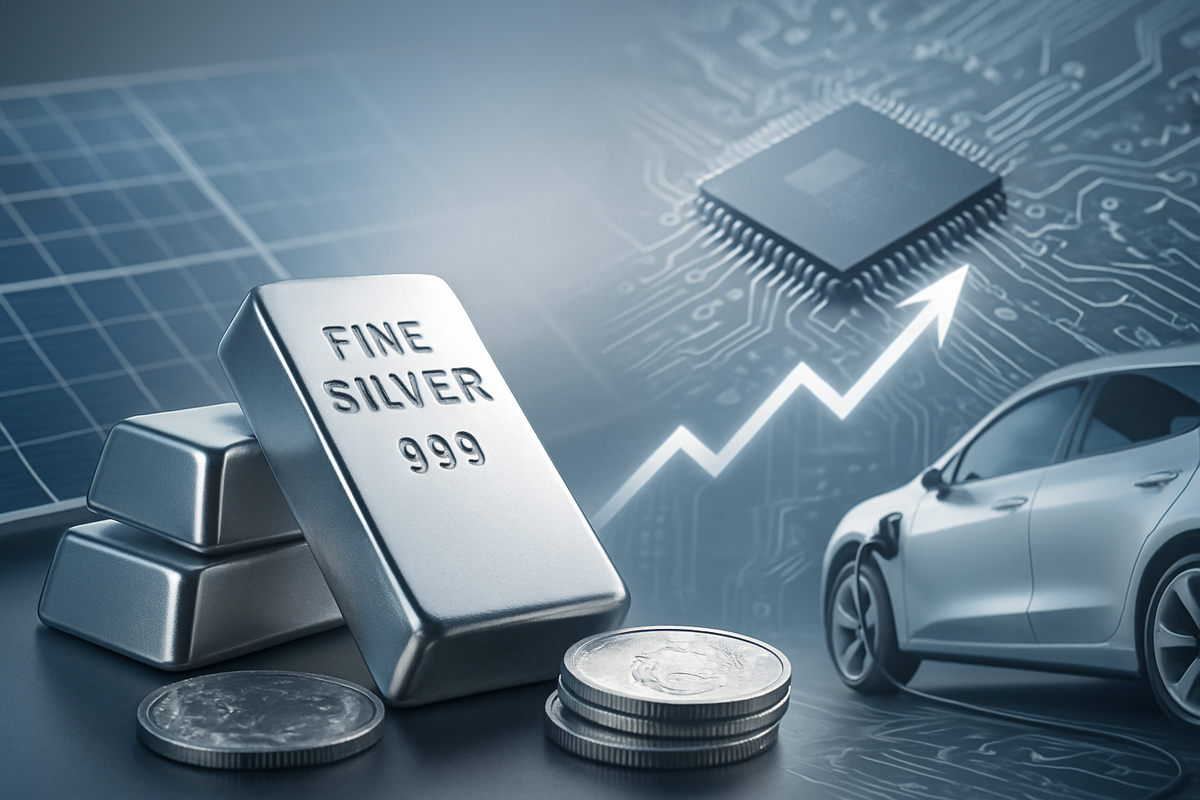
As of December 12, 2025, the silver market is ablaze with optimism, as leading financial analysts increasingly point to a significant bullish trend, with a particular focus on buying opportunities during price dips towards the $65 per troy ounce mark. This robust outlook is not merely speculative but is anchored in a powerful combination of dovish monetary policies, an insatiable industrial demand, and persistent supply deficits that are reshaping the precious metal's trajectory.
The white metal is currently trading near all-time highs, fluctuating around $64 to $65 per ounce, reflecting an impressive surge of approximately 23.34% over the last month and a staggering 111.75% year-over-year. This rally has ignited considerable interest among investors and market watchers, who are now closely monitoring every price movement. The consensus among experts is that any short-term pullbacks are likely to be fleeting, presenting strategic entry points for those looking to capitalize on what many believe is a multi-year bull market for silver.
Silver's Historic Ascent: Driving Forces and Market Milestones
The current "explosive" rally in silver prices, pushing towards and even beyond the $65 target, is a story of converging market forces. At its core lies a persistent structural supply deficit, with 2025 marking the fifth consecutive year of shortfalls, estimated at around 117 million ounces. This deficit is compounded by stagnant mine production, largely due to silver being a byproduct of other metal mining, making it difficult to ramp up supply quickly in response to surging demand.
Adding fuel to this fire is record industrial demand, particularly from the burgeoning green technology sector. Solar panel manufacturing, electric vehicles (EVs), 5G infrastructure, semiconductors, and AI data centers are all voracious consumers of silver. The solar sector alone is projected to exceed 230 million ounces of silver consumption by 2026, and attempts to substitute silver in these critical applications have largely proven inferior. This robust industrial appetite, coupled with dwindling physical inventories on exchanges like COMEX and in Chinese strategic reserves, has created a genuine physical market squeeze, with borrowing rates for physical silver surging above 100%.
The timeline of silver's recent performance underscores this bullish momentum. From lows of approximately $28 per ounce in early 2025, silver has more than doubled in value, significantly outperforming gold. A pivotal moment occurred on December 9, 2025, when spot silver broke above the $60 per troy ounce level, reaching a historic high. This was followed by an extension of gains, touching an intraday high of $64.2062 on December 11, 2025, and settling around $64.51 on December 12, 2025, firmly establishing new all-time highs. This rapid ascent has been accompanied by strong inflows into silver-backed Exchange Traded Funds (ETFs), signaling renewed institutional and retail investor confidence in silver as both a tangible asset and a hedge against economic uncertainties.
Key financial institutions and analysts are largely in agreement on silver's positive trajectory. Bank of America (BofA) notably raised its 12-month silver target to $65 per ounce for 2026, citing narrowing real yields and strengthening ETF inflows. Even more bullish, BNP Paribas suggests silver could soar to $100 per ounce by the end of 2026. The Silver Institute forecasts ongoing deficits through 2026, further supporting these optimistic price outlooks. While some, like HSBC, maintain more conservative forecasts, the overwhelming market sentiment, reflected in CME Silver Futures positioning and the analysis of experts like Skerdian Meta, points to continued appreciation driven by tightening supply and anticipated Federal Reserve interest rate cuts. The market is pricing in an 85% chance of a 25-basis-point Fed rate cut in December 2025, which would further reduce the opportunity cost of holding non-yielding assets like silver.
The initial market reaction has been one of intense enthusiasm, marked by significant momentum buying and record ETF inflows. Silver's latest daily move on December 12, 2025, saw its market capitalization surge to $3.631 trillion, briefly surpassing Microsoft (NASDAQ: MSFT) to become the world's fifth-largest asset. This aggressive buying has also led to a "state of seizure" in the London bullion market due to physical shortages and has even prompted the U.S. Mint to suspend American silver eagle production due to blank shortages. While some analysts, like Guy Wolf of Marex Group, caution that silver might be "overexcited" and potentially 15% above fair value, the strong private-wealth interest and the fundamental drivers of green energy demand suggest that any near-term correction would likely be seen as a buying opportunity rather than a sign of a reversal.
Corporate Fortunes: Winners and Losers in a High-Priced Silver Market
A sustained silver price above $60-$65 per ounce would dramatically reshape the financial landscape for a diverse array of public companies, creating a clear division between significant beneficiaries and those facing considerable headwinds. The direct impact would be most acutely felt by silver mining companies, which stand to gain substantially, while industries heavily reliant on silver as a raw material would contend with escalating input costs.
For silver mining companies, a sustained price in this range would be a transformative boon. Their revenues would see a direct and substantial increase, assuming stable production volumes. More importantly, profit margins would expand dramatically, as their All-In Sustaining Costs (AISC) would remain relatively stable while the selling price of their product soars. This leveraged effect means that a $5 increase in silver price above their cost base could lead to a far greater percentage increase in their profits. Stronger cash flows would enable these companies to invest in growth projects, reduce debt, and potentially offer enhanced shareholder returns through dividends or share buybacks. Furthermore, previously uneconomical lower-grade ore bodies would become viable, extending mine lifespans and incentivizing new exploration.
Several key players in the silver mining sector are poised to benefit significantly. Hecla Mining Co. (NYSE: HL), as the largest primary silver producer in the United States and Canada, would see a substantial boost to its profitability. Similarly, Pan American Silver Corp. (NASDAQ: PAAS), one of the world's largest primary silver producers with extensive assets across the Americas, would experience a direct uplift in its revenue and profit margins. First Majestic Silver Corp. (NYSE: AG), which derives the majority of its revenue from silver, would likely report record revenues and robust earnings growth. Precious metals streaming companies, such as Wheaton Precious Metals Corp. (NYSE: WPM), are also in an advantageous position. Wheaton provides upfront financing to miners in exchange for future silver production at fixed, low prices. A soaring spot price would dramatically widen their profit margins, offering leveraged exposure to silver's appreciation without the direct operational risks of mining. Mexican miner Fresnillo Plc (LSE: FRES), with an AISC around $17 an ounce, would see nearly every dollar of silver price increase above this cost drop straight into profit. Mid-tier producer Endeavour Silver Corporation (NYSE: EXK) would also benefit immensely, especially as its projects near commercial production.
Conversely, companies that extensively use silver in their products face significant challenges. Silver is an indispensable component in high-growth sectors such as solar panels, electric vehicles (EVs), and advanced electronics, including smartphones, 5G infrastructure, and AI data centers. A sustained price above $60-$65 per ounce would lead to substantially higher raw material costs for these manufacturers, inevitably compressing their profit margins unless these costs can be fully passed on to consumers or offset through efficiency gains. This is particularly difficult in highly competitive markets, where pricing pressures are already intense. While manufacturers are actively exploring ways to "thrift" (reduce silver content) or find alternative materials, silver's unparalleled electrical and thermal conductivity makes direct, performance-equivalent substitution extremely challenging.
Specific examples of companies facing these headwinds include solar panel manufacturers like First Solar, Inc. (NASDAQ: FSLR), JinkoSolar Holding Co., Ltd. (NYSE: JKS), and Canadian Solar Inc. (NASDAQ: CSIQ). Silver already accounts for a significant portion of solar module production costs (e.g., 14% in 2025, up from 5% in 2023), and a sustained high price would exacerbate these pressures, despite ongoing efforts to reduce silver content. Electric Vehicle (EV) manufacturers, such as Tesla, Inc. (NASDAQ: TSLA), also rely on substantially more silver than traditional vehicles for their complex electrical systems. Higher silver prices would increase manufacturing costs, potentially impacting vehicle pricing and profit margins. Similarly, electronics giants like Apple Inc. (NASDAQ: AAPL), whose products are built on high-performance components requiring silver, would face increased material costs, though their strong brand power might offer some flexibility in absorbing or passing on these expenses. The inelasticity of silver supply and its critical role in these burgeoning technologies suggest that industrial demand will remain robust, ensuring that these cost pressures will persist.
Wider Implications: Silver's Resurgent Role in a Shifting Global Economy
The current surge in silver prices carries profound wider implications, signaling a fundamental recalibration of the metal's role in the global economy. No longer solely viewed as a monetary metal or a safe-haven asset, silver is increasingly asserting itself as a critical industrial commodity, indispensable to the defining technological and environmental shifts of our era.
This transformation is primarily driven by powerful industry trends. The green energy transition stands out as a colossal engine for silver demand. Silver is an irreplaceable component in solar photovoltaic (PV) cells, with the solar industry's consumption projected to reach 250 million ounces annually by 2030. Despite ongoing "thrifting" efforts to reduce silver content per panel, the sheer scale of global solar installations continues to escalate demand. Similarly, Electric Vehicles (EVs) are another burgeoning source, with an average EV utilizing roughly double the silver of a traditional internal combustion engine vehicle. The rapid expansion of EV production is expected to triple automotive silver demand by 2030, underscoring silver's critical role in the future of transportation. Beyond green energy, electronics growth remains a steadfast driver. Silver's unparalleled electrical and thermal conductivity makes it essential for printed circuit boards (PCBs), electrical contacts, switches, and conductive adhesives across a spectrum of devices. The relentless expansion of 5G networks, data centers, and artificial intelligence (AI) infrastructure further solidifies silver's position as a vital material for high-performance electronics. These industrial applications now account for a significant majority (50% to 65%) of total global silver consumption, a stark departure from historical patterns.
The ripple effects of a strong silver rally extend across the broader commodities market. In the precious metals complex, silver and gold typically exhibit a strong positive correlation, moving in tandem as safe-haven assets. Silver, often dubbed the "high-beta" version of gold, tends to amplify gold's price swings. Thus, a robust silver rally often signals broader investor interest in precious metals, driven by macroeconomic uncertainty, inflation concerns, and currency volatility. This dynamic can also influence the gold-to-silver ratio, which tends to narrow as silver outperforms. Platinum and palladium, while primarily industrial metals used in catalytic converters, can also see upward pressure during periods of increased safe-haven demand or inflation, drawing investor attention to them as potentially undervalued alternatives. In the industrial commodities sphere, the impact is a double-edged sword: while miners benefit, industries heavily reliant on silver face substantially higher production costs. This intensifies pressure to innovate in material science, though silver's unique properties make direct, performance-equivalent substitutes challenging and often more expensive, potentially impacting the competitiveness of "green" technologies.
Regulatory and policy implications are also coming to the forefront. The US Geological Survey's 2025 draft proposal to add silver as a critical mineral is a significant development, acknowledging its essential role in national and economic security. Such a designation could pave the way for policies aimed at securing domestic supply chains through enhanced permitting, subsidies, and strategic stockpiling. Other nations, including the European Union and Japan, are pursuing similar strategies to reduce dependency on potentially unstable suppliers for critical raw materials, which could further tighten global silver markets. Furthermore, mining regulations, tax policies, and labor laws in major silver-producing countries like Mexico and Peru can directly influence profitability and investment decisions, with new environmental obligations or resource nationalism potentially increasing costs and development timelines.
Historically, silver's price has been prone to significant rallies, often driven by a blend of speculative interest, economic uncertainty, and shifts in demand. The infamous Hunt Brothers episode (1979-1980) saw silver surge from $5 to $36 per ounce (equivalent to nearly $140 today), primarily due to an attempt to corner the market, coinciding with a gold rally. Other periods of market crisis and instability, such as the early 1980s and the 2008 financial crisis, also saw investors flock to safe-haven assets, driving silver prices higher. The 2011 peak for both gold and silver further illustrates this pattern. The current rally, however, is unique in its scale and drivers, characterized by a "historic valuation reset" driven by unprecedented industrial demand from green energy and AI technologies, coupled with persistent structural supply deficits and robust investor interest. This suggests a more fundamental and enduring shift in silver's market dynamics compared to past, more speculative surges.
The Road Ahead: Navigating Silver's Bullish Trajectory
Looking forward, the trajectory of silver prices appears overwhelmingly bullish, with analysts projecting continued upward momentum well beyond the current $65 per ounce target. In the short to medium term (2025-2026), while some consolidation or minor pullbacks are possible due to profit-taking, the underlying fundamental drivers are expected to provide strong support. Bank of America maintains a 12-month target of $65, while more aggressive forecasts from BNP Paribas suggest silver could reach $100 per ounce by the end of 2026. Longer-term projections, extending towards 2028 and 2030, paint an even more dramatic picture, with many anticipating silver challenging $100-$120 per ounce, and some bold predictions, like that from Keith Neumeyer of First Majestic Silver, even suggesting $200 to $400 an ounce before the current cycle concludes, citing an impending supply-demand "brick wall."
This sustained upward potential is anchored in the persistent structural supply deficit, which is projected to continue through 2026 and beyond, coupled with relentlessly strong industrial demand from solar, EVs, and AI applications. A weakening US dollar, lower interest rates anticipated from central banks, and ongoing geopolitical uncertainties further bolster silver's appeal as both an industrial necessity and a safe-haven asset.
For investors, strategic adaptations are crucial. Diversification across physical silver, silver-backed ETFs, and carefully selected mining equities (especially those with low All-In Sustaining Costs) is a prudent approach. Given silver's inherent volatility, robust risk management strategies, including position sizing and stop-loss orders, are paramount. Long-term investors may view current dips as compelling entry points, while tactical traders can employ trend-following strategies. For industrial consumers, the imperative is to invest heavily in R&D to reduce silver content ("thrifting") or explore viable, cost-effective alternative materials, potentially spurring new technological breakthroughs. Mining companies, on the other hand, will find higher prices making lower-grade ore bodies economical, extending mine life, and incentivizing increased exploration, though bringing new production online remains a time-consuming process. Governments and corporations are also likely to prioritize strategic stockpiling to enhance supply chain resilience for this critical mineral.
Emerging market opportunities and challenges will also unfold. High prices can stimulate mining industries in silver-producing emerging economies, fostering economic growth. Opportunities will also arise for companies that develop innovative silver-saving technologies. However, manufacturing sectors in emerging economies that rely on silver will face increased input costs, potentially impacting their competitiveness. The inelasticity of silver supply, being largely a byproduct of other metal mining, means that even with strong price incentives, rapid increases in supply are difficult, maintaining upward pressure on the market.
Various scenarios for the silver market are plausible. The most likely is a continued bull market, driven by the relentless industrial demand and supply deficits, potentially seeing silver increasingly decouple from gold due to its industrial necessity. A short-term correction with long-term resilience is also a moderate probability, where profit-taking leads to a brief pullback, but strong fundamentals limit the downside and quickly resume the upward trend. A base case scenario might see moderate, volatile growth, with consolidation before steady appreciation. A bear case scenario, while less probable, could emerge from a severe economic recession or aggressive monetary tightening, pushing prices lower, though the fundamental demand drivers make a sustained downturn less likely. The overarching theme is one of a dynamic market where silver's dual role as a monetary and industrial metal will continue to drive its value.
Comprehensive Wrap-up: Silver's Enduring Significance
The current silver price outlook is unequivocally bullish, marking a significant re-evaluation of the metal's role in the global economy. Silver has transcended its traditional identity as merely a precious metal and safe-haven asset, solidifying its position as a strategic industrial commodity indispensable to the green energy transition and the digital revolution. This profound shift is underscored by a confluence of factors: persistent structural supply deficits, accelerating industrial demand from sectors like solar, EVs, 5G, and AI, and a supportive macroeconomic environment characterized by dovish monetary policies and a weaker US dollar. Silver's dramatic outperformance against gold in 2025 further highlights this pivotal moment, signaling a potential rebalancing of investment portfolios.
Moving forward, the silver market is poised for continued appreciation. While short-term volatility and periods of consolidation are natural after such rapid gains, these are widely viewed as temporary resets within a broader, multi-year uptrend. Forecasts from major institutions and technical models project silver comfortably above $65, with some stretching towards $100-$120 and even higher in the long term. This bullish consensus is rooted in the inelasticity of silver supply, its critical industrial applications with limited substitutes, and sustained investor interest. The lasting impact of this trend is a fundamental re-narrative for silver, cementing its status as a strategic material and a vital component for global technological and environmental advancements.
For investors, vigilance and strategic agility will be key in the coming months. Several critical indicators and events warrant close monitoring. Monetary policy decisions from the Federal Reserve, particularly regarding interest rate cuts and their impact on real yields and the US dollar (DXY), will continue to exert significant influence. Investors should closely track industrial demand trends, especially growth rates in solar energy installations, EV production, semiconductor manufacturing, and AI infrastructure, as these sectors are the primary drivers of silver consumption. On the supply side, reports on global mine production and recycling rates will be crucial, given the persistent deficits. Investment flows into silver-backed ETFs and changes in retail and institutional demand will provide insights into market sentiment. Finally, technical indicators such as key support and resistance levels (e.g., $60.00 and the $50-$54 base), moving averages, and the gold/silver ratio will offer valuable cues for timing investment decisions. Geopolitical developments and any further regulatory actions, particularly concerning silver's critical mineral status, could also shape market dynamics. In essence, silver is not just a commodity to watch; it's a market undergoing a historic transformation, promising significant opportunities for those who understand its evolving significance.
This content is intended for informational purposes only and is not financial advice