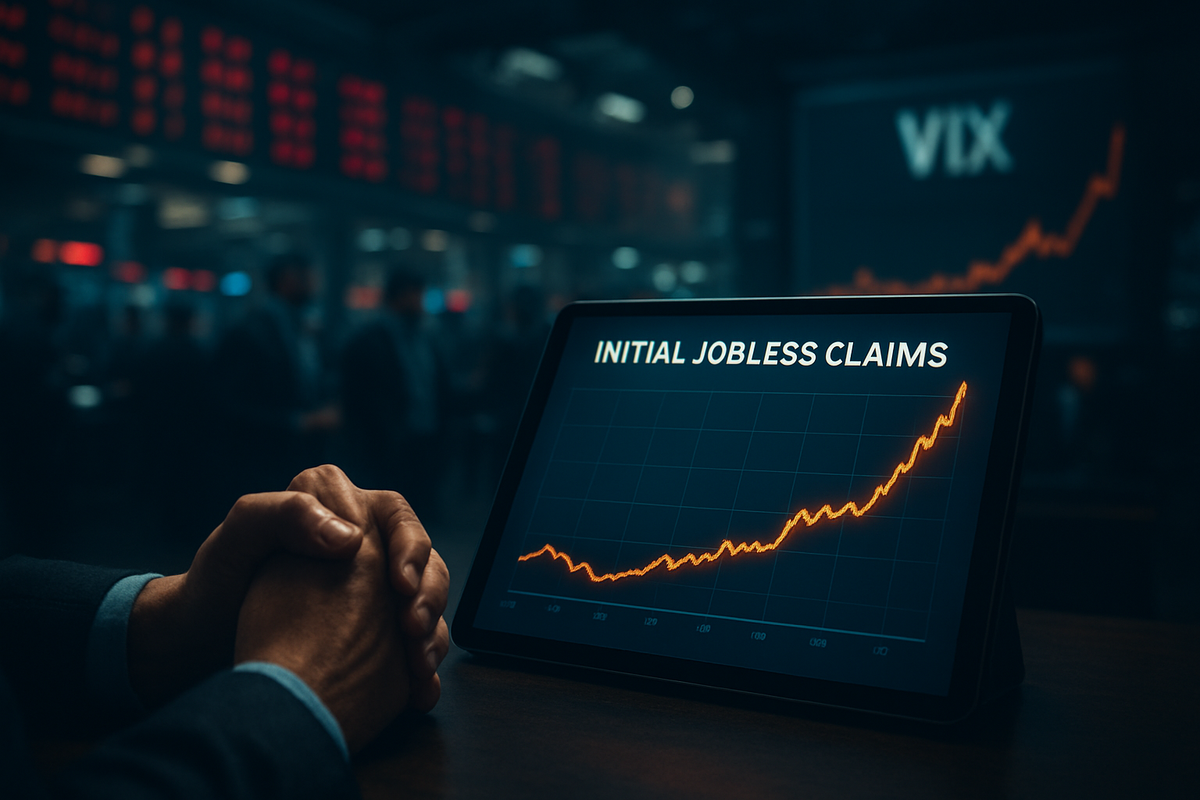
As of December 18, 2025, the U.S. financial markets are navigating a treacherous "two-speed" economy where the resilience of the past year has given way to a palpable sense of fragility. Recent jobless claims data, released this week for the period ending December 13, showed initial filings at 224,000. While this figure remains historically moderate, the trendline is unmistakably upward, with Trading Economics models now projecting claims to surge toward 270,000 by the close of the quarter. This shift has reignited the "Recession Watch" on Wall Street, sending the CBOE Volatility Index (INDEXCBOE:VIX) into the mid-teens as investors grapple with a cooling labor market and the lingering effects of a November government shutdown.
The immediate implication for the market is a fundamental shift in narrative. In late 2024, "good news was bad news," as strong employment data often led to fears of a more hawkish Federal Reserve. Today, however, the script has flipped: "bad news is bad news." With the unemployment rate hitting 4.6% in November—the highest since 2021—investors are no longer worried about inflation as much as they are about a "hard landing." The S&P 500 (NYSEARCA:SPY), which has hovered near the 6,800 mark, has recently seen a series of three-day losing streaks as traders demand more aggressive rate cuts to stave off a full-blown contraction.
A Cooling Trend: The Road to 4.6% Unemployment
The transition from the "Jobs Stunner" era of late 2024 to the current labor malaise has been a steady erosion rather than a sudden collapse. In December 2024, the labor market was so tight that initial jobless claims hit an eight-month low of 211,000, and the unemployment rate sat at a comfortable 4.1%. At that time, the Federal Reserve was cautious about cutting rates too quickly, fearing a resurgence of inflation. Throughout 2025, however, a combination of tariff-driven price increases and a record-breaking federal government shutdown in November began to sap corporate confidence.
By mid-December 2025, the "hiring freeze" has become the dominant corporate strategy. While mass layoffs haven't yet reached the levels seen in previous major recessions, the "quits rate" has plummeted to record lows as workers cling to their current roles. Major stakeholders, including the Federal Reserve and the Congressional Budget Office (CBO), have been forced to revise their outlooks. The most recent November jobs report, which showed a meager addition of only 64,000 non-farm payrolls alongside a significant downward revision to October’s data, served as a "wake-up call" for the markets. Initial reactions saw a flight to safety, with Treasury yields dropping as investors bet on a more dovish Fed pivot in the coming weeks.
The Bifurcated Market: Winners and Losers of the Labor Shift
The current labor market cooling has created a sharp divide among public companies, particularly in the retail and consumer discretionary sectors. Walmart Inc. (NYSE: WMT) has emerged as a relative winner, recently raising its outlook as it gains market share from value-conscious shoppers. However, even the retail giant warned of "mounting financial stress" for low-income earners as the job market slows. In contrast, Target Corporation (NYSE: TGT) and Macy's Inc. (NYSE: M) have struggled, with both companies trimming guidance and citing "selective" consumer behavior. Macy's CEO Tony Spring noted that even affluent customers are becoming "uncertain and confused" by the current economic trajectory.
In the tech and industrial sectors, the impact is equally varied. Apple Inc. (NASDAQ: AAPL) has warned that new tariffs, combined with a cooling consumer base, could add nearly $900 million in costs this quarter, potentially squeezing margins. Meanwhile, Starbucks Corporation (NASDAQ: SBUX) reported a 2% decline in global comparable sales, citing a "margin squeeze" from higher labor costs and investments in worker hours meant to counter ongoing labor unrest. On the other hand, defensive stocks in healthcare and utilities, such as UnitedHealth Group (NYSE: UNH), have seen renewed interest as investors seek shelter from the volatility surrounding discretionary spending and labor-sensitive industries like Home Depot (NYSE: HD), which recently adjusted its sales expectations downward due to "project deferral."
The Wider Significance: Tariffs, Shutdowns, and the 3Ds
The current volatility is not occurring in a vacuum; it is the result of what JP Morgan (NYSE: JPM) analysts call the "3Ds framework"—Duration, Diffusion, and Depth of economic weakness. This event fits into a broader trend of "mid-cycle slowing" that has been exacerbated by external shocks. The November 2024 government shutdown created a "data fog" that delayed critical employment reports, making it difficult for the Fed to calibrate its response. Furthermore, the "tariff pass-through" effect has finally reached a breaking point, where companies like O'Reilly Automotive (NASDAQ: ORLY) are seeing a pullback in DIY maintenance as consumers prioritize essentials over discretionary upkeep.
Historically, this period draws comparisons to the mid-cycle slowdowns of the mid-1990s, where the Fed successfully navigated a "soft landing." However, the current geopolitical climate and the aggressive use of tariffs add a layer of complexity not seen in previous decades. The ripple effects are being felt by partners and competitors alike; as hiring rates plummet to levels not seen since the 2008 financial crisis, the entire ecosystem of recruitment, corporate expansion, and capital expenditure is being recalibrated.
Looking Ahead: The December Pivot and Beyond
The short-term outlook hinges entirely on the Federal Reserve’s final meeting of 2025. Markets are currently "pricing in" a normalization cut of 25 to 50 basis points, but many on Wall Street, including economists at Goldman Sachs (NYSE: GS), argue that more aggressive action may be required to prevent the "Recession Watch" from becoming a "Recession Reality." Strategic pivots are already underway; many companies are shifting their focus toward automation and cost-cutting to preserve margins as labor becomes both a source of cost pressure and a sign of economic weakness.
In the long term, the market may see a "normalization" of the labor market where the extreme tightness of the post-pandemic era is replaced by a more balanced, albeit slower, growth environment. The potential for a "hard landing" remains the primary risk, especially if the 2026 hiring outlook does not improve. Investors should prepare for continued volatility in the VIX and a potential rotation back into high-growth tech if interest rates begin a sustained descent, though this will depend on whether companies like Meta Platforms (NASDAQ: META) can maintain their high capital expenditure in a slower-growth world.
Summary and Investor Outlook
The relationship between jobless claims and market volatility has reached a critical juncture in December 2025. The transition from 2024’s resilience to the current "cracks" in the labor market has shifted investor focus from inflation to growth preservation. Key takeaways include the rising unemployment rate of 4.6%, the upward trend in initial claims, and the bifurcated performance of retail giants like Walmart versus Target.
Moving forward, the market will likely remain in a state of heightened sensitivity to any labor data. Investors should watch for the Federal Reserve’s December rate decision and the first few employment reports of 2026 to see if the cooling labor market stabilizes or continues its downward slide. While the "Recession Watch" is in full effect, the potential for a soft landing still exists, provided the Fed can "walk the line" between controlling inflation and supporting a flagging job market. For now, caution and a focus on defensive, high-quality balance sheets remain the order of the day.
This content is intended for informational purposes only and is not financial advice.