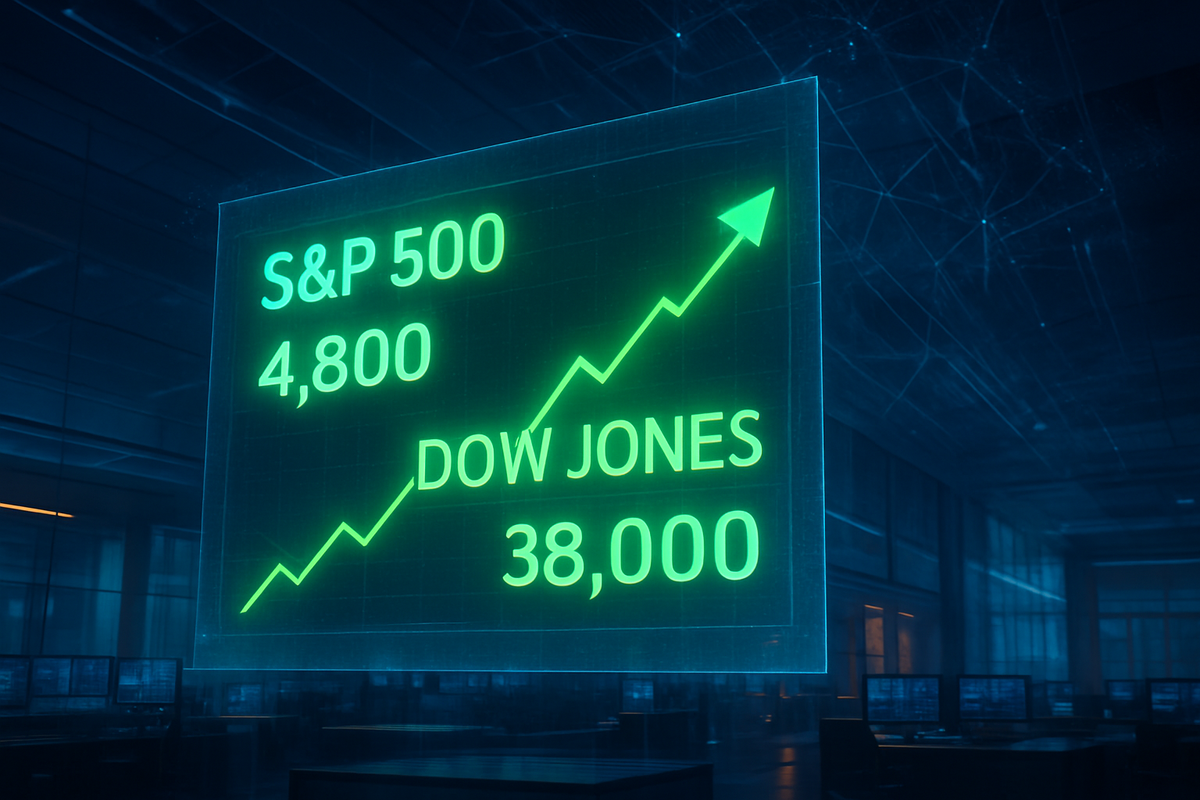
As 2025 draws to a close, the American economy has defied the skeptics once again. Following the release of robust third-quarter Gross Domestic Product (GDP) data, the U.S. stock market has catapulted to unprecedented heights, with the S&P 500 (INDEXSP:.INX) and the Dow Jones Industrial Average (INDEXDJX:.DJI) shattering previous records in a historic "Santa Claus rally." This surge, underpinned by a resilient consumer base and a revitalized manufacturing sector, has transformed early-year recessionary fears into a full-blown celebration of economic endurance.
The immediate implications are profound for both institutional investors and the general public. With the S&P 500 hovering near the 7,000 milestone and the Dow Jones Industrial Average closing at a record 48,731.16 on Christmas Eve, investor sentiment has shifted from cautious optimism to aggressive accumulation. This momentum is not merely a seasonal fluke; it is the market's delayed reaction to a fundamental strengthening of the U.S. economic engine, which has managed to navigate high interest rates and geopolitical volatility to deliver growth that has outpaced nearly all other G7 nations.
The catalyst for this late-year euphoria was the "Final" estimate for Q3 2025 GDP, which showed the U.S. economy expanding at a blistering annualized rate of 4.3%. This figure significantly outperformed the consensus estimate of 3.2% and marked the fastest pace of growth in two years. The release of this data was particularly impactful because it had been delayed by nearly two months due to a contentious 43-day federal government shutdown that paralyzed Washington throughout October and November. When the Bureau of Economic Analysis finally released the figures in December, the pent-up demand for clarity sparked a massive wave of buying.
The timeline leading to this moment was a rollercoaster for stakeholders. The year began with a contraction in Q1 2025, as GDP dipped -0.5% amid an import surge triggered by businesses front-loading inventory ahead of threatened trade tariffs. However, a rebound to 3.8% in Q2 set the stage for the Q3 breakout. Key players in this recovery included the American consumer, whose spending grew by 3.5% despite persistent inflation, and the Federal Reserve, which managed to implement three interest rate cuts throughout the year, bringing the Fed funds rate down to 3.75% by December.
Initial market reactions were swift. In the final week of December alone, the S&P 500 added over $1.6 trillion in market capitalization. This rally was further bolstered by individual corporate triumphs, such as a late-year $20 billion licensing deal between AI startup Groq and industry leaders, which reassured investors that the artificial intelligence boom still had significant runway. The synergy between strong macroeconomic data and technological innovation has created a "Goldilocks" environment—growth that is strong enough to support corporate earnings but not so hot that it forces the Fed to reverse its easing cycle.
The primary victors of this GDP-fueled rally have been concentrated in the technology and industrial sectors. Nvidia (NASDAQ: NVDA) continues to be the standard-bearer for the market, with its stock rising roughly 40% in 2025 as it remains the indispensable provider of AI infrastructure. Similarly, the "Manufacturing Renaissance" has propelled industrials like GE Vernova (NYSE: GEV), which surged nearly 79% this year as it capitalized on the electrification of the national grid. Other notable winners include Palantir Technologies (NYSE: PLTR), which saw its stock jump 121% as enterprise adoption of its AI platforms accelerated, and Micron Technology (NASDAQ: MU), which benefited from a global shortage of memory chips.
However, the rally has not been a "rising tide" for all. The Real Estate sector has been the notable laggard, returning a meager 2.3% year-to-date. Companies in this space, particularly those focused on commercial office space, continue to struggle under the weight of a $1.8 trillion debt maturity wall looming in 2026. While Data Center REITs like Digital Realty (NYSE: DLR) have found success, they have not been enough to offset the broader sector's stagnation. Additionally, the Energy sector has faced headwinds as U.S. oil production hit record highs of 13.84 million barrels per day, creating a global glut that has kept WTI crude prices in the $50 range, weighing on the margins of giants like ExxonMobil (NYSE: XOM).
Consumer-facing stocks have seen a "bifurcation" of results. Nike (NYSE: NKE) experienced a late-December surge of 4.6% following news of high-profile insider buying, signaling confidence in a turnaround. Conversely, retailers focused on lower-income demographics have struggled to maintain margins as the 3.5% growth in consumer spending has been increasingly concentrated in services and high-end electronics rather than basic staples. This disparity highlights a market that is rewarding innovation and "future-proof" business models while punishing those tied to legacy economic structures.
The wider significance of this rally lies in its confirmation of a "soft landing" that many economists thought impossible a year ago. By maintaining 4.3% growth while inflation cooled to the 2.7% range, the U.S. has effectively decoupled its growth from the traditional "Phillips Curve" trade-off. This event fits into a broader industry trend of AI-driven productivity gains, which are beginning to show up in the macro data through improved labor efficiency and corporate profit margins. The market is no longer just betting on the promise of AI; it is reacting to the profits generated by it.
However, a new "ripple effect" emerged in late 2025 that has altered the competitive landscape: the "DeepSeek Effect." News that more efficient AI models could run with significantly less energy triggered a sudden sell-off in power-intensive utility stocks like Constellation Energy (NASDAQ: CEG). This shift suggests that the "insatiable power demand" narrative may be maturing, forcing investors to become more discerning about which infrastructure plays are truly sustainable. This trend mirrors historical precedents like the mid-1990s internet boom, where initial broad-based excitement eventually gave way to a focus on efficiency and actual utility.
From a policy perspective, the 2025 rally has validated the Federal Reserve's cautious pivot. The decision to cut rates despite inflation remaining slightly above the 2% target has provided the liquidity necessary for the market to reach these record highs. However, the 43-day government shutdown serves as a stark reminder of the fiscal volatility that remains a constant threat. The market’s ability to look past this political dysfunction and focus on the underlying GDP strength suggests a growing resilience among investors toward Washington’s "brinkmanship" style of governance.
Looking ahead to 2026, the market faces a transition from "recovery mode" to "sustained expansion." In the short term, the momentum of the Santa Claus rally is expected to carry into the first quarter, but analysts warn of potential volatility as the "debt wall" for real estate and small-cap companies approaches. Strategic pivots will be required for companies in the energy and utility sectors, as they must adapt to a world where energy efficiency in AI might outpace energy demand.
Market opportunities are likely to emerge in the "secondary" AI wave—companies that use AI to revolutionize traditional sectors like healthcare and logistics, rather than just the hardware providers. A potential challenge remains the global oil glut; if OPEC+ continues to unwind production cuts, energy companies may face a prolonged period of depressed earnings, potentially dragging on the S&P 500's energy component. Conversely, lower energy costs could act as a "hidden tax cut" for consumers, further fueling the spending that drove the 43% GDP growth in Q3.
The defining takeaway of late 2025 is the triumph of macroeconomic fundamentals over geopolitical and political noise. The 4.3% GDP growth rate has provided a solid floor for equity valuations, allowing the S&P 500 to approach the 7,000 mark with a sense of legitimacy rather than speculative fervor. While the tech sector remains the primary engine of growth, the broadening of the rally into industrials and certain consumer segments suggests a healthier, more diversified market than the one seen in 2024.
As we move into the new year, investors should keep a close eye on the Federal Reserve's commentary regarding further rate cuts and the evolving "efficiency" narrative in the tech sector. The 2025 rally has proven that the U.S. economy is more resilient than anticipated, but the "dispersion" between winning and losing sectors remains at historic highs. Success in 2026 will likely depend on identifying those companies that can maintain margin growth in a cooling inflation environment while navigating the structural shifts brought about by the AI revolution.
This content is intended for informational purposes only and is not financial advice.