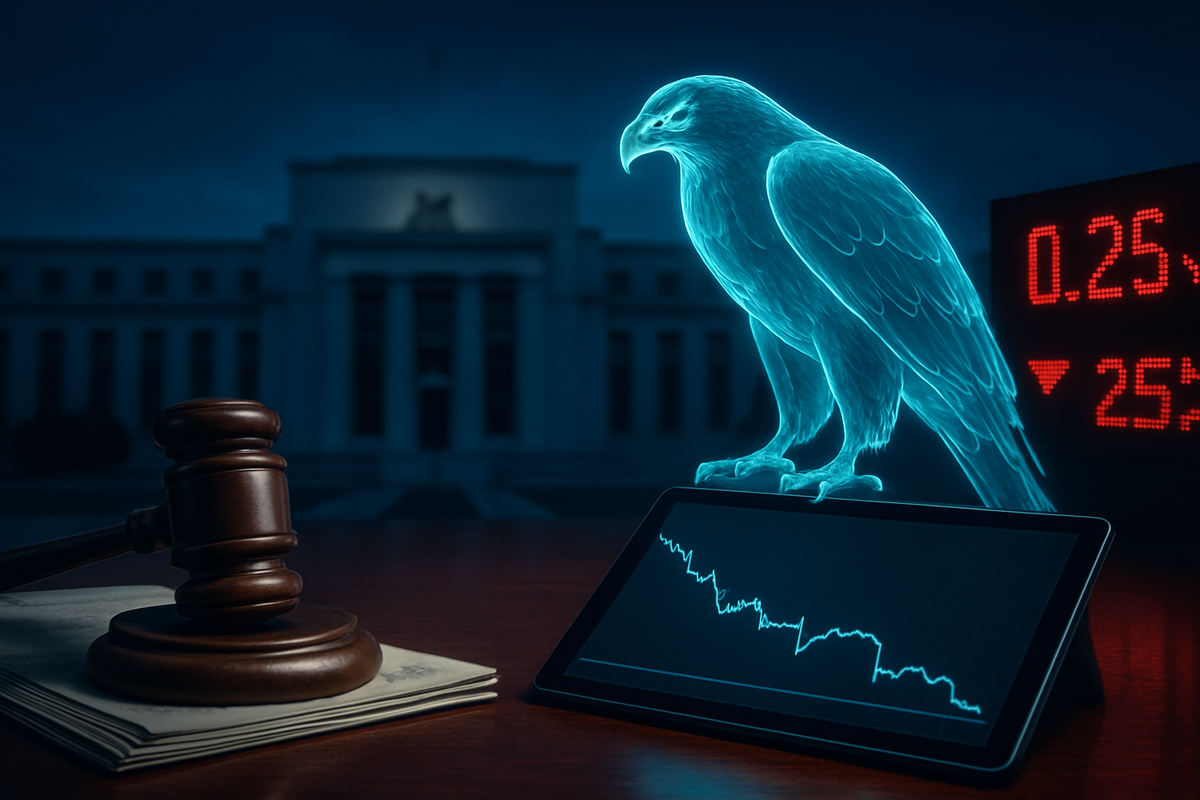
As 2025 draws to a close, the financial world is still reverberating from the Federal Reserve’s final policy meeting of the year. In a move that was both expected and startling, the Federal Open Market Committee (FOMC) delivered a 25-basis-point rate cut on December 10, bringing the federal funds rate to a target range of 3.50% to 3.75%. However, the policy easing was accompanied by a stern, "hawkish" message from Chair Jerome Powell that effectively slammed the door on the aggressive rate-cut cycle many investors had hoped would continue into 2026.
The immediate fallout of this "hawkish cut" has been a dramatic repricing of risk across global markets. While the headline rate reduction offered a brief reprieve, the Fed’s updated "dot plot"—which signaled only one additional cut for the entirety of 2026—rattled futures markets and sent Treasury yields surging. As of today, December 31, 2025, the 10-year Treasury yield sits stubbornly above 4%, a stark reminder that the era of "higher for longer" has not yet been consigned to history.
A Divided Fed and the 'Data Fog' of 2025
The December meeting was one of the most contentious in recent memory, marked by a 9-3 vote that revealed deep fissures within the FOMC. The dissent was split between those who feared the labor market was cooling too quickly and those who remained haunted by "sticky" services inflation. Governor Stephen Miran led the dovish charge, advocating for a more aggressive 50-basis-point cut to shore up an unemployment rate that hit 4.6% in November. Conversely, regional presidents Austan Goolsbee and Jeffrey Schmid voted to hold rates steady, pointing to a Consumer Price Index (CPI) that remains lodged between 2.7% and 2.8%.
This policy friction was exacerbated by a significant "data gap" following a 43-day federal government shutdown earlier in the fourth quarter. The shutdown delayed critical reports, including the October non-farm payrolls, forcing the Fed to navigate through a "data fog" using private-sector metrics and anecdotal evidence. During his press conference, Chair Powell emphasized that with the federal funds rate now nearing "neutral" levels, the Fed no longer feels an urgent need to stimulate the economy, especially as the inflationary effects of the mid-year trade tariffs and the "One Big Beautiful Bill Act" (OBBBA) stimulus begin to manifest.
Market Winners and Losers: The Great Rotation
The Fed's pivot toward a more cautious stance created a stark divergence in equity performance. JPMorgan Chase & Co. (NYSE: JPM) saw its shares slide nearly 5% in the wake of the meeting. While the bank typically benefits from higher rates, a simultaneous warning from CFO Jeremy Barnum regarding skyrocketing 2026 expenses—driven by AI investments and regulatory compliance—spooked investors. Similarly, Nvidia Corp. (NASDAQ: NVDA) experienced a week of volatility as rising yields increased the cost of capital for the tech giants that fuel its revenue. Fears of an "AI capex bubble" were further stoked by Oracle Corp. (NYSE: ORCL), which recently reported surging data center costs.
On the other hand, the Russell 2000 (NYSE Arca:IWM), representing small-cap stocks, initially hit a new all-time high following the rate cut. Investors rotated out of overvalued mega-caps like Apple Inc. (NASDAQ: AAPL)—which has faced "valuation exhaustion" at a 35x forward earnings multiple—and into smaller companies that stand to benefit from any reduction in borrowing costs. However, this rally remains precarious; analysts warn that if the Fed pauses its cutting cycle in early 2026, the floating-rate debt held by many Russell 2000 firms could become a significant headwind.
Broader Significance: AI Growth vs. Fiscal Stimulus
The Fed’s hawkishness is not occurring in a vacuum. It is a direct response to a complex macroeconomic landscape where fiscal policy is working at cross-purposes with monetary tightening. The OBBBA stimulus package passed earlier this year has injected significant liquidity into the economy, keeping GDP growth forecasts for 2026 robust at 2.3%. Much of this growth is being driven by massive enterprise investment in Artificial Intelligence, a trend that the Fed is watching closely as it weighs the potential for AI-driven productivity gains to eventually cool inflation.
Historically, this period mirrors the mid-1990s "soft landing" attempts, where the Fed successfully calibrated rates to prevent overheating without triggering a recession. However, the current geopolitical environment and the persistence of service-sector inflation make the 2025-2026 transition far more volatile. The Fed’s decision to end its quantitative tightening (QT) phase and begin purchasing $40 billion in short-term Treasury bills per month suggests a move toward stabilizing market liquidity, even as they keep the "hammer" of high interest rates ready.
The Road to 2026: What Lies Ahead
Looking toward the first quarter of 2026, the market consensus has shifted dramatically. Futures markets are now pricing in an 84% probability that the Fed will pause at its January meeting. The strategic pivot for investors is moving away from "speculative growth" and toward "quality growth"—companies with high free cash flow and strong balance sheets that can weather a prolonged period of 3.5%+ interest rates. Microsoft Corp. (NASDAQ: MSFT) and other cash-rich tech leaders are expected to remain defensive favorites as the market adjusts to the reality of fewer cuts.
The primary challenge for the coming year will be the Fed’s ability to manage the "last mile" of inflation. If the labor market continues to soften toward a 5% unemployment rate while inflation remains stuck near 3%, the Fed will face an agonizing choice between supporting jobs and maintaining price stability. Investors should brace for a "show me" period in 2026, where corporate earnings must justify high valuations without the crutch of cheap money.
Final Wrap-Up: Navigating the New Neutral
The Federal Reserve’s December 2025 meeting will be remembered as the moment the "pivot party" ended. By delivering a 25-basis-point cut while simultaneously signaling a halt to further easing, the Fed has signaled that it believes the economy is strong enough to stand on its own two feet. The move toward a "neutral" rate of roughly 3.25% to 3.50% suggests that the era of zero-interest-rate policy (ZIRP) is a distant memory, and the market must now learn to operate in a more traditional interest rate environment.
As we enter 2026, the key takeaways for investors are clear: watch the inflation data as it emerges from the "data fog," monitor the health of the labor market, and be wary of valuation-stretched mega-caps. The "hawkish cut" of 2025 has set the stage for a year of disciplined investing, where fundamental strength will matter far more than central bank largesse.
This content is intended for informational purposes only and is not financial advice.