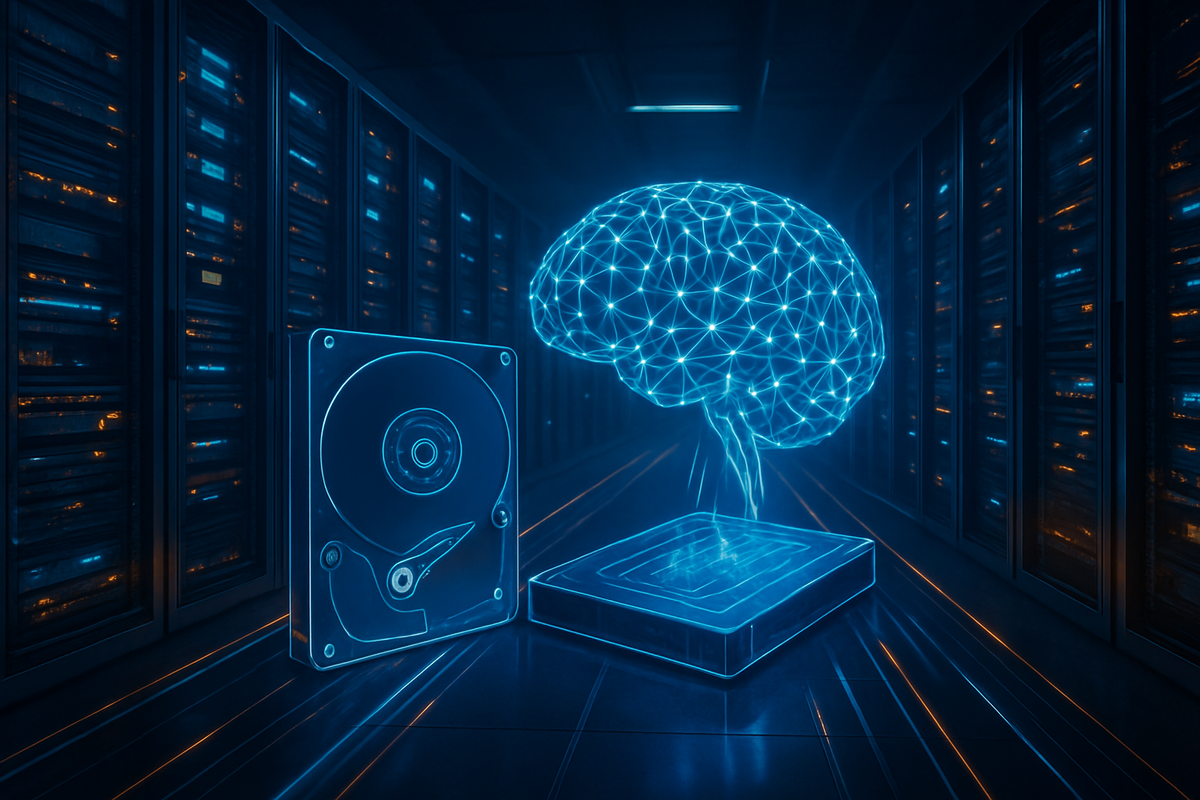
As the calendar turns to the final day of 2025, the financial markets are reflecting on a year defined by the "second wave" of the Artificial Intelligence revolution. While 2023 and 2024 were the years of the processor, 2025 has undeniably belonged to storage. Western Digital (NASDAQ: WDC), once viewed as a legacy hardware manufacturer, has emerged as a cornerstone of the AI era, fueled by a glowing "long" recommendation from Cantor Fitzgerald that has reverberated through the trading floors of Wall Street.
The immediate implications of this shift are profound. Cantor Fitzgerald’s bullish stance, led by senior analyst CJ Muse, posits that the massive datasets required for AI training and the subsequent explosion of AI-generated content have created a "storage supercycle" that is only in its early innings. With Western Digital successfully completing its high-profile corporate split earlier this year, the company has unlocked significant shareholder value, positioning itself as a pure-play leader in the high-capacity hard drive market while its former flash division captures the lightning-fast performance needs of AI inference.
The Great Divide: A Strategic Transformation and the Cantor Call
The journey to Western Digital’s current market dominance reached a fever pitch in early 2025. Following years of pressure from activist investors and a need to clarify its business model, the company officially completed the spin-off of its Flash business on February 24, 2025. This move created two distinct entities: the "new" Western Digital (NASDAQ: WDC), which retained the hard disk drive (HDD) business focused on mass-capacity cloud storage, and SanDisk Corporation (NASDAQ: SNDK), which took over the high-performance Enterprise SSD (eSSD) and consumer flash markets.
Cantor Fitzgerald’s CJ Muse was a primary architect of the market's optimism surrounding this split. Throughout late 2024 and the entirety of 2025, Muse maintained an "Overweight" rating, eventually raising his price target for the post-split WDC to a staggering $250. Muse’s thesis centered on the "AI Data Cycle"—a framework Western Digital introduced to explain how AI models consume and generate data. He argued that the market was fundamentally underestimating the volume of storage required to feed the "compute hunger" of Nvidia (NASDAQ: NVDA) H100 and Blackwell GPUs.
The reaction from the industry was swift. As WDC began reporting record gross margins in its HDD segment—driven by the adoption of 32TB UltraSMR drives—investors who had previously flocked to chipmakers began diversifying into "the digital filing cabinet" of the AI world. By mid-2025, Western Digital’s cloud segment revenue accounted for nearly 90% of its total sales, proving that the demand for "cool" storage (HDDs) was growing just as fast as the demand for "hot" storage (SSDs).
Winners and Losers in the Storage Renaissance
In this new landscape, Western Digital and its chief rival, Seagate Technology (NASDAQ: STX), have emerged as the primary beneficiaries. Seagate has seen a parallel surge in demand for its Mozaic 3+ platform, as hyperscalers like Amazon (NASDAQ: AMZN) and Google (NASDAQ: GOOGL) scramble to expand their data lake capacities. These companies "win" because the economics of AI favor their high-capacity HDDs, which remain six to ten times more cost-effective per terabyte than solid-state alternatives for long-term data retention.
Conversely, the "losers" in this cycle have been the smaller, legacy storage providers who failed to pivot toward the high-capacity nearline market. Furthermore, while the Flash market has been lucrative, companies like Samsung Electronics (KRX: 005930) and SK Hynix (KRX: 000660) have faced intense competition and the inherent cyclicality of the NAND market. While SanDisk (the WDC spin-off) has thrived by focusing on high-margin Enterprise SSDs, the broader memory market has struggled with the massive capital expenditures required to keep pace with the rapid transition to PCIe Gen 5 and Gen 6 technologies.
Micron Technology (NASDAQ: MU) occupies a unique middle ground. While it has benefited immensely from High Bandwidth Memory (HBM) used in AI processors, its traditional storage business has faced stiff headwinds from the specialized, high-capacity dominance of the WDC-Seagate duopoly in the data center. The market has clearly signaled that in 2025, "capacity is king," favoring those who can provide the densest storage solutions at the lowest Total Cost of Ownership (TCO).
The AI Data Cycle: A Structural Shift in Industry Trends
The wider significance of the Cantor Fitzgerald recommendation lies in the recognition that AI is not a fleeting trend but a structural shift in global computing. The "AI Data Cycle" identifies six distinct stages of data movement—from raw data archiving to content generation—each requiring a specific type of storage. This has effectively ended the long-standing debate over whether SSDs would eventually replace HDDs. Instead, the industry has accepted a "coexistence" model where both technologies are essential for different parts of the AI pipeline.
This trend has significant ripple effects on the semiconductor sector at large. As storage becomes a larger portion of the data center bill of materials (BOM), networking giants like Broadcom (NASDAQ: AVGO) and Marvell Technology (NASDAQ: MRVL) are being forced to innovate faster in storage connectivity and controllers. Historically, storage was seen as a commodity; however, the complexity of managing petabyte-scale datasets for AI training has elevated it to a strategic asset, similar to how microprocessors were viewed in the 1990s.
Regulators have also begun to take notice. The concentrated nature of the HDD market—now effectively a duopoly between WDC and Seagate—has raised questions about supply chain resilience. However, given the critical nature of this infrastructure for national AI competitiveness, policy implications in 2025 have focused more on subsidizing domestic production and ensuring "sovereign AI" capabilities, rather than antitrust actions that might stifle the rapid scaling required by the cloud giants.
What Lies Ahead: The Zettabyte Era and Beyond
Looking toward 2026, the short-term outlook for Western Digital remains exceptionally bright, though not without challenges. The primary hurdle will be meeting the insatiable demand. Both WDC and Seagate are operating at near-full capacity, and any disruption in the supply of critical components—such as specialized glass substrates or read-write heads—could create a bottleneck for the entire AI industry. Strategic pivots may be required as hyperscalers begin to experiment with custom silicon for storage management, potentially forcing WDC to integrate more deeply with software-defined storage layers.
In the long term, the emergence of "AI-generated everything" suggests that the world is entering the Zettabyte era. This will require a leap in storage density that goes beyond current SMR (Shingled Magnetic Recording) and HAMR (Heat-Assisted Magnetic Recording) technologies. Investors should watch for potential breakthroughs in DNA storage or multi-dimensional optical storage, though these remain in the R&D phase for now. The market opportunity is vast: as AI models move from text to high-resolution video and 3D simulations, the "storage-to-compute" ratio is expected to shift even further in favor of storage.
A New Chapter for the Market’s "Digital Filing cabinet"
As we conclude 2025, the key takeaway is that the AI trade has matured. The "easy money" made by betting solely on GPU manufacturers has transitioned into a more nuanced play on the entire infrastructure stack. Western Digital’s 195% year-to-date surge is a testament to the market’s realization that intelligence is useless without a place to store it. Cantor Fitzgerald’s early and aggressive "long" call on WDC has been vindicated by a year of record earnings and a successful corporate reorganization that has set the standard for the industry.
Moving forward, the market will be characterized by a "flight to quality" in the storage sector. Investors should keep a close eye on quarterly shipments of high-capacity nearline drives and the adoption rates of PCIe Gen 5 enterprise SSDs. While the cyclical nature of the hardware business will always remain a risk, the structural demand from the AI Data Cycle provides a floor that the industry has never seen before. For Western Digital, the transition from a "boring" hardware maker to an AI infrastructure powerhouse is complete, and the coming months will determine if it can maintain its lead in an increasingly data-dense world.
This content is intended for informational purposes only and is not financial advice.