As the opening bells of 2026 ring across Wall Street, the narrative dominating the financial landscape is no longer just about the potential of Artificial Intelligence, but the staggering physical reality of its build-out. With global hyperscalers projected to pour more than $600 billion into capital expenditures this year, the "Silicon Supercycle" has moved from a speculative trend to the primary engine of the U.S. stock market. This unprecedented wave of spending is reshaping the S&P 500, pushing the index toward ambitious targets of 8,000 and beyond, as investors pivot from valuing "hype" to rewarding the tangible infrastructure that underpins the next industrial revolution.
The immediate implications of this spending surge are visible in the decoupling of tech earnings from the broader economy. While traditional sectors face the headwinds of a maturing cycle, the AI infrastructure complex—comprising chipmakers, data center operators, and specialized power providers—is operating in a state of hyper-growth. This massive deployment of capital is not merely a bet on future software; it is a fundamental re-architecting of the global economy, where compute power is becoming the new gold standard of corporate productivity and national security.
The Dawn of the Rubin Era and the $600 Billion Capex Wall
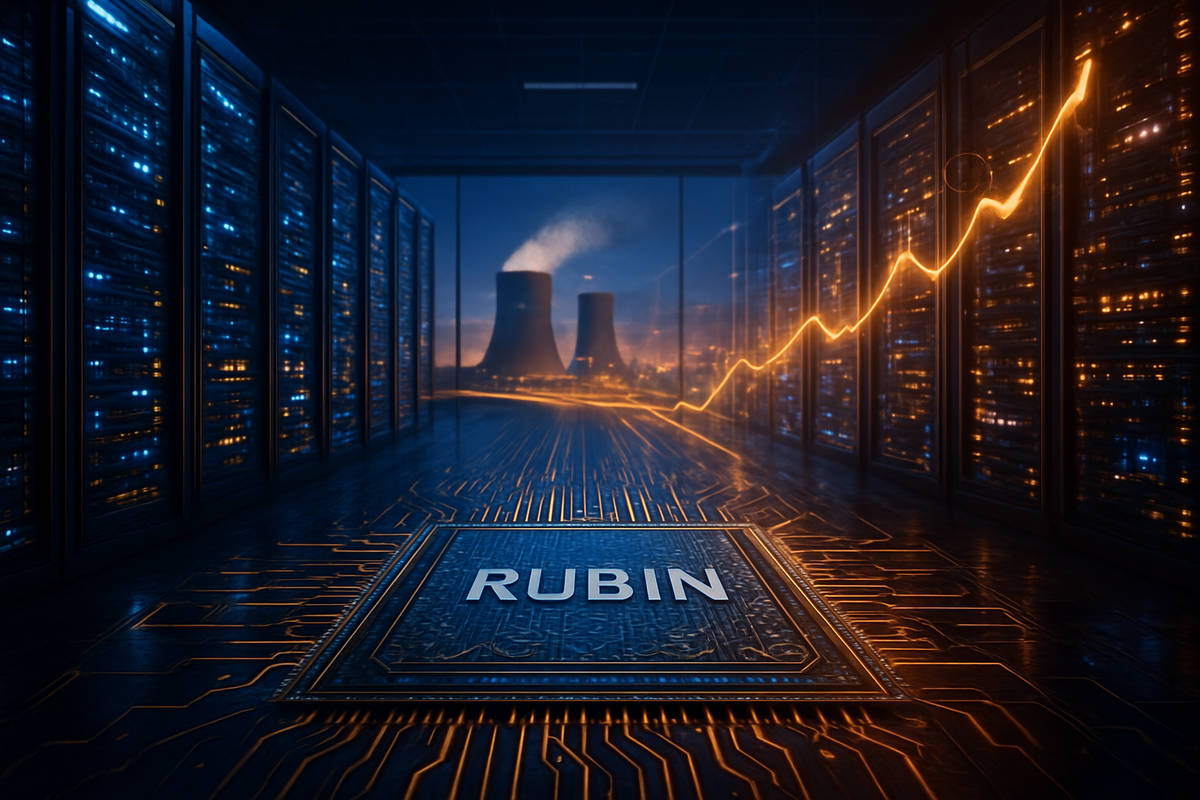
The road to 2026 has been defined by an accelerating "arms race" among the world’s largest technology firms. Following the "Blackwell" era of 2024 and 2025, the market has now entered the "Rubin" era, named after Nvidia’s (NASDAQ: NVDA) latest architecture. Released in the second half of 2025 and seeing full enterprise deployment this month, the Rubin platform represents a quantum leap in efficiency, utilizing TSMC’s 3nm process and the new Vera CPU. This hardware evolution has forced the "Big Four"—Microsoft (NASDAQ: MSFT), Amazon (NASDAQ: AMZN), Alphabet (NASDAQ: GOOGL), and Meta (NASDAQ: META)—to drastically revise their 2026 spending plans upward.
Aggregate capital expenditure for these hyperscalers is expected to hit $602 billion in 2026, a 36% increase from the already record-breaking levels of 2025. This timeline of escalation began in late 2023 when the first generative AI models proved their commercial viability, leading to a scramble for H100 and B200 chips. By early 2026, the focus has shifted from merely acquiring chips to building "sovereign AI clouds" and massive 100,000-GPU clusters. Key players like Amazon have committed over $125 billion to their 2026 budget, specifically targeting the integration of their custom Trainium and Inferentia chips alongside Nvidia’s Rubin systems to lower the long-term cost of inference.
Market reactions to these astronomical figures have been surprisingly bullish, though increasingly selective. Unlike the "spend at any cost" mentality of 2024, the market in 2026 is rewarding companies that can demonstrate a clear "Return on AI Investment" (ROAI). Alphabet and Meta, in particular, have seen their stock prices buoyed by evidence that AI-driven advertising and coding efficiencies are directly contributing to double-digit margin expansions, justifying the tens of billions spent on data centers in the previous 24 months.
The Power Players: Chips, Clouds, and the Nuclear Renaissance
The primary victors of the 2026 infrastructure boom are those who control the "bottlenecks." Nvidia remains the undisputed king of the hardware layer, with its Rubin NVL144 rack configurations delivering 3.6 ExaFLOPS of compute—a performance jump that has kept competitors at bay. However, the "winners" list has expanded to include the energy sector. As data centers now consume an estimated 1,050 TWh of electricity globally, utility companies have become the unlikely darlings of tech investors. Constellation Energy (NASDAQ: CEG) and Talen Energy (NASDAQ: TLN) have seen their valuations soar as they finalize "behind-the-meter" deals to power AI clusters directly from nuclear plants.
Conversely, the "losers" in this environment are traditional enterprise software firms that have failed to integrate generative AI into their core products. These "legacy" tech companies are finding their budgets cannibalized as CIOs divert funds toward AI infrastructure. Furthermore, smaller cloud providers are struggling to keep pace with the massive capex requirements of the Big Four, leading to a further consolidation of market share among the top three cloud platforms (AWS, Azure, and Google Cloud).
The energy sector's transformation is perhaps the most striking development of 2026. Microsoft’s partnership with Constellation Energy to restart the Three Mile Island Unit 1 (now the Crane Clean Energy Center) has reached critical milestones this month, signaling a new era where tech giants act as primary financiers for the nuclear renaissance. This "Bring Your Own Generation" (BYOG) strategy is allowing the hyperscalers to bypass the aging and congested U.S. electrical grid, ensuring their AI clusters remain online even as regional power demands reach record highs.
A Supercycle Without Precedent: Beyond the Dot-com Comparison
The AI infrastructure surge of 2026 is often compared to the Dot-com boom of the late 1990s, but analysts argue the parallels are thinning. Unlike the 1990s, where companies spent on "eyeballs" and unproven business models, the 2026 spending is backed by the strongest balance sheets in corporate history. The Big Four are generating hundreds of billions in free cash flow, allowing them to fund their $600 billion capex wall without the need for the high-interest debt that sank the tech sector in 2000.
This event fits into a broader trend of "computational mercantilism," where AI infrastructure is viewed as a strategic national asset. This has led to significant regulatory shifts, including the "AI Infrastructure Act of 2025," which provided tax credits for domestic data center construction and streamlined the permitting process for small modular reactors (SMRs). The ripple effects are being felt globally, as countries like Saudi Arabia and Japan launch their own multi-billion dollar AI funds to ensure they are not entirely dependent on U.S.-based hyperscalers.
Historically, such massive infrastructure builds—like the railroads in the 1800s or the build-out of the internet in the 90s—eventually lead to a period of overcapacity. However, the "inference boom" of 2026 suggests that the demand for compute is currently elastic. As AI models move from "chatbots" to "autonomous agents" that perform complex tasks across the web, the requirement for real-time processing power is expected to grow exponentially, potentially delaying any "AI winter" for the remainder of the decade.
What Comes Next: Edge AI and the Move Toward 2027
Looking toward the second half of 2026 and into 2027, the market is already anticipating the next strategic pivot: Edge AI. While the current focus is on massive centralized data centers, the next wave of infrastructure spending will likely target "local" compute—integrating AI chips directly into smartphones, automobiles, and industrial robotics. This will require a new generation of low-power semiconductors, providing a potential opening for companies like Apple (NASDAQ: AAPL) and Arm Holdings (NASDAQ: ARM) to capture a larger share of the AI pie.
Nvidia has already teased its 2027 roadmap, featuring the "Feynman" architecture, which promises to integrate quantum-classical hybrid computing. For investors, the challenge will be navigating the "valuation gap" that may emerge if the productivity gains from AI don't materialize as quickly as the infrastructure is built. A short-term risk remains: if a major hyperscaler signals a "pause" in spending, it could trigger a sharp correction in the semiconductor and utility sectors. However, given the current competitive dynamics, such a move is unlikely as no firm wants to be left behind in the race for AGI (Artificial General Intelligence).
Final Assessment: The Foundation of the Next Decade
The $600 billion AI infrastructure spend of 2026 is more than just a line item on a balance sheet; it is the construction of the foundation for the next decade of global economic growth. The S&P 500's performance this year will be inextricably linked to the success of these investments. While the sheer scale of the spending is daunting, the intersection of technological breakthroughs—like Nvidia's Rubin chips—and the nuclear energy pivot has created a robust ecosystem that appears capable of sustaining this momentum.
For investors, the key takeaways are clear: the "AI trade" has evolved. It is no longer enough to own "tech"; one must own the entire value chain, from the silicon in the server to the uranium in the reactor. As we move through 2026, the market will continue to be a "show me" story, where the companies that can best translate their massive capex into tangible earnings growth will lead the next leg of the bull market. Watch for quarterly capex updates and energy interconnection agreements as the primary signals for market direction in the coming months.
This content is intended for informational purposes only and is not financial advice.