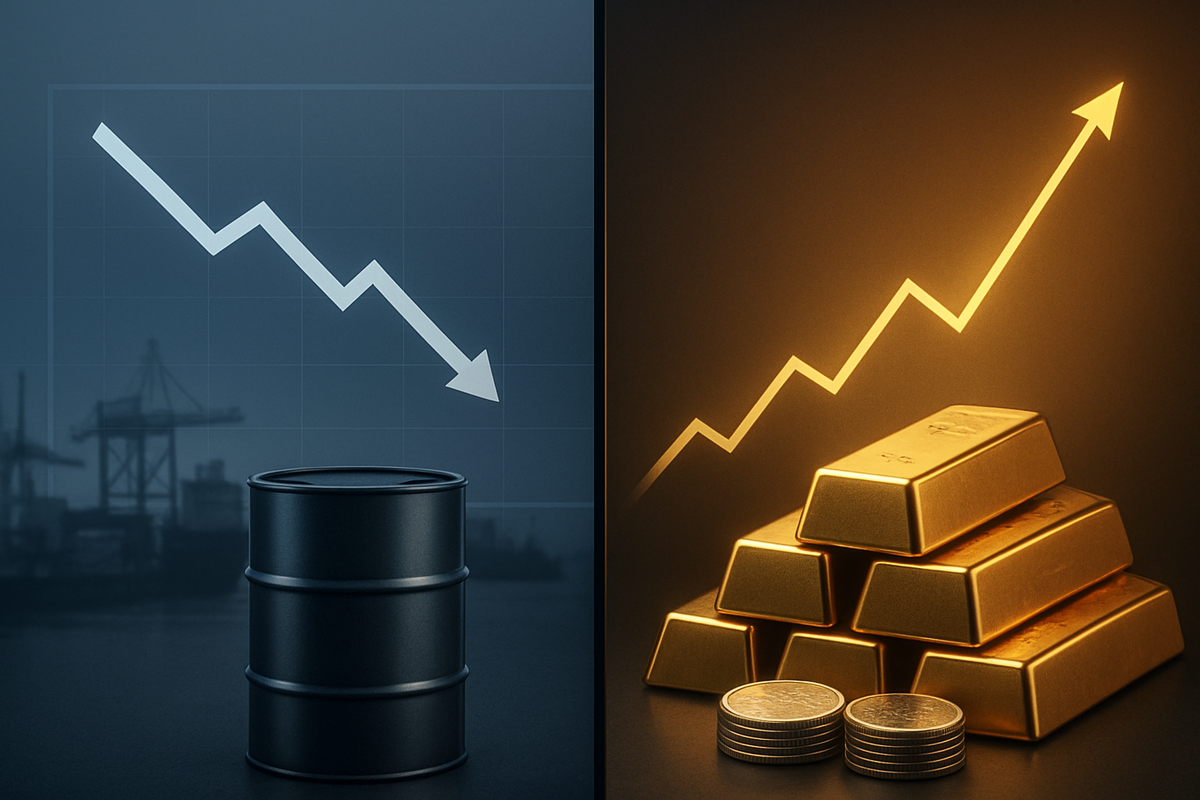
The global economic landscape is entering a period of significant deflationary pressure for raw materials. According to the latest Commodity Markets Outlook from the World Bank, aggregate commodity prices are projected to decline by 7% in 2026. This downward trend, marking the fourth consecutive year of cooling prices, is expected to bring the global commodity index to its lowest point since 2020. The primary drivers behind this "bearish super-cycle" are a staggering global oil surplus, cooling industrial demand from China, and a pervasive atmosphere of policy uncertainty that has tempered global growth expectations.
However, the headline decline masks a growing schism in the markets. While energy and agricultural sectors are bracing for a period of oversupply, precious metals continue to defy the gravity of the broader index. Even as the World Bank forecasts a multi-year low for the overall market, safe-haven demand and central bank diversification have propelled gold and silver toward historic highs. This divergence is creating a complex environment for investors, who must now navigate a market defined by "cheap energy" on one hand and "expensive security" on the other.
The 2026 Outlook: A Respite from Inflation Amidst a Global Glut
The World Bank’s report, finalized in late 2025 and reviewed through the lens of early 2026 market data, paints a picture of a world "awash in oil." The surplus is expected to be nearly 65% larger than the peak seen during the 2020 pandemic lockdowns, potentially reaching an excess of 3 million barrels per day. This imbalance is driven by two main factors: stagnant demand in China—where a rapid transition to electric vehicles (EVs) has permanently altered oil consumption patterns—and a surge in production from non-OPEC+ countries like the United States, Brazil, and Guyana. Consequently, Brent crude is projected to average $60 per barrel in 2026, a significant drop from the highs of the early 2020s.
The timeline of this decline has been gradual but persistent. Since the peak of the post-pandemic supply chain crisis in 2022, commodity prices have been on a steady downward trajectory. The latest 7% projection for 2026 follows a similar 7% decline in 2025. Key stakeholders, including World Bank Chief Economist Indermit Gill, have noted that while this provides a much-needed "respite" for global consumer inflation, it places immense fiscal pressure on commodity-exporting developing nations. Initial market reactions in January 2026 have confirmed these fears, as energy-heavy indices have lagged while consumer-facing sectors have begun to price in lower input costs.
Sector Divergence: Winners in Transit and Losers in the Oil Patch
The shift toward a low-commodity-price environment is already creating clear winners and losers across the public markets. Airlines and logistics companies are emerging as the primary beneficiaries of the falling energy index. United Airlines (NASDAQ: UAL) and Delta Air Lines (NYSE: DAL) have both issued optimistic guidance for the first half of 2026, citing the moderating cost of jet fuel as a major tailwind for profit margins. In recent earnings calls, airline executives highlighted that the World Bank's forecast for lower oil prices acts as a "buffer" against rising labor costs and a cooling global economy.
Conversely, the traditional energy sector faces a more challenging horizon. Majors like ExxonMobil (NYSE: XOM) and Chevron (NYSE: CVX) are navigating a market where price appreciation is capped by the massive global surplus. While these companies remain highly profitable through operational efficiencies and diversified portfolios, their stock performance in early 2026 has been characterized by caution. Interestingly, oil services firms like Halliburton (NYSE: HAL) have shown surprising resilience; by focusing on high-tech drilling efficiency that lowers the "break-even" price for shale producers, they have managed to beat earnings expectations even as the underlying commodity price softens.
In the mining sector, the story is one of total contrast. While industrial metal producers like Rio Tinto (NYSE: RIO) are grappling with the effects of China's property sector slowdown, gold miners are in the midst of a historic rally. Newmont (NYSE: NEM), the world's largest gold miner, has seen significant interest as gold prices remain buoyed by geopolitical risk and central bank buying. The World Bank notes that while energy is falling, precious metals surged 41% in 2025 and are expected to remain at record levels through 2026 as a hedge against global policy uncertainty.
The Geopolitical Ripple: Policy Uncertainty as a Double-Edged Sword
The significance of this commodity decline extends far beyond the ticker tape. Historically, periods of low commodity prices have acted as a stimulant for global growth, but the 2026 scenario is complicated by "policy uncertainty." The World Bank identifies trade tensions and shifting geopolitical alliances as factors that both suppress demand (by discouraging investment) and create volatility. This environment is reminiscent of the mid-2010s, but with the added variable of the "Green Transition." China’s pivot away from traditional internal combustion engines is no longer a future projection—it is a current market reality that is structural, not cyclical.
Furthermore, the "ripple effect" of these price drops is being felt in the halls of government. Developing nations that rely on commodity exports are being urged to accelerate fiscal reforms. For the global economy, the 7% decline in commodity prices is the "last mile" of the inflation fight. If the World Bank’s projections hold, central banks across the G7 may have more room to cut interest rates in 2026, potentially sparking a late-year recovery in global manufacturing. However, this relies on the assumption that regional conflicts—particularly in the Middle East—do not escalate into a broader energy supply shock that could override the current surplus.
Strategic Pivots: Navigating the 2026 Market
Looking ahead, the market is preparing for a "two-speed" economy. In the short term, investors should expect continued volatility in energy prices due to seasonal weather shocks and geopolitical headlines, but the long-term trend remains firmly bearish. For energy companies, the strategic pivot is already underway: moving capital away from high-cost "frontier" exploration and toward maximizing output in existing, low-cost basins like the Permian. This "efficiency first" model will be the only way to sustain dividends if Brent crude settles into the $50-$60 range.
For the broader market, the opportunity lies in sectors with high energy intensity that have not yet fully priced in the 2026 decline. This includes chemicals, plastic manufacturing, and heavy transport. As the 6-year low in commodity prices becomes the new baseline, we may see a resurgence in consumer spending power, particularly in emerging markets where food and fuel represent a larger share of the household budget. The primary challenge will be the potential for "complacency"—if new supply projects are canceled due to low prices today, the seeds for the next commodity spike in 2028 or 2029 may be sown this year.
Summary and Final Thoughts for Investors
The World Bank’s October 2025 and January 2026 updates provide a definitive roadmap for the year ahead: a 7% decline in prices, led by a massive oil glut, bringing the market to its lowest level since 2020. The key takeaways for the market are clear: energy prices are likely capped for the foreseeable future, while gold remains the preferred sanctuary for capital amid global instability. This "bearish respite" offers a unique window for the global economy to stabilize inflation, but it also demands a disciplined approach from investors.
Moving forward, the market will be hyper-focused on three things: the pace of China's industrial recovery, the volume of central bank gold purchases, and the actual implementation of OPEC+ production shifts. While the overall index is falling, the "spikes" in natural gas and precious metals prove that this is not a uniform decline. Investors should watch for the next round of quarterly earnings in April 2026 to see if the projected fuel savings for airlines and logistics firms translate into the expected margin expansions. For now, the "commodity super-cycle" has been replaced by a "surplus cycle," and the market is adjusting accordingly.
This content is intended for informational purposes only and is not financial advice