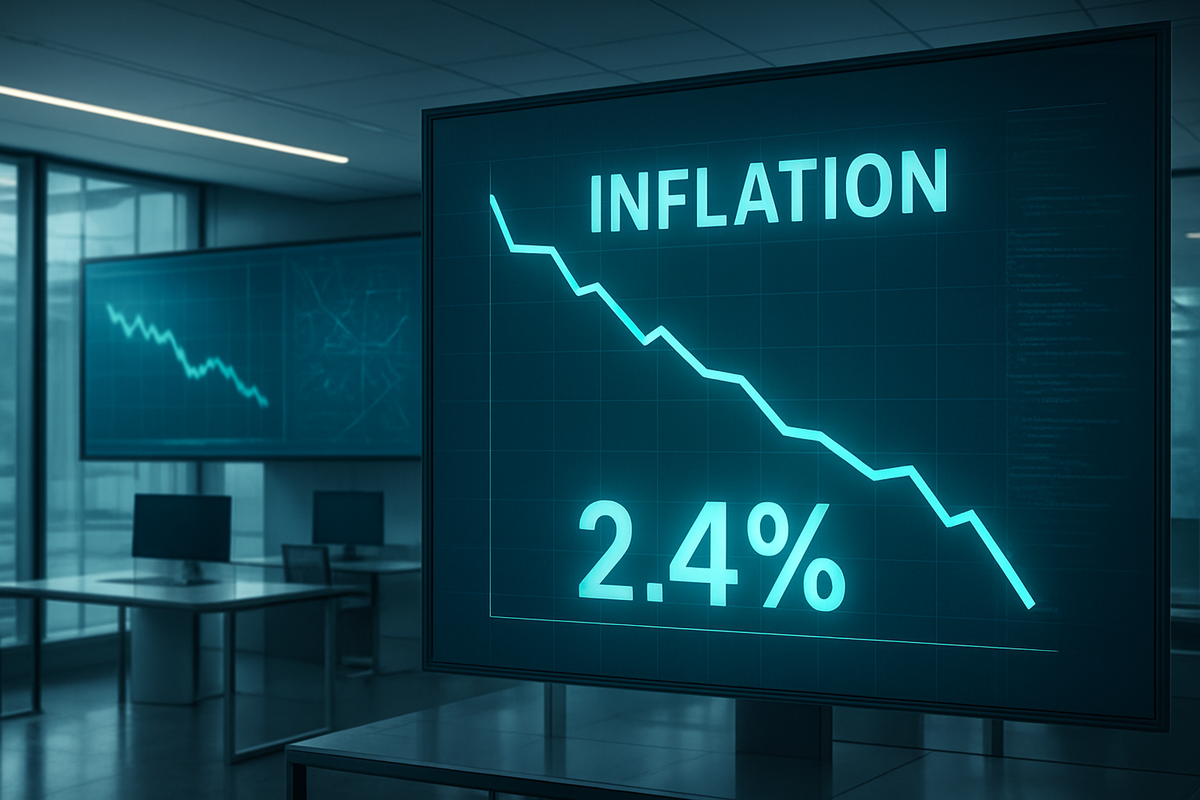
The long-awaited cooling of price pressures has finally arrived, providing a much-needed lifeline to a financial market battered by a chaotic start to the month. On February 13, 2026, the Bureau of Labor Statistics (BLS) released the January Consumer Price Index (CPI) report, revealing that headline inflation has decelerated to 2.4% year-over-year. This print marks the lowest level of inflation since May 2025, signaling that the Federal Reserve's restrictive monetary policy and the "America First" trade agenda may finally be guiding the economy toward a sustainable 2% target.
The 2.4% figure, which came in below the consensus estimate of 2.5%, acted as a critical stabilizer during a week of extreme volatility. Following a brief but disruptive partial government shutdown and a massive "SaaSpocalypse" that wiped out nearly $285 billion in market cap from the software sector, the inflation data has shifted the narrative from "stagflation fears" back to a "soft landing" optimism. While the cooling data initially sparked hopes for an immediate rate cut, the market has pragmatically recalibrated its expectations, with the first 25-basis-point reduction now firmly projected for the Federal Open Market Committee (FOMC) meeting in July 2026.
A Perfect Storm: From Shutdown to Disinflation
The road to this week’s 2.4% CPI print was anything but smooth. The data release itself was delayed by several days due to a partial U.S. government shutdown that began on January 31, 2026. Triggered by a funding standoff over Department of Homeland Security (DHS) operations, the shutdown left investors in an information vacuum for the first few days of February. When the BLS finally resumed operations, it delivered a double-header of economic reality: first, a massive downward revision to 2025 labor data—revealing that only 181,000 jobs were added last year rather than the 584,000 initially reported—and second, the cooler-than-expected CPI.
The "SaaSpocalypse" added a layer of technological anxiety to the macro-economic uncertainty. On February 3, Anthropic released its "Claude Cowork" suite, which demonstrated the ability to replace entire tiers of business workflows. This sparked a rapid sell-off in major software firms like Salesforce (NYSE: CRM) and ServiceNow (NYSE: NOW), as investors questioned the long-term viability of the application-layer software model. The S&P 500 Software and Services Index plummeted 13% in just three days, leaving the broader market desperate for a catalyst that could prove the "real economy" was still on solid footing.
The CPI report provided that catalyst. Core inflation, which excludes volatile food and energy prices, also hit a five-year low of 2.5%. Shelter costs, which have been the "stickiest" component of inflation for over two years, finally showed meaningful deceleration, growing at a 3.0% annual rate. Even with the pass-through of new tariffs affecting computer and apparel prices, the overarching trend toward disinflation remained intact, giving the Federal Reserve the cover it needs to begin planning an exit from its 3.50%–3.75% federal funds rate range.
Winners and Losers in the Post-SaaSpocalypse Rally
The cooling inflation print has created a stark divide between "defensive growth" and "disrupted legacy" companies. Retail giants like Walmart (NYSE: WMT) and Amazon (NASDAQ: AMZN) have emerged as primary winners. As middle-class consumers continue to "trade down" to manage their personal budgets, Walmart has seen its price-to-earnings ratio expand into the 40s, while Amazon’s $200 billion capital expenditure plan for 2026 is now viewed as a necessary move to automate logistics and combat persistent labor costs.
In the technology sector, the reaction has been bifurcated. Megacap names like Apple (NASDAQ: AAPL) and Nvidia (NASDAQ: NVDA) saw a relief bounce as the lower CPI print eased the pressure on their high-valuation multiples. However, companies like Cisco Systems (NASDAQ: CSCO) have struggled, recently issuing weak guidance that reflects a more cautious enterprise spending environment. Palantir (NYSE: PLTR) also experienced extreme volatility, rallying on a revenue beat before crashing on valuation concerns, highlighting that even in a cooling inflation environment, the market is no longer willing to pay "any price" for AI growth.
The financial sector faces its own set of challenges. While JPMorgan Chase (NYSE: JPM) is expected to benefit from an expansion in Net Interest Income (NII) in 2026, others are feeling the heat. Morgan Stanley (NYSE: MS) saw a 4.9% decline this month as fears grew that AI-driven wealth management tools might disrupt their core advisory business. Meanwhile, Goldman Sachs (NYSE: GS) has shifted its strategy to go "long" on AI-beneficiaries while "shorting" companies at risk of workflow replacement, a strategy that the 2.4% CPI print has bolstered by reducing the "macro noise" and allowing idiosyncratic risks to take center stage.
The July Pivot and the Warsh Transition
The broader significance of the February CPI report lies in its timing relative to the Federal Reserve’s leadership transition. Current Chair Jerome Powell’s term is set to expire on May 15, 2026, and President Trump has already nominated Kevin Warsh to succeed him. This transition has led the market to push rate cut expectations back to July. Investors anticipate a "wait-and-see" period during the transition as the committee adapts to Warsh’s potentially more hawkish focus on the Fed’s $6.6 trillion balance sheet.
Historically, the "last mile" of inflation—moving from 3% down to 2%—has been the most difficult for central banks. By hitting 2.4%, the Fed has successfully navigated the inflationary spikes caused by the 2025 supply chain reconfigurations and the tariff-driven price bumps of late last year. This event mirrors the disinflationary cycles of the late 1990s, where technological productivity gains helped dampen price pressures even as the economy continued to grow. The current "AI productivity" narrative is now the Fed's best friend, as it potentially allows for growth without the typical wage-price spiral that characterized previous decades.
However, the massive downward revisions to the 2025 jobs report suggest that the economy may be more fragile than it appears. The Fed now finds itself in a delicate balancing act: keeping rates high enough to ensure inflation doesn't rebound, but lowering them soon enough to prevent the revised-down labor market from sliding into a deeper recession. The 2.4% CPI print gives them the flexibility to choose the latter, provided the data continues to cooperate through the spring.
What Comes Next: The Path to the July FOMC
In the short term, all eyes will shift to the January Personal Consumption Expenditures (PCE) price index, the Fed's preferred inflation gauge, which is expected to align with the CPI’s downward trend. If the PCE confirms that core prices are tracking toward the 2% target, the "July Cut" will become the central pillar of market pricing. Investors should also monitor the upcoming March 17–18 FOMC meeting for any changes in the "dot plot," which will provide the first official look at how the committee views the revised 2025 labor data.
A potential strategic pivot for corporations will be the acceleration of AI integration to further lower operating costs. As inflation cools, the "pricing power" that companies enjoyed in 2024 and 2025 is evaporating. To maintain margins, firms will likely double down on automation, potentially leading to further volatility in the software and services sectors as the "agent-led" economy matures. The challenge for the market will be distinguishing between companies that are using AI to become more efficient and those that are being rendered obsolete by it.
The primary risk to this cooling trend remains geopolitical. While tensions over Arctic trade routes and the "Greenland Crisis" have ebbed in recent weeks, any sudden escalation in trade wars or a flare-up in global energy markets could easily push the headline CPI back toward 3%. For now, however, the 2.4% print has provided a "Goldilocks" moment—just cool enough to justify future cuts, but not so cold as to signal an immediate economic collapse.
Summary and Investor Outlook
The February 2026 CPI report is a watershed moment for the post-pandemic economy. By reaching 2.4%, inflation has returned to its May 2025 lows, effectively ending the period of "tariff-shock" volatility that dominated the previous six months. While the market had to endure a week of "SaaSpocalypse" software crashes and a government shutdown to get here, the resulting data has provided a much-needed floor for risk assets.
Moving forward, the market will transition from a "macro-obsessed" environment to one focused on "earnings resilience." Investors should watch for the official handover of the Fed Chairmanship in May and the subsequent July FOMC meeting as the definitive turning point for interest rate policy. The key takeaway for the coming months is clear: the inflation battle is being won, but the "productivity war"—driven by AI and a shifting labor landscape—is only just beginning.
This content is intended for informational purposes only and is not financial advice.