On February 11, 2026, McDonald’s Corp (NYSE: MCD) reported fourth-quarter and full-year 2025 financial results that surpassed Wall Street’s most optimistic projections, signaling a dramatic turnaround for the fast-food giant. Following a year of sluggish traffic and public relations hurdles in late 2024, the company’s strategic pivot toward a permanent "McValue" platform and aggressive digital loyalty engagement appears to have paid off. The results don’t just reflect a corporate recovery; they serve as a critical barometer for the state of the American consumer, who is increasingly trading down and demanding transparency in pricing as they enter 2026.
The immediate implication of these results is a clear mandate for the quick-service restaurant (QSR) industry: the era of aggressive, broad-based price hikes is over. McDonald’s ability to drive a 6.8% increase in U.S. comparable sales during Q4 suggests that while inflation-weary consumers are still willing to spend, they are gravitating toward brands that prioritize "deep value." This shift has forced a wedge in the market, separating global scale-leaders from mid-tier competitors who lack the margin flexibility to compete on price.
A "Double Beat" and the Return of Guest Counts
McDonald’s delivered a commanding "double beat" for the final quarter of 2025, posting revenue of $7.01 billion—a 10% year-over-year increase that handily beat the $6.83 billion forecast by analysts. Adjusted earnings per share (EPS) came in at $3.12, marking a 10% jump in constant currency. These figures capped off a resilient fiscal year 2025, with total revenue reaching $26.89 billion and systemwide sales hitting a staggering $140 billion globally. The recovery is particularly notable given the "traffic softness" and safety concerns that plagued the brand in late 2024, including the high-profile E. coli incident that briefly dented consumer confidence.
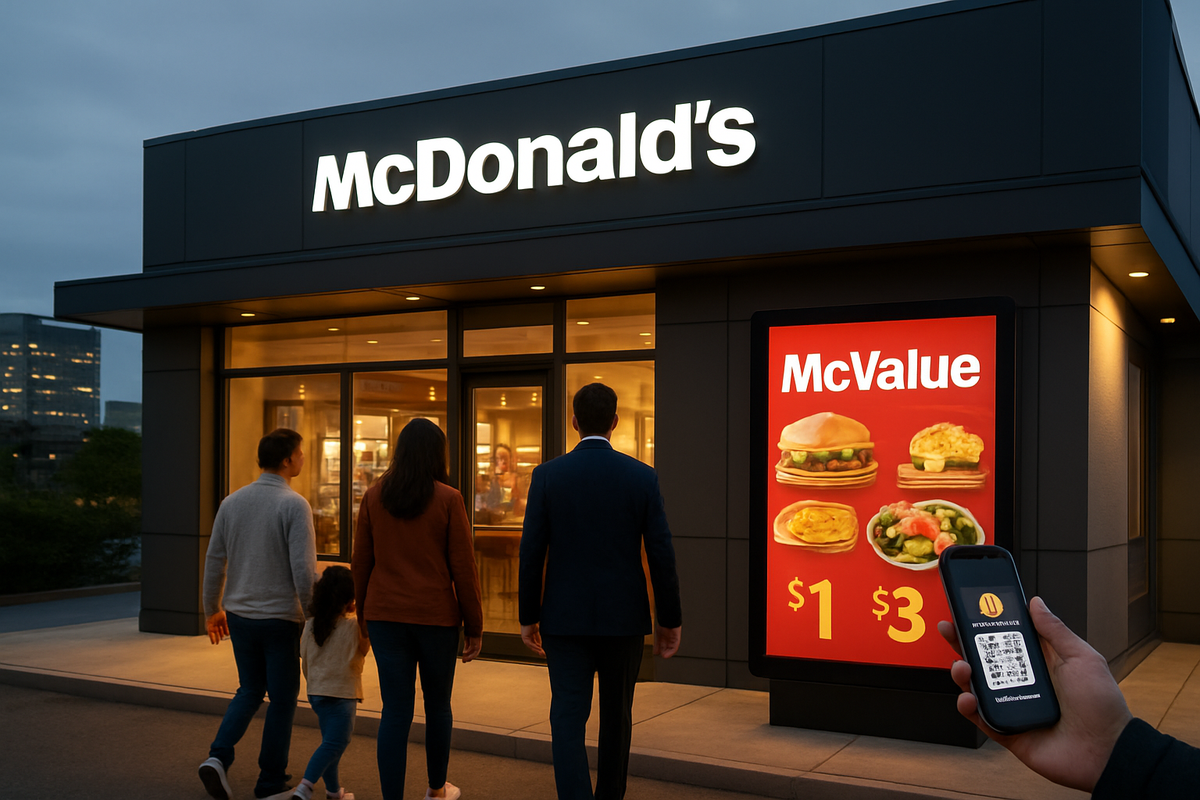
The timeline of this recovery began in mid-2025 when management recognized that low-income diners were abandoning the brand for home-cooked meals. In response, McDonald’s evolved its temporary $5 Meal Deal into a permanent, multi-tiered "McValue" menu. This anchor, combined with high-profile product launches like the "Big Arch" premium burger and the long-awaited return of Snack Wraps and McWings, successfully brought diners back into the fold. Global comparable sales rose 5.7% in Q4, significantly outperforming the 3.7% consensus and proving that the "Value Reset" was exactly what the market required.
The reaction from the investor community has been largely positive, though cautious regarding the cost of this growth. During the earnings call, CEO Chris Kempczinski highlighted that active loyalty users have now reached 210 million globally, with digital sales accounting for nearly $37 billion of the year's total revenue. However, the heavy reliance on discounting to drive this traffic has put a spotlight on the internal health of the franchise system, where restaurant-level margins have remained "flattish" despite the top-line surge.
The Scale Divide: Winners and Losers in the Value War
As McDonald’s reclaims its throne as the value leader, the competitive landscape is being reshaped. The Q4 data suggests that scale-advantaged players like McDonald’s and Yum! Brands (NYSE: YUM)—the parent of Taco Bell—are the primary winners. These companies have the supply chain leverage and corporate war chests to subsidize aggressive discounts while maintaining overall profitability. McDonald’s even took the unusual step of co-investing $75 million in Q4 to support its franchisees, a move designed to protect operator margins while keeping "McValue" prices low for the consumer.
Conversely, mid-tier players are reeling. The Wendy’s Company (NASDAQ: WEN) saw a sharp 11.3% plunge in U.S. sales during the same period, illustrating the peril of failing to provide a compelling value proposition in a hyper-sensitive market. Similarly, Restaurant Brands International (NYSE: QSR), the parent of Burger King, and Starbucks (NASDAQ: SBUX) have faced uphill battles as consumers increasingly view mid-priced "affordable luxuries" as dispensable. The 2025 results indicate that the market is bifurcating: consumers are either opting for the absolute lowest price point or choosing premium "fast-casual" experiences like Chipotle Mexican Grill (NYSE: CMG), leaving the traditional "middle" of the fast-food market in a precarious position.
For franchisees of smaller chains, the outlook is sobering. Without the corporate subsidies seen at McDonald’s, many smaller operators are struggling to absorb rising beef and labor costs while being forced to participate in "race-to-the-bottom" pricing. This dynamic is likely to lead to increased consolidation within the industry as larger restaurant groups look to acquire struggling smaller brands at a discount throughout 2026.
Broader Significance: The "Fast-Food Fatigue" Index
The success of the "McValue" platform is a significant indicator of broader economic trends. It suggests that while the U.S. economy remains resilient, the consumer is suffering from "fast-food fatigue" regarding high prices. For years, the QSR sector outperformed general inflation, but 2025 proved to be the breaking point. McDonald’s results confirm that the "defensive play" in the 2026 economy is to pivot back to the core mission of affordability. This event fits into a wider industry trend where "transparency in value" has become more important than "premiumization" for the mass market.
Historically, McDonald’s has served as a bellwether for the low-to-middle-income consumer. The surge in guest counts in Q4 2025 suggests that these consumers are returning to the market, but only under specific conditions. This mirrors the post-2008 recovery period when the "Dollar Menu" became the primary driver of growth. The ripple effect is already being felt by competitors and partners; suppliers are being asked to find efficiencies to support these value menus, and delivery platforms like DoorDash (NASDAQ: DASH) are seeing a shift in order mix toward higher-volume, lower-priced bundles.
Regulatory and policy implications also loom. As McDonald’s and its peers lean into digital loyalty programs to track and target consumers, data privacy and the use of "dynamic pricing" algorithms are expected to face increased scrutiny from the FTC and state regulators. The 2025 results show that 20% of sales now come through loyalty members, giving the company unprecedented power over consumer behavior and pricing elasticity data—a point of contention for advocates of consumer price protections.
The 2026 Outlook: Expansion Amidst Deceleration
Looking ahead to the remainder of 2026, McDonald’s has signaled a "cautious but aggressive" strategy. The company plans to open 2,600 new restaurants this year, including 750 in the U.S. and International Operated Markets. This massive expansion indicates long-term confidence in the brand's ability to capture market share. However, management has also issued a warning for the first quarter of 2026, citing a "tough lap" against the strong performance of early 2025 and persistent macroeconomic pressures that could cause a temporary deceleration in comparable sales.
The short-term challenge for McDonald’s will be managing the "discount mix." If the economy stabilizes and inflation cools further, the company will need to transition these value-seeking customers back toward higher-margin premium items like the "Big Arch." The long-term strategic pivot involves the continued evolution of the "CosMc’s" pilot and other small-format, beverage-led concepts designed to compete with Starbucks and Dutch Bros (NYSE: BROS). These ventures represent a hedge against the saturation of the traditional burger market.
In a potential "worst-case" scenario where beef prices continue to spike due to cattle supply shortages, McDonald’s will be forced to choose between further squeezing franchisee margins or raising prices and risking the guest counts they worked so hard to recover in 2025. Investors will be watching for any signs that the corporate office is stepping back from its subsidy programs, as this would be the first signal of a potential margin contraction for the company as a whole.
Conclusion: A Resilient Icon with a High-Stakes Strategy
McDonald’s Q4 2025 and full-year results underscore the company's unique ability to course-correct in the face of consumer backlash. By abandoning aggressive pricing in favor of the "McValue" reset, the Golden Arches have successfully re-established themselves as the default choice for the budget-conscious American. The "double beat" on earnings and revenue provides a solid foundation for 2026, even as the broader industry faces a reckoning over pricing and traffic.
Moving forward, the market should be viewed as a battleground of scale. McDonald's has proven that digital loyalty and deep value are the keys to winning in an era of hyper-sensitive consumer spending. However, the "flattish" franchise margins remain a critical point of concern. For investors, the next few months will be about monitoring guest count sustainability; if traffic remains positive even as the company begins to phase out some of its most aggressive discounts, it will be a clear sign that McDonald’s has truly regained its mojo.
The lasting impact of 2025's "Value Reset" may be a permanent shift in how the fast-food industry communicates price to the public. As we move into 2026, the question is no longer how high prices can go, but how much value a brand can pack into a $5 or $10 transaction. For now, McDonald’s appears to have found the winning formula.
This content is intended for informational purposes only and is not financial advice.