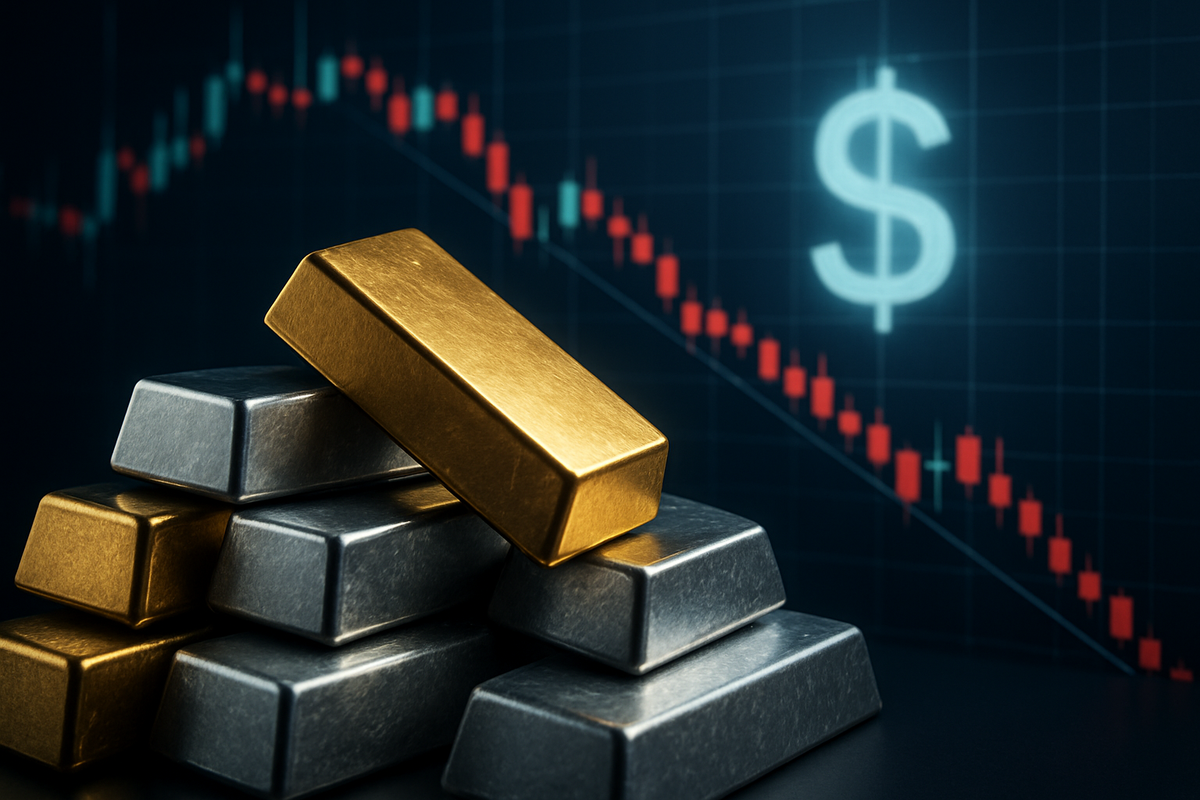
The high-flying precious metals market faced a sharp reality check this week as gold and silver prices tumbled on global exchanges, marking a significant departure from the record-shattering gains seen earlier in the year. On the Multi Commodity Exchange (MCX) in India, gold futures for April delivery slid over 0.7%, while silver futures for March delivery plummeted by more than 3% in a single high-intensity trading session. This sudden cooling of the "bullion fever" has sent ripples through the financial markets, forcing investors to re-evaluate their positions as the safe-haven trade hits a major technical and fundamental wall.
The immediate catalyst for the sell-off appears to be a dual-pronged attack of a resurgent U.S. dollar and a wave of aggressive profit-booking by institutional players. After gold briefly crossed the psychological $5,000 per ounce threshold earlier in 2026 and silver reached nearly $120 per ounce, market participants are now moving to lock in triple-digit returns. This retracement is being further exacerbated by cooling inflation data from the United States, which has subtly shifted the narrative around the Federal Reserve's much-anticipated rate-cut cycle, dampening the appeal of non-yielding assets like gold and silver.
The descent began in earnest during the February 16–17, 2026, trading window. On the MCX, gold futures dropped approximately ₹1,094 to settle near ₹1,54,801 per 10 grams, a decline of roughly 0.76%. Silver experienced a far more violent "flash" correction, with the March contract diving over 3.4%—a staggering ₹8,265 drop—to trade at ₹2,36,100 per kg. This volatility coincided with the U.S. Presidents' Day holiday and the Lunar New Year break in major Asian hubs like China and Singapore, which drained global liquidity and allowed relatively smaller sell orders to trigger outsized price movements.
Leading up to this correction, the bullion market had been in a "parabolic" state, fueled by geopolitical tensions and persistent fears of a "hard landing" for the global economy. However, the release of the U.S. Consumer Price Index (CPI) for January 2026 served as a cold shower for the bulls. Annual inflation slowed to 2.4%, down from 2.7% in previous months, while the monthly CPI increase of 0.2% came in lower than the 0.3% consensus estimate. Paradoxically, while lower inflation typically supports the case for rate cuts, the relative resilience of the U.S. economy led many to believe the Federal Reserve might not need to be as aggressive in its easing as previously priced in.
The reaction from the U.S. Dollar Index (DXY) was immediate, with the greenback recovering to the 97.8 level. Because precious metals are priced in dollars, a stronger DXY makes them more expensive for international buyers, particularly in emerging markets like India and China, which are the world's largest consumers of physical gold. This currency pressure, combined with new, higher margin requirements imposed by the CME Group (Comex), forced leveraged traders to unwind their "long" positions, accelerating the downward momentum on both the MCX and international spot markets.
The sharp reversal in bullion prices has created a stark divide between industry "winners" and "losers." Mining companies, which operate as leveraged proxies for metal prices, have been hit the hardest. Newmont Corporation (NYSE: NEM) and Barrick Gold (NYSE: GOLD) both saw their share prices retreat as the shrinking margins of their mining operations weighed on investor sentiment. Silver-heavy producers were even more vulnerable; First Majestic Silver (NYSE: AG) and Hecla Mining (NYSE: HL) witnessed significant single-day drops, reflecting their sensitivity to silver's higher volatility compared to gold. For these miners, a sustained drop in prices could mean a re-evaluation of high-cost projects that were only viable during the recent price peak.
On the other side of the ledger, industrial consumers of silver may find a silver lining in the correction. First Solar (NASDAQ: FSLR), a leader in thin-film solar modules, and Samsung Electronics (KRX: 005930), which has been aggressively developing silver-heavy solid-state batteries, stand to benefit from lower input costs. Silver is a critical industrial component, and the "silver shock" of early 2026 had put immense pressure on manufacturing margins. A price retreat provides these companies with a window to restock inventories at more manageable levels, potentially improving their bottom-line performance in the coming quarters.
Retail giants like Titan Company Ltd. (NSE: TITAN) face a more complex scenario. While lower gold prices often stimulate volume growth by making jewelry more affordable for the Indian middle class, sharp and sudden drops often lead to a "wait-and-watch" approach among consumers who expect further declines. Furthermore, retailers must manage the risk of inventory write-downs, as the gold currently in their showrooms was likely purchased at higher price points. In the high-end luxury space, firms like LVMH (Euronext: MC) remain largely insulated, as their brand equity allows them to maintain pricing power regardless of raw material fluctuations.
This correction fits into a broader historical pattern where extreme "bull runs" are followed by sharp "technical resets." The 2026 drop draws comparisons to the post-pandemic corrections of 2021 and the 2013 gold crash, where a strengthening dollar and a shift in Fed policy expectations broke the back of a multi-year rally. The current event signals that the "inflation hedge" trade may be losing its urgency as central banks globally manage to bring consumer prices back toward their 2% targets.
The move also highlights the shifting landscape of global monetary leadership. With the expected transition of the Federal Reserve chairmanship to more hawkish candidates like Kevin Warsh in 2026, the market is pricing in a return to traditional monetary discipline. This shift has reduced the "debasement" fear that drove many investors into gold in the first place. Furthermore, the drop in silver specifically reflects a cooling in the speculative "green metal" trade, as manufacturers have begun exploring "thrifting" technologies—such as copper substitution—to reduce their reliance on expensive silver.
From a regulatory standpoint, the increased margin requirements seen this month suggest that exchange operators are becoming wary of the systemic risk posed by extreme commodity volatility. These "macro-prudential" measures are designed to prevent a total market dislocation but often result in the kind of sharp liquidations we are currently witnessing. For the broader market, this event serves as a reminder that even the most robust safe havens are not immune to the gravitational pull of U.S. Treasury yields and a dominant dollar.
In the short term, analysts expect gold and silver to enter a period of consolidation as the market digests the recent CPI data and waits for the next move from the Federal Reserve. If the dollar continues its upward trajectory, gold could find its next major support level around the $4,200 mark, while silver may test the $85-$90 range. Investors will be closely watching the resumption of trading in Asian markets post-Lunar New Year, as Chinese demand often provides a floor for prices during global sell-offs.
Long-term, the strategic pivot for many companies will involve diversifying their commodity exposure. Miners may shift their focus back to operational efficiency and cost-cutting after a period of "growth at any cost" during the rally. For industrial users, the temporary price relief might slow the transition to silver alternatives, but the volatility of 2026 has likely permanently changed how companies manage their precious metal supply chains, with more emphasis on long-term hedging and physical stockpiling during price dips.
The market may also see a "rotation" of capital. As the luster fades from precious metals, speculative interest could move back into traditional equities or emerging technologies, provided that the U.S. economy remains on its "soft landing" path. However, any sudden flare-up in geopolitical tensions or a surprise reversal in inflation cooling could reignite the bullion fire just as quickly as it was extinguished.
The recent retreat of gold and silver on the MCX and global markets marks a pivotal moment in the 2026 financial narrative. The double-digit percentage drops in silver and the steady decline in gold underscore the market's sensitivity to the U.S. dollar and the shifting sands of Federal Reserve policy. While the correction has been painful for mining stocks and bullion bulls, it offers a necessary reprieve for industrial manufacturers and a potential entry point for long-term investors who missed the initial rally.
Moving forward, the primary takeaway is that the "parabolic" phase of the precious metals market has likely concluded, replaced by a more nuanced, data-driven environment. Investors should keep a close eye on the DXY and upcoming Fed minutes to gauge the sustainability of this dollar strength. While the long-term case for gold as a store of value remains intact, the era of easy, momentum-driven gains appears to be on hiatus. In the coming months, the ability of silver to maintain its industrial demand despite the price volatility will be the key indicator for the broader metals complex.
This content is intended for informational purposes only and is not financial advice