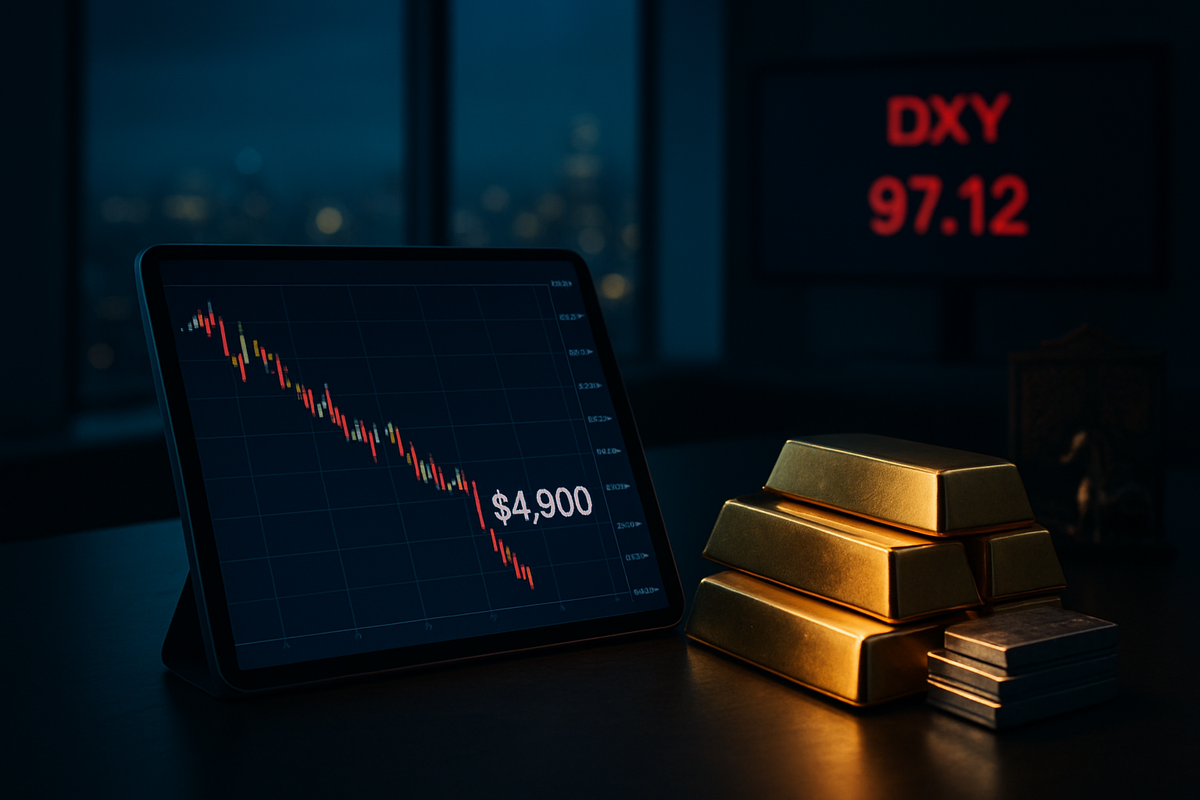
NEW YORK — Precious metals markets are experiencing a significant cooling period this week, with gold prices drifting back toward the critical $4,900 per ounce support zone. This retracement comes on the heels of a relentless multi-month rally that saw the yellow metal briefly eclipse the psychological $5,000 barrier earlier this month. Silver has followed a similar downward trajectory, stabilizing in the $74 to $86 range after a volatile "liquidity rupture" in late January that saw prices collapse from all-time highs above $120.
The immediate pressure on the metals complex is being driven by a resurgent U.S. Dollar Index (DXY), which has climbed above the 97.00 mark, and a notable absence of physical buying from Asia. With Chinese markets shuttered for the Lunar New Year holiday—celebrating the Year of the Fire Horse—the world’s largest physical gold consumer is sidelined, leaving the market vulnerable to technical selling and speculative repositioning ahead of high-impact economic data scheduled for later this week.
The $4,900 Threshold: Support Tests Amidst an Asian Lull
As of February 17, 2026, spot gold (XAU/USD) was trading near $4,918, a level that technical analysts describe as a "must-hold" floor to maintain the current bullish supercycle. The retreat from the $5,100 peak has been exacerbated by the seasonal absence of Chinese investors. The Lunar New Year, which began on February 15 and runs through February 23, typically sees a surge in physical gift-giving, but the bulk of that demand was front-loaded in January. With the Shanghai Gold Exchange closed, global trading volumes have thinned, allowing the rebounding U.S. dollar to exert maximum downward pressure.
The U.S. Dollar Index (DXY) has found renewed life above 97.20, bolstered by a "hawkish" sentiment shift following the recent nomination of Kevin Warsh as the next Federal Reserve Chair. This transition, dubbed the "Warsh Shock" by market participants, has recalibrated expectations for the 2026 interest rate path. Investors are now bracing for the release of the January FOMC minutes on Wednesday, February 18, and the Personal Consumption Expenditures (PCE) inflation data on Friday, February 20. Speculators remain cautious, fearing that a hot PCE print could validate a more aggressive stance from the Fed, further lifting the dollar and weighing on non-yielding assets like gold.
Mining Giants and ETFs Face Margin Pressure
The retreat in spot prices has sent ripples through the equities market, particularly affecting the world’s largest producers. Newmont Corporation (NYSE: NEM) and Barrick Gold Corporation (NYSE: GOLD) have both seen their share prices pull back by approximately 12% to 15% since the start of the month. While these companies remain highly profitable at $4,900 gold, the sudden compression in margins from the $5,100 peak has led to some institutional profit-taking.
Silver-focused companies have fared even worse due to the metal's higher beta and the recent CME margin hikes. First Majestic Silver Corp. (NYSE: AG) and Pan American Silver Corp. (NYSE: PAAS) have faced intense selling pressure following the "forced liquidation" event in late January, where silver margins were hiked to 18%. This regulatory move forced many leveraged traders to dump positions, causing silver to "flash crash" from $121 to the mid-$70s in a matter of days. For investors holding the iShares Silver Trust (NYSE Arca: SLV) or the SPDR Gold Shares (NYSE Arca: GLD), the current environment is one of extreme caution, as the lack of "buy-the-dip" conviction during the Chinese holiday suggests further downside testing could be imminent.
The Macro Backdrop: Dollar Dominance and the "Warsh Shock"
The current market dynamic marks a sharp departure from the 2024–2025 period, when gold and silver rose in tandem with a weakening dollar. The 2026 landscape is defined by a "strong dollar, stronger inflation" paradox. Even as the DXY pushes toward 100, inflationary pressures in the transition to green energy and AI-driven power demand have kept silver and gold fundamentally bid. However, the nomination of Kevin Warsh has signaled to the market that the Federal Reserve may no longer tolerate the "inflationary drift" that allowed gold to double in value over the last 24 months.
This event mirrors the historical precedents of the early 1980s, where aggressive margin changes and a shift in Fed leadership broke the back of a parabolic precious metals rally. While the long-term industrial demand for silver—driven by the 2026 solar boom and massive EV infrastructure projects—remains a solid floor, the speculative "froth" is being systematically removed. The ripple effect is being felt in the currency markets as well, with the Euro and Yen struggling to keep pace with the "Warsh-led" dollar, further making gold an expensive hedge for international buyers.
Navigating the Week Ahead: FOMC and PCE Volatility
The short-term fate of the $4,900 support level rests almost entirely on the twin pillars of the FOMC minutes and the PCE report. If the minutes reveal a consensus for "higher for longer" rates or a faster-than-expected quantitative tightening (QT) schedule, gold could easily break below $4,850, triggering a wave of stop-loss selling. Conversely, any hint of concern regarding a slowing labor market could provide the spark for a relief rally back toward $5,000.
In the long term, the market is looking toward the reopening of Chinese exchanges next week. If Chinese buyers return to find gold at a "discount" near $4,900, their entry could provide the necessary liquidity to stabilize prices. Strategic pivots are already being observed among major hedge funds, which are moving away from leveraged futures and into physical bullion or royalty companies like Wheaton Precious Metals Corp. (NYSE: WPM), which offer more insulation from the volatile margin environment seen in the paper markets.
Market Wrap: A Strategic Pause in the Supercycle
The current retreat to $4,900 is being viewed by many institutional analysts as a healthy, albeit painful, correction in an overheated market. The combination of the Chinese holiday lull and a resurgent DXY above 97 has provided the perfect cover for a necessary de-leveraging of the metals complex. The "Warsh Shock" and the CME’s margin adjustments have effectively reset the bar for what constitutes "fair value" in a high-interest-rate environment.
Moving forward, investors should watch for two key signals: the stabilization of the DXY and the volume of physical gold buying once Shanghai resumes trading. While the immediate outlook is clouded by the upcoming PCE data, the structural deficit in silver and the central bank demand for gold suggest that the secular bull market is far from over. However, the days of easy, parabolic gains have likely passed, replaced by a more volatile, data-driven environment where $4,900 gold is the new battleground.
This content is intended for informational purposes only and is not financial advice.