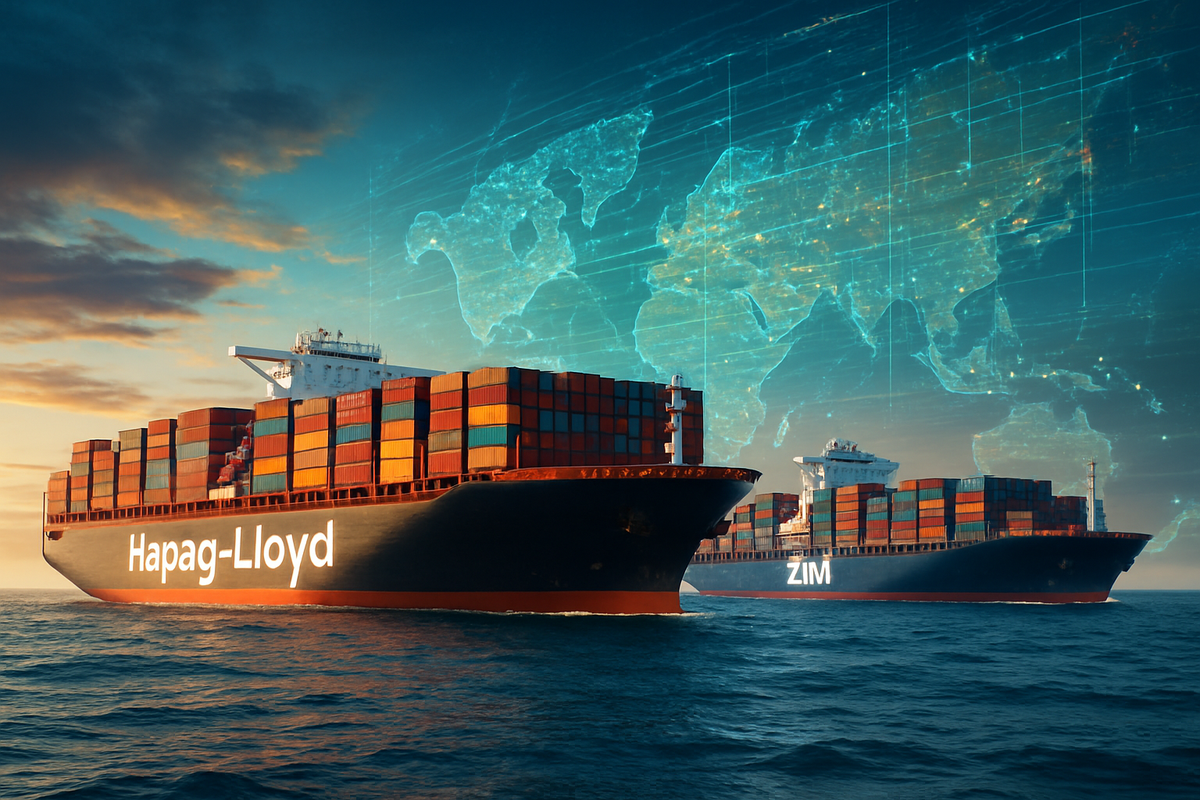
The global shipping landscape underwent a seismic shift this morning as the German maritime powerhouse Hapag-Lloyd AG (XETR:HLAG) announced a definitive agreement to acquire ZIM Integrated Shipping Services Ltd. (NYSE: ZIM) for $4.2 billion. This all-cash transaction, valued at $35.00 per share, represents a staggering 75% premium over ZIM’s closing price last Friday. The deal effectively swallows one of the industry's most agile "niche" players, signaling a definitive end to the era of mid-tier independence in the transpacific and Mediterranean trade lanes.
Immediate implications for the market are profound. By absorbing ZIM’s modern, LNG-powered fleet, the combined entity will command approximately 9% of global container capacity, narrowing the gap between the world's "Big Three" and the rest of the field. For freight markets, the move suggests a tightening of capacity on premium "e-commerce" routes, where ZIM has long been a dominant force. Investors responded with fervor; ZIM shares surged 68% in pre-market trading, while retail and logistics stocks showed early signs of volatility as the market began pricing in potentially higher long-term shipping rates.
A Targeted Strike in a Volatile Market
The acquisition follows a 14-month period of intense speculation regarding ZIM’s future. After the "super-cycle" profits of 2024 began to normalize in mid-2025, ZIM found itself in a precarious "scale gap"—large enough to compete on global routes but too small to weather the predatory pricing strategies of the newly formed "Gemini Cooperation" and "Ocean Alliance." The timeline of the deal accelerated in late January 2026, following a closed-door meeting at the World Economic Forum, where ZIM’s board reportedly agreed to explore "strategic alternatives" amidst a tightening regulatory environment in the Eastern Mediterranean.
The terms of the deal are specifically structured to satisfy the "Golden Share" held by the State of Israel. To gain regulatory approval, Hapag-Lloyd has committed to maintaining ZIM’s operational headquarters in Haifa for at least a decade and ensuring that a minimum of 11 vessels remain available to the Israeli government for national emergencies. This "dual-flag" strategy was the key that unlocked the deal, overcoming the geopolitical hurdles that had derailed previous merger attempts in 2022 and 2023.
Market analysts note that the $4.2 billion price tag is not just a bet on ZIM’s hardware, but its software. ZIM has been a leader in digital freight booking and blockchain-based bill of lading systems. Hapag-Lloyd CEO Rolf Habben Jansen noted in a press conference early on February 17, 2026, that "the integration of ZIM’s digital-first customer interface with our global network will create a value proposition that purely scale-driven competitors cannot match."
Winners and Losers: From Haifa to Bentonville
The clear winners in today’s announcement are ZIM’s long-term shareholders, who have endured a rollercoaster of dividends and equity swings over the past three years. However, the ripple effects extend far beyond the stock ticker. A.P. Moller - Maersk (CPH:MAERSK-B) and COSCO SHIPPING Holdings Co., Ltd. (HKG:1919) may see a short-term benefit from the elimination of an aggressive price-cutter in the market. By removing ZIM’s independent "wildcard" pricing, the remaining giants gain more leverage over annual contract negotiations.
On the losing side, domestic shipping competitors like Matson, Inc. (NYSE: MATX) may face increased pressure as the newly enlarged Hapag-Lloyd brings superior scale to the niche Pacific routes Matson has traditionally protected. Furthermore, transport-sensitive retail giants such as Walmart Inc. (NYSE: WMT) and Amazon.com, Inc. (NASDAQ: AMZN) are facing a more consolidated supplier base. These "big-box" importers have historically used ZIM as a leverage point to drive down rates from the larger carriers; with ZIM under the Hapag-Lloyd umbrella, that bargaining chip has effectively vanished.
Logistics tech providers who weren't aligned with the Hapag-ZIM ecosystem may also find themselves on the outside looking in. The consolidation of data and booking platforms into a single proprietary stack could marginalize third-party freight tech startups that relied on ZIM’s open-API philosophy to provide "independent" market data.
The End of the "Niche" Era
This acquisition is a landmark event that fits into a broader industry trend toward "Green Scale." With 40% of ZIM’s fleet already powered by Liquefied Natural Gas (LNG) or dual-fuel engines, the deal allows Hapag-Lloyd to leapfrog its competitors in the race toward Net Zero emissions. The maritime industry is facing increasingly stringent carbon taxes from the EU and the IMO, and acquiring "green capacity" is often cheaper and faster than waiting for newbuild slots in overcrowded shipyards.
Historically, this deal mirrors the 2017-2018 consolidation wave that saw the formation of Ocean Network Express (ONE) and the acquisition of Hamburg Süd by Maersk. However, the 2026 context is different; it is driven by technological integration and decarbonization rather than just survival in a low-rate environment. The industry is moving toward a "hub-and-spoke" model where reliability and sustainability are becoming as important as the cost per TEU (twenty-foot equivalent unit).
Regulators in the US and EU are expected to scrutinize the deal for antitrust violations, particularly on the Transpacific route where ZIM held significant market share. However, because Hapag-Lloyd has traditionally been stronger in the Transatlantic and Latin American trades, the "complementary" nature of their networks may provide a smoother path to approval than many expect.
Navigating the Post-Merger Horizon
In the short term, shippers should prepare for a period of service reshuffling. As Hapag-Lloyd integrates ZIM’s vessels into its "Gemini" alliance structure, some of ZIM’s legacy direct-call routes may be replaced by hub-and-spoke services. This could result in longer transit times for some regional ports but greater schedule reliability for major hubs like Savannah, Rotterdam, and Singapore. Strategic pivots will be required for smaller freight forwarders who relied on ZIM's personalized service; they may now need to seek out regional carriers or pay a premium for "white-glove" treatment within the larger Hapag-Lloyd system.
Long-term, the market may see a "cooling" of the freight rate wars that have plagued the industry since the 2024 Red Sea disruptions. With one less independent actor in the market, the capacity to "dump" rates to fill ships is reduced. This provides a more stable, albeit higher, pricing floor for the industry. Investors should watch for whether this prompts a "defensive" merger between other mid-tier players like HMM Co., Ltd. or Yang Ming Marine Transport Corp., as they look to avoid becoming the next target.
Summary and Investor Outlook
The acquisition of ZIM by Hapag-Lloyd marks a definitive chapter in maritime history. It validates the "agile" model ZIM pioneered while simultaneously proving that in a world of carbon taxes and global alliances, scale is the ultimate survival tool. For the market, this means higher barriers to entry, more predictable freight rates, and a accelerated push toward digital and green shipping.
Investors should closely monitor the regulatory approval process over the next six months. Any forced divestiture of ZIM’s US-bound capacity could create an opening for another competitor to gain market share. Moving forward, the key metric to watch will be the "integration alpha"—whether Hapag-Lloyd can successfully merge ZIM’s high-tech, high-speed culture with its own disciplined, traditional operations. If successful, the $4.2 billion spent today will be remembered as the foundation of a new maritime superpower.
This content is intended for informational purposes only and is not financial advice.