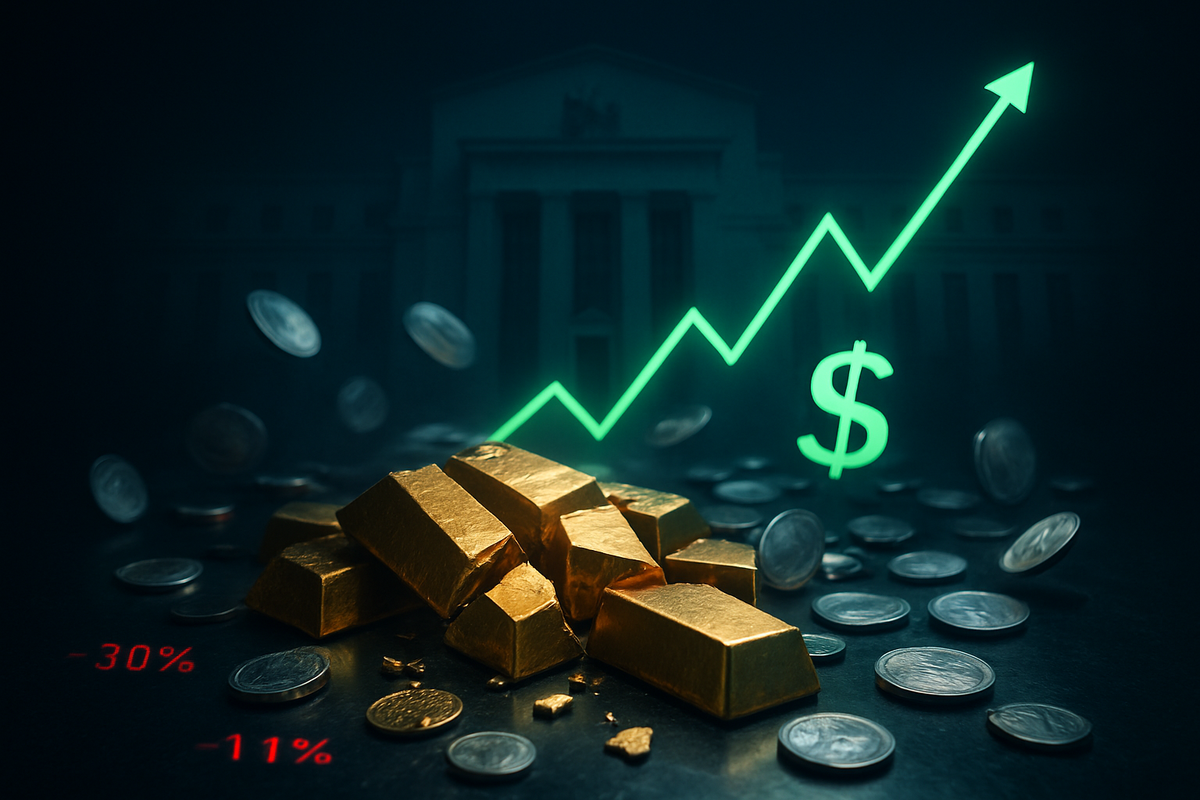
The global financial landscape was rocked in late January by a seismic shift in Federal Reserve leadership expectations, triggering a historic "flash crash" in precious metals that has left investors reeling. The nomination of Kevin Warsh as the next Chair of the Federal Reserve (Fed) acted as a catalyst for a massive unwinding of the "debasement trade," a strategy many had used to hedge against potential political interference in central bank policy.
The fallout was immediate and severe: on January 30, 2026, silver futures plummeted 30%—their most devastating single-day performance since the 1980 "Silver Thursday"—while gold prices slid 11%. This violent correction has fundamentally altered the market's outlook on the US dollar and the long-term independence of the world's most influential financial institution.
The January 30th Flash Crash and the Warsh Mandate
The turmoil began at approximately 1:10 p.m. ET on Friday, January 30, 2026, immediately following the announcement from the White House. For months, speculation had mounted that the administration might choose a more "pliant" candidate, such as Kevin Hassett, to lead the Fed. Investors had been pricing in a scenario where the central bank might lose its independence, leading to aggressive rate cuts and potentially higher inflation. However, the selection of Kevin Warsh—a former Fed Governor (2006–2011) known for his hawkish leanings and commitment to a smaller Fed balance sheet—shattered that thesis instantly.
As news of the nomination spread, the iShares Silver Trust (NYSEARCA: SLV) and the SPDR Gold Trust (NYSEARCA: GLD) saw a surge in volume that triggered multiple circuit breakers. Silver, which had been trading near multi-year highs, crashed from over $115 per ounce to an intraday low of $80.55. Gold followed suit, dropping from record territory above $5,600 to approximately $4,812 per ounce. Market analysts attributed the speed of the decline to "forced liquidation," as leveraged long positions were systematically wiped out by algorithmic trading platforms reacting to the sudden shift in policy expectations.
The appointment of Warsh is widely viewed as a signal that the "Sound Money" era is returning. Warsh has historically been a critic of excessive quantitative easing and has advocated for a more rule-based approach to monetary policy. His nomination assuaged deep-seated fears that the Federal Reserve would become an arm of the executive branch, restoring a level of institutional credibility that many feared was at risk of eroding.
Mining Giants and ETFs Bear the Brunt of the Selloff
The equity markets were not spared in the wake of the precious metals collapse. Mining companies, whose valuations are tethered to the spot prices of the metals they extract, saw billions in market capitalization vanish in a matter of hours. Pan American Silver (NASDAQ: PAAS) was among the hardest hit, with its share price cratering as much as 25% intraday before mounting a modest recovery. Other silver-heavy producers like First Majestic Silver (NYSE: AG) and Hecla Mining (NYSE: HL) also saw double-digit percentage losses, as the profitability outlook for high-cost silver mines was suddenly thrown into question.
Gold miners faced similar headwinds. Newmont Corp (NYSE: NEM) and Barrick Gold (NYSE: GOLD) saw their shares drop by approximately 7.3% and 8.1%, respectively. Agnico Eagle Mines (NYSE: AEM) and Gold Fields (NYSE: GFI) also faced significant downward pressure. For these companies, the sharp drop in gold prices directly impacts their future cash flows and dividend capacities, leading to a massive rotation out of the sector.
On the other side of the trade, the US dollar emerged as the primary beneficiary. The ICE US Dollar Index (DXY) rallied 0.8% to 97.08 on the day of the announcement. Financial institutions with heavy allocations to dollar-denominated debt and fixed-income products saw a boost in sentiment, as the prospect of higher real interest rates and a hawkish Fed policy trajectory made the greenback more attractive to global capital.
A Historical Pivot in Central Bank Independence
The "Warsh Shock" is being compared by historians to the 1980 silver collapse involving the Hunt Brothers, though the drivers today are purely macroeconomic. The significance of this event lies in the market's re-evaluation of Fed independence. For much of 2025, the "debasement trade"—buying gold, silver, and bitcoin to protect against currency devaluation—was the dominant theme in global finance. By nominating a candidate with a reputation for institutional autonomy and fiscal discipline, the administration effectively pulled the rug out from under this trade.
This shift fits into a broader trend of central banks around the world grappling with the balance between economic growth and inflationary pressures. The immediate strength of the US dollar following the nomination suggests that the market now views US monetary policy as likely to remain more restrictive than previously anticipated. This has significant ripple effects on emerging markets, which often struggle when the dollar strengthens, as their dollar-denominated debt becomes more expensive to service.
Furthermore, the event highlights the fragility of the precious metals market in the face of sudden policy shifts. The 30% drop in silver underscores how speculative premiums can evaporate when the underlying rationale for a hedge—in this case, the fear of a politicized Fed—is removed. The regulatory implications may also be significant, as the SEC and CFTC are expected to scrutinize the "flash crash" dynamics to ensure that automated trading systems did not exacerbate the volatility to an unsafe degree.
Looking Ahead: The New Monetary Landscape
In the short term, the precious metals market is likely to remain in a period of consolidation. While the immediate panic has subsided, gold and silver are struggling to find a firm floor as investors recalibrate their models to account for a "Warsh-led" Fed. Analysts suggest that the high-interest-rate environment favored by Warsh will keep a ceiling on non-yielding assets like bullion, at least until the first formal policy meeting of his tenure later this year.
Strategically, mining companies may need to pivot. Firms that were planning aggressive expansions based on $30+ silver or $2,500+ gold may now have to put those projects on hold or seek ways to reduce all-in sustaining costs (AISC). We may also see an increase in M&A activity within the sector, as larger, well-capitalized miners look to acquire smaller players whose valuations have been decimated by the crash.
The long-term scenario depends heavily on whether Warsh can successfully navigate the "soft landing" that has eluded his predecessors. If his hawkish stance leads to a significant economic slowdown, the demand for gold as a safe haven could return, albeit for different reasons. However, for the foreseeable future, the "inflation hedge" narrative has been fundamentally broken, replaced by a renewed focus on the dollar's dominance and the Fed's role as an independent arbiter of value.
Summary of the Market Impact
The nomination of Kevin Warsh has delivered a powerful message to the markets: the Federal Reserve's institutional integrity remains a cornerstone of US economic policy. The resulting 30% drop in silver and 11% drop in gold represent more than just a bad day for commodities; they represent a massive shift in global capital allocation and a vote of confidence in the future of the US dollar.
Moving forward, the market will be characterized by higher volatility in the precious metals sector and a continued strengthening of the greenback. Investors should watch closely for Warsh's confirmation hearings and his first official statements regarding the balance sheet. These will provide the roadmap for the next four years of monetary policy.
The key takeaway for investors is the importance of diversifying away from narrow "debasement" themes. As the "Warsh Shock" demonstrated, the market’s perception of political risk can change in an instant, and those caught on the wrong side of the policy shift can face historic losses. For now, the era of the "politicized Fed" has been delayed, and the reign of the dollar has been reinvigorated.
This content is intended for informational purposes only and is not financial advice.