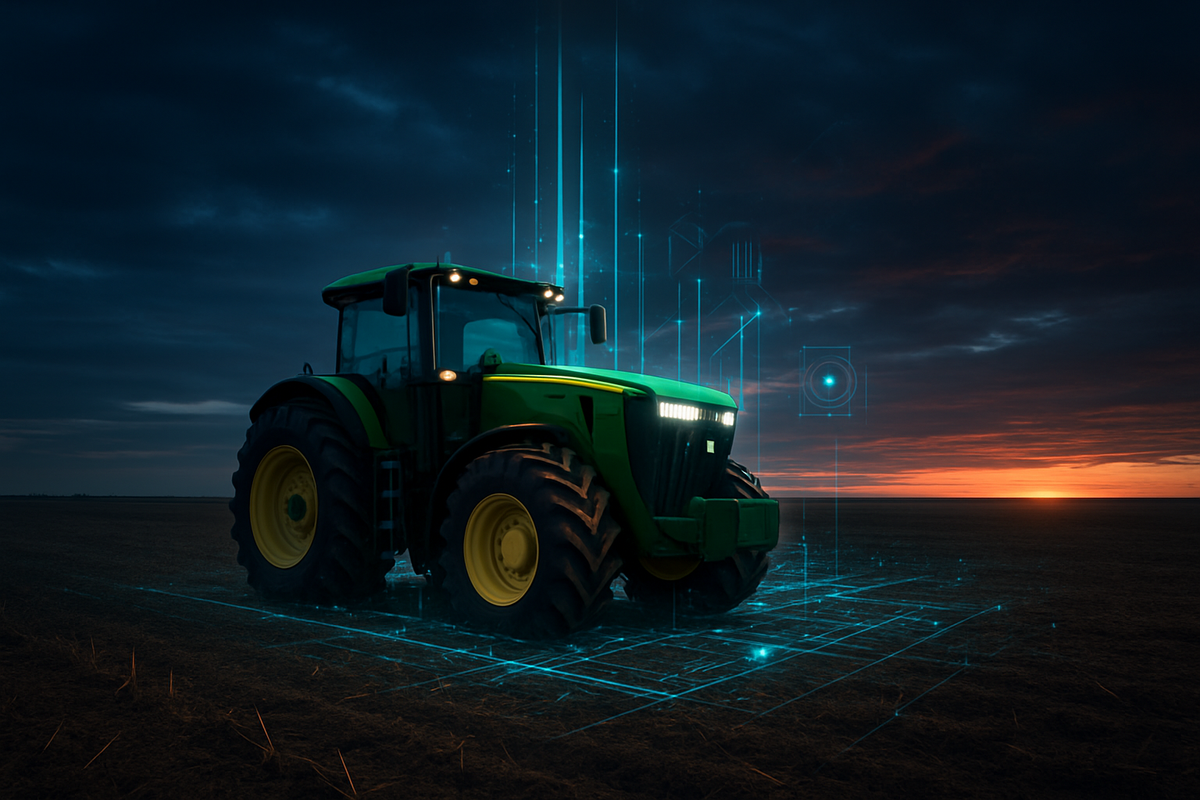
On the eve of its first-quarter earnings report, scheduled for February 19, 2026, Deere & Co. (NYSE: DE) finds itself at a pivotal crossroads. After years of record-breaking profitability fueled by post-pandemic demand, the world’s largest farm equipment manufacturer is now staring down the barrel of a significant cyclical downturn. Investors and industry analysts are bracing for a report that is expected to confirm 2026 as the "trough" year for agricultural machinery, with the company’s ability to navigate high interest rates, plummeting commodity prices, and shifting trade policies under intense scrutiny.
The upcoming results follow a bruising 2025 fiscal year where net income plummeted by nearly 30% to $5.027 billion. As Deere prepares to release its Q1 2026 figures, the consensus estimate for earnings per share (EPS) sits at a modest $1.92—a staggering 40% drop from the $3.19 reported in the same quarter last year. This anticipated decline reflects a broader industry malaise that has forced manufacturers to slash production, manage bloated dealer inventories, and accelerate a transition toward high-margin technology services to offset the collapse in heavy machinery sales.
A Year of Defensive Maneuvers and Production Cuts
The road to this moment has been defined by a rapid cooling of the global agricultural market. Following the boom years of 2022 and 2023, the industry hit a wall in 2024 as interest rates remained stubbornly high and crop prices for corn and soybeans retreated to pre-pandemic levels. For Deere & Co. (NYSE: DE), the impact was immediate; equipment sales fell by 16% in 2024 and another 12% in 2025. By late last year, the company was forced into aggressive production cuts—under-producing retail demand to help its dealer network clear a massive backlog of new and used inventory.
The timeline of this downturn has been particularly harsh on large-scale machinery. In 2025, industry-wide unit sales for high-horsepower tractors and combines cratered by as much as 35% to 41%. Management, led by CEO John May, has spent the last 12 months pivoting the company’s focus from sheer volume to "operational excellence." This has involved deep vertical integration and a commitment to the "Smart Industrial" strategy, even as the company faces a projected $1.2 billion pre-tax headwind from new tariffs expected to hit in fiscal 2026. The initial market reaction to these challenges has been a period of volatility for DE stock, which has largely traded sideways as investors weigh the company's long-term tech potential against short-term cyclical pain.
Winners and Losers in a Tightening Market
While the entire sector is under pressure, the downturn is creating a clear divide between those with deep pockets and those struggling with legacy overhead. Deere & Co. (NYSE: DE) remains the market leader with a 60% share of the U.S. large-machine market, but its "closed" digital ecosystem—the John Deere Operations Center—is facing a growing challenge from competitors offering more flexible, "open" platforms.
AGCO Corporation (NYSE: AGCO) has emerged as a resilient player in this environment. By leveraging its PTx Trimble joint venture—a partnership with Trimble Inc. (NASDAQ: TRMB)—AGCO has focused on "retrofit" technology. This allows farmers to upgrade their existing, older fleets with precision ag tools rather than buying expensive new machines, a strategy that has kept AGCO’s 2026 outlook more optimistic than its peers. Meanwhile, CNH Industrial (NYSE: CNHI) is struggling through a more difficult transition. Having seen net income fall from $1.26 billion in 2024 to just $505 million in 2025, CNHI is bracing for further margin compression in 2026. The "losers" in this scenario are primarily the smaller, less-diversified equipment dealers and row-crop farmers who, despite headline figures of high net farm income, are actually facing negative median incomes once government disaster assistance is removed from the equation.
The Shift from Iron to Algorithms
The current downturn is more than just a cyclical dip; it is a catalyst for the "software-ization" of the farm. This event fits into a broader industry trend where "iron" (the physical machines) is becoming secondary to the data and automation that drive them. Deere’s "Leap Ambitions" strategy aims to have 1.5 million connected machines and 500 million "engaged acres" by the end of 2026. By decoupling profits from the number of tractors sold and moving toward recurring software-as-a-service (SaaS) revenue, Deere is attempting to build a recession-proof floor for its earnings.
This transition has significant ripple effects. Competitors like CNH Industrial (NYSE: CNHI) are also doubling down on autonomy through acquisitions like Raven Industries, while regulatory pressures—particularly the "Green Deal" in Europe—are forcing all manufacturers to innovate in fuel efficiency and chemical reduction. Historical precedents, such as the farm crisis of the 1980s, suggest that periods of extreme financial pressure often lead to a rapid consolidation of land and a surge in the adoption of labor-saving technologies. In 2026, that labor-saving technology is AI-driven systems like See & Spray™, which reduced herbicide use by 50% on over 5 million acres last year.
Looking Ahead: The 2027 Recovery Horizon
In the short term, Deere & Co. (NYSE: DE) must survive a 2026 that management has explicitly labeled the "bottom of the cycle." The primary challenge will be navigating the $1.2 billion tariff expense while maintaining the R&D spend necessary to hit its 2030 goal of a fully autonomous corn production system. Strategic pivots are already underway, including the launch of second-generation autonomous machines for the 2026 season and a new "Unlimited Annual License" for software to simplify the recurring revenue model for cash-strapped farmers.
The long-term outlook remains tethered to the global need for increased food productivity. As dealer inventories are finally expected to normalize by late 2026, the stage is being set for a potential 2027 recovery. The market opportunity lies in the aging fleet currently on farms; as farmers delay purchases during this downturn, a massive "replacement cycle" is building up that could lead to a surge in demand once interest rates stabilize and commodity prices find a floor.
Summary and Investor Outlook
As Deere & Co. (NYSE: DE) prepares to pull the curtain back on its Q1 results, the key takeaway is resilience through technology. While the headline numbers for revenue and EPS are almost certain to be down significantly year-over-year, the true measure of the company’s health will be its progress on recurring revenue targets and its ability to maintain margins in its Production & Precision Ag segment.
Investors should keep a close eye on two specific metrics: dealer inventory levels and the guidance regarding tariff impacts. If Deere can demonstrate that it has successfully cleared the "used iron" glut from dealer lots, it will signal that the worst of the production cuts are in the rearview mirror. While 2026 will undoubtedly be a difficult year for the agricultural sector, the strategic shift toward a high-tech, autonomous future suggests that the "Green Giant" is positioning itself to emerge from this trough leaner, smarter, and more profitable than ever before.
This content is intended for informational purposes only and is not financial advice