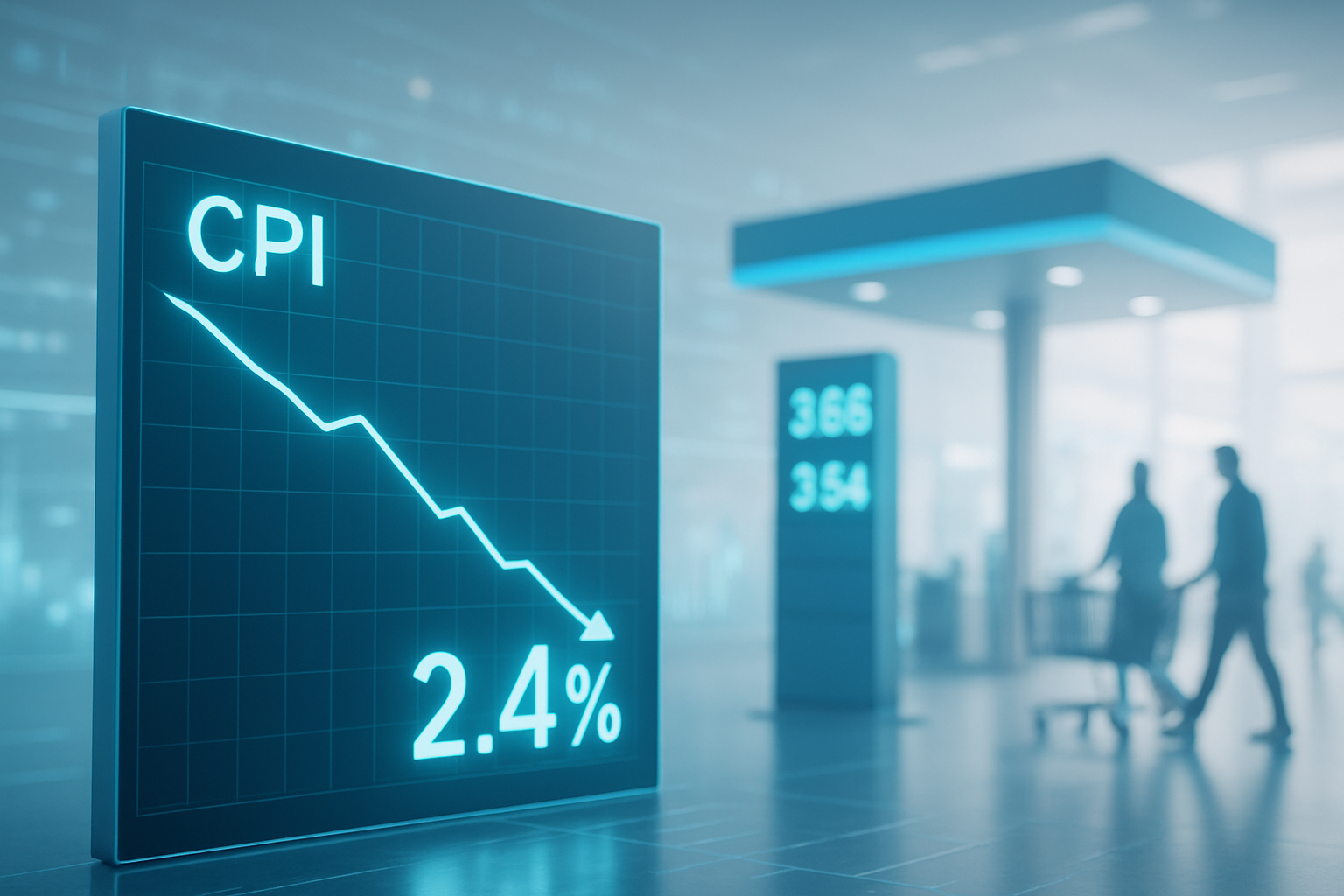
The U.S. economy received a much-needed "Goldilocks" signal this week as the January Consumer Price Index (CPI) report, released on February 13, 2026, showed headline inflation cooling to 2.4%. This figure represents the slowest annual pace of price increases since May 2025, providing a significant relief valve for a market that has spent months grappling with the dual threats of a government shutdown and fears of a resurgent inflationary spiral.
The report highlights a pivotal shift in the macroeconomic landscape, largely driven by a sharp retreat in energy costs that has begun to filter through the broader economy. With headline inflation now inching closer to the Federal Reserve's long-sought 2.0% target, the data is fueling intense speculation regarding the timing of the first interest rate cut of 2026, even as core services remain somewhat sticky.
The January CPI data outperformed consensus expectations of 2.5%, decelerating from the 2.7% reading observed in December 2025. This 2.4% year-over-year print marks a definitive return to the cooling trend that was briefly interrupted by price spikes in the latter half of 2025. On a month-over-month basis, the headline index rose a modest 0.2%, while core CPI—which strips out volatile food and energy components—rose 0.3%, bringing its annual rate to 2.5%, the lowest since early 2021.
The timeline leading to this moment was defined by a volatile 2025, where supply chain hiccups and geopolitical tensions briefly pushed inflation back toward the 3% mark. However, the early weeks of 2026 saw a dramatic reversal in the energy sector. Gasoline prices plummeted 7.5% year-over-year, while heating and fuel oil costs saw a sharp monthly decline of 5.7%. These drops acted as a primary "drag" on the headline number, more than offsetting continued price increases in other categories.
Key stakeholders, including Federal Reserve officials and Wall Street analysts, reacted with cautious optimism. Chicago Fed President Austan Goolsbee signaled that "several" rate cuts remain on the table for 2026 if these trends hold. The immediate market reaction on the day of the release was a "flight to bonds," which saw the 10-year Treasury yield plunge to approximately 4.05%, its lowest level in three months, while the policy-sensitive 2-year yield dropped to 3.41%.
The cooling inflation report created a stark divide between sectors poised to benefit from lower input costs and those struggling with declining commodity values. Among the clear winners were consumer discretionary stocks, which rallied as lower gasoline prices effectively gave American households a "tax cut" at the pump. Rivian Automotive, Inc. (NASDAQ: RIVN) saw its shares jump 26.6% in the wake of the news, as investors bet on increased demand for electric vehicles amidst a more favorable rate environment. Similarly, cruise operators like Carnival Corporation & plc (NYSE: CCL) benefitted from the prospect of lower fuel expenses and higher discretionary spending power for travelers.
On the losing side, the energy sector faced a "sting" from the very same price drops that helped the CPI report. Major players such as Exxon Mobil Corporation (NYSE: XOM) saw pressure on margins as global oil demand forecasts were lowered by the IEA. Furthermore, the technology sector experienced a paradoxical sell-off; despite the lower yields, the Nasdaq Composite slipped 0.22% as "AI exhaustion" and high capital expenditure plans weighed on megacap names. Cisco Systems, Inc. (NASDAQ: CSCO), in particular, suffered a difficult week, falling over 9% following weak guidance that overshadowed the positive macro data.
Financial institutions also faced headwinds, with the sector dropping nearly 2% on the day of the report. Investors are increasingly concerned that the rapid adoption of AI tools could disrupt wealth management and advisory margins at firms like JPMorgan Chase & Co. (NYSE: JPM), a sentiment that outweighed the potential benefits of a more stable inflationary environment. Small-cap stocks, however, found a silver lining; the Russell 2000 index outperformed its larger peers, gaining nearly 2% as the prospect of loosening financial conditions offered a lifeline to smaller, more debt-sensitive companies.
This latest CPI report fits into a broader trend of "disinflationary normalization" that has been the hallmark of the post-pandemic era, albeit with more fits and starts than many anticipated. The 2.4% figure suggests that the aggressive tightening cycle of previous years has finally embedded itself into the supply-side mechanics of the economy. However, the divergence between falling energy prices and rising utility costs—natural gas prices surged 9.8% year-over-year—indicates that the "energy transition" remains a source of structural price volatility.
The ripple effects of this cooling are expected to reach far beyond the gas pump. For competitors in the retail and logistics space, lower fuel costs provide a tailwind for operating margins, potentially ending the cycle of "inflationary surcharges" that defined the 2022–2024 period. Historically, such a sharp drop in headline inflation while the labor market remains resilient has often preceded a "soft landing," a scenario where the Fed successfully tames prices without triggering a deep recession.
Regulatory and policy implications are also coming into focus. With inflation nearing the target, the political pressure on the Federal Reserve to begin easing will likely intensify, especially as the 2026 midterm cycle approaches. Comparisons are already being drawn to the mid-1990s, where a similar calibration of monetary policy allowed for a decade of sustained, non-inflationary growth. However, the "sticky" nature of shelter costs, which rose only 0.2% month-over-month in January but remain high on an annual basis, suggests that the Fed cannot yet declare total victory.
In the short term, the market will likely focus on the Federal Open Market Committee's (FOMC) next move. While the Fed held the benchmark rate at 3.50%–3.75% in January, market futures now price in a 90% probability of a rate cut by June 2026. This potential pivot requires strategic adaptations from corporations, many of whom have spent the last three years hoarding cash and bracing for "higher for longer" rates. We may see a resurgence in mergers and acquisitions as borrowing costs become more predictable.
Scenarios for the remainder of the year vary. If energy prices continue their downward trajectory, headline inflation could briefly touch the 2.0% floor by early summer. Conversely, any geopolitical flare-up that restricts oil supply could quickly reverse these gains, forcing the Fed to maintain its restrictive stance. The "software slump" seen in the tech sector also suggests a looming challenge: companies must now prove that their massive investments in AI can deliver productivity gains that offset the waning power of price increases to drive revenue growth.
Investors should prepare for a market that is increasingly sensitive to "real" economic data rather than just inflationary spikes. The focus is shifting from "how high will prices go?" to "how much growth can we sustain?" As the "inflation bogeyman" recedes, the quality of corporate earnings and the resilience of the consumer will become the primary drivers of equity valuations.
The January CPI report is a watershed moment for the 2026 economic outlook. At 2.4%, inflation has returned to a range that allows for more traditional monetary policy, moving away from the "crisis management" mode that dominated the early 2020s. The primary takeaway is that while the path to 2% is not a straight line, the significant "drag" from energy prices has provided the necessary momentum to push the headline number to its lowest level in nearly a year.
Moving forward, the market appears to be in a transition phase. The "cautious relief" felt by investors signifies a shift in risk appetite, where the benefits of lower inflation are being weighed against the potential for an AI-driven disruption in the tech and financial sectors. The decoupling of the Russell 2000 from the Nasdaq on the day of the report is a clear signal that the "inflation trade" is evolving into a "rate-relief trade."
Investors should keep a close watch on the upcoming February labor data and retail sales figures to see if the cooling inflation is accompanied by a cooling economy or a strengthening one. The "Goldilocks" scenario—low inflation and steady growth—is currently the base case, but as history has shown, the final mile toward the Fed's 2% target is often the most unpredictable.
This content is intended for informational purposes only and is not financial advice