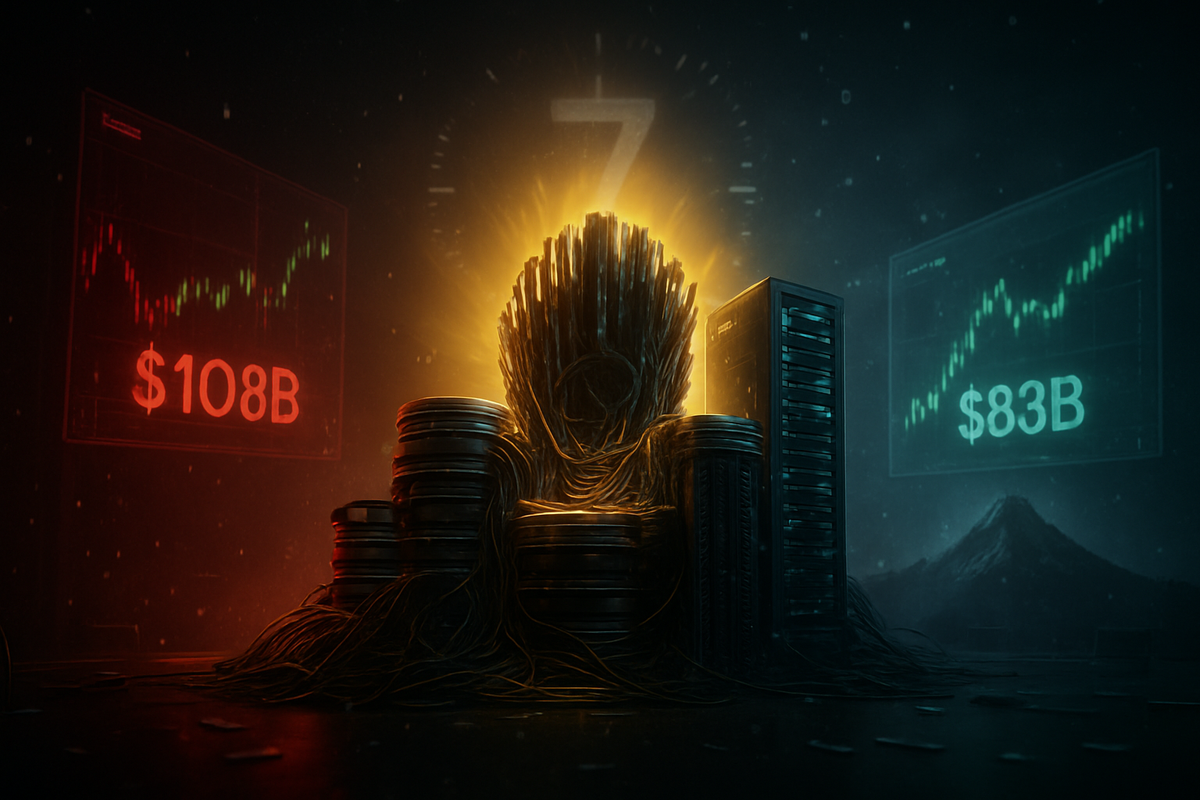
The global media landscape sits on a knife’s edge as of February 18, 2026, with the future of one of Hollywood’s most storied empires hanging in the balance. Paramount Global (NASDAQ: PARA), now bolstered by its merger with Skydance Media, has been granted a critical seven-day window to submit a "best and final" offer to acquire Warner Bros. Discovery (NASDAQ: WBD). This high-stakes ultimatum follows a hostile $108.4 billion counter-bid intended to disrupt an existing $83 billion merger agreement between WBD and Netflix (NASDAQ: NFLX).
The clock is ticking toward a February 23 deadline for Paramount-Skydance to prove that its massive all-cash offer—which includes a commitment to cover a staggering $2.8 billion break fee—is superior to the board-recommended Netflix deal. While the financial gap between the two offers is nearly $25 billion, the WBD board of directors continues to favor the Netflix path, citing a "clearer regulatory trajectory" and a strategic pivot that would spin off the company’s struggling linear television networks into a separate entity.
The $108 Billion Hostile Gamble: A Timeline of Escalation
The current volatility traces back to late 2025, when Netflix shocked the industry by moving away from its traditional "build, don't buy" philosophy to sign a definitive agreement for WBD’s "crown jewels"—its film and TV studios, the DC Universe, and the HBO/Max streaming ecosystem. Under that $82.7 billion deal ($27.75 per share), WBD planned to split, leaving its legacy cable networks like CNN, TNT, and Discovery to form a new company, "Discovery Global." However, the peace was short-lived. In January 2026, David Ellison’s Paramount-Skydance launched a hostile tender offer of $30 per share, valuing the entire company at $108.4 billion and promising to keep the assets whole.
The hostile nature of the Paramount bid has turned this into a personal and financial war of attrition. Paramount-Skydance, backed by a $40 billion equity cushion from Oracle (NYSE: ORCL) founder Larry Ellison and various sovereign wealth funds, argues that the Netflix deal "cannibalizes" the industry by discarding valuable linear cash flows. To sweeten the pot and remove "deal friction," Paramount has pledged to pay the $2.8 billion termination fee WBD would owe Netflix if it breaks the current contract. They have even introduced a "ticking fee" of $0.25 per share per quarter to compensate shareholders for any regulatory delays—a direct jab at the board’s concerns over antitrust scrutiny.
Winners, Losers, and the Future of Content
For shareholders of Warner Bros. Discovery (NASDAQ: WBD), the bidding war is an unexpected windfall. After years of post-merger stock stagnation, the current offers represent a massive premium over the company's mid-2024 valuation. However, the "winner" of this battle faces an arduous path. If Netflix (NASDAQ: NFLX) prevails, it instantly becomes the undisputed king of prestige content, gaining the HBO library and the DC franchise to fuel its global dominance. Conversely, a loss would signal that Netflix's attempt to dominate the "Legacy Hollywood" space has hit a ceiling, potentially cooling investor sentiment toward its expansionist strategy.
Paramount Global (NASDAQ: PARA) stands as the most aggressive player in this drama. A successful acquisition of WBD would create a "mega-major" studio, consolidating two of the "Big Five" Hollywood studios under one roof. While this offers unparalleled scale, it also saddles the combined entity with immense debt and the burden of managing a declining linear television portfolio. Meanwhile, legacy cable employees and executives are watching the March 20 vote with trepidation; a Netflix win likely means a spin-off into a "zombie" company focused on debt repayment, while a Paramount win keeps the networks attached to a major studio but raises significant concerns about redundant roles and aggressive cost-cutting.
A Watershed Moment for Antitrust and Industry Trends
This bidding war is more than just a corporate skirmish; it is a referendum on the future of the American media industry. The WBD board’s preference for Netflix, despite the lower price tag, highlights the terrifying reality of modern antitrust enforcement. Regulators at the DOJ and FTC have historically looked more favorably on "vertical" mergers—like a streamer buying a studio—than "horizontal" mergers where two direct competitors (like Paramount and Warner Bros.) combine. The board fears that a Paramount-WBD merger would be tied up in court for years, whereas the Netflix deal offers a "cleaner" exit strategy.
Furthermore, the battle underscores the "re-bundling" trend of 2026. After years of fragmentation, the market is aggressively consolidating. Netflix's bid to own its production pipeline entirely is a defensive move against the rising costs of licensing, while Paramount’s bid is an offensive move to achieve "too-big-to-fail" status in the eyes of advertisers and cable providers. This mirrors the historical consolidation of the 1990s but with the added complexity of the digital-first era, where tech giants and traditional media companies are finally colliding head-on for total cultural relevance.
The Road to March 20: What Comes Next?
The next seven days will be frantic. Industry insiders expect Paramount-Skydance to potentially raise their bid to $31 or $32 per share to make it legally impossible for the WBD board to ignore the "Superior Proposal" clause. If they do, Netflix will be forced to decide whether to enter a bidding war it never wanted or to take its $2.8 billion "consolation prize" in the form of the break fee and walk away. Analysts suggest Netflix may choose the latter, using the cash to fund a massive internal content push or to target smaller, less complicated acquisitions.
Regardless of the "best and final" outcome this week, all eyes remain fixed on the March 20 shareholder vote. Institutional investors, who hold the majority of WBD’s voting power, are currently torn. They must weigh the immediate $108 billion cash certainty of the Paramount bid against the long-term growth potential of the Netflix-Discovery Global split. If the board continues to recommend Netflix despite a significantly higher Paramount offer, we may see a rise in shareholder derivative lawsuits alleging a breach of fiduciary duty, adding yet another layer of legal drama to the proceedings.
Summary of the High-Stakes Stalemate
The battle for Warner Bros. Discovery is the defining financial event of the mid-2020s. It pits the disruptor (Netflix) against the consolidated establishment (Paramount-Skydance) in a fight for the most valuable IP in the world. Key takeaways for the market include the resilience of "legacy" linear assets as bargaining chips and the unprecedented influence of private equity and tech wealth in traditional media M&A.
For investors, the coming month is a period of maximum uncertainty. Watch for the February 23 deadline for Paramount's final bid and any subsequent response from the WBD board. If the board shifts its recommendation, expect a sharp rally in PARA stock, though WBD may see volatility as the market prices in a longer regulatory timeline. The March 20 vote will ultimately decide whether Hollywood remains a fragmented field of competing giants or moves one step closer to a winner-take-all monopoly.
This content is intended for informational purposes only and is not financial advice.