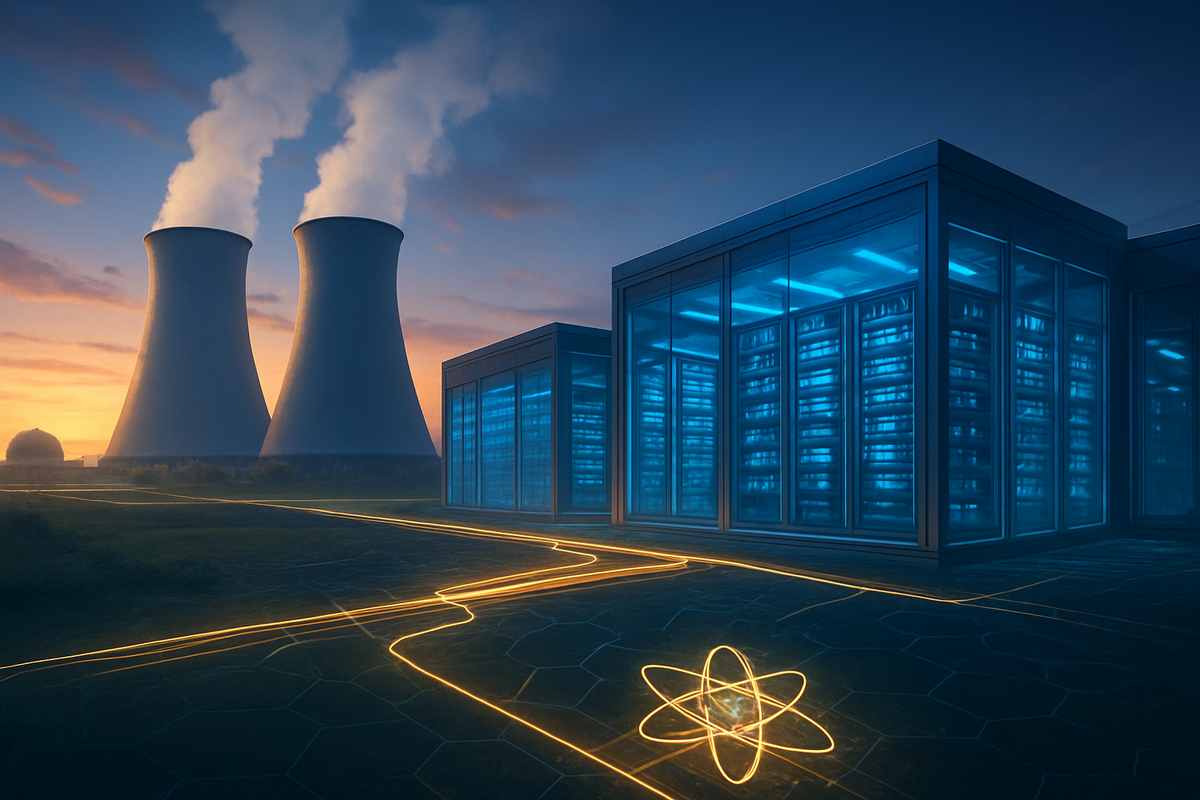
As of February 18, 2026, the global energy landscape is witnessing a historic transformation that many analysts are calling "Nuclear Renaissance 2.0." Once considered a legacy industry burdened by high costs and regulatory hurdles, nuclear power has transitioned into a premium growth sector. This pivot is driven by the insatiable electricity demands of generative artificial intelligence and a geopolitical imperative to secure carbon-free, baseload power.
The immediate implications are visible in the capital markets, where utility and uranium stocks have undergone a fundamental "re-rating." With uranium spot prices hovering near $100 per pound and tech giants signing multi-billion dollar power purchase agreements (PPAs), the sector is no longer just a defensive play. It is now at the heart of the modern industrial strategy, bridging the gap between aggressive decarbonization goals and the reality of a power-hungry digital economy.
The Catalyst: Big Tech and the Policy Tailwinds of 2025
The momentum building behind nuclear energy reached a fever pitch in late 2024 and throughout 2025, sparked by a series of unprecedented corporate and legislative moves. The defining moment occurred when Microsoft Corp (NASDAQ: MSFT) signed a landmark 20-year agreement with Constellation Energy Corp (NASDAQ: CEG) to restart Unit 1 of the Three Mile Island facility, now renamed the Crane Clean Energy Center. This deal signaled to the market that hyperscalers were willing to pay a premium for reliable, 24/7 carbon-free energy to fuel their expanding data center footprints.
Following Microsoft’s lead, Google (NASDAQ: GOOGL) and Amazon.com Inc (NASDAQ: AMZN) quickly entered the fray. Google secured a first-of-its-kind fleet agreement with Kairos Power to deploy Small Modular Reactors (SMRs), while Amazon led a significant $500 million funding round for X-energy. By the time the COP30 summit concluded in late 2025, more than 30 nations had pledged to triple their nuclear capacity by 2050, providing a long-term policy floor for the industry that had been absent for decades.
In the United States, the implementation of the ADVANCE Act has been a game-changer. Signed into law in mid-2024, the Act has successfully streamlined the Nuclear Regulatory Commission’s (NRC) licensing process. As of February 2026, the NRC has fulfilled nearly all its mandates to reduce fees and fast-track the deployment of advanced reactor designs. This regulatory easing has transformed the "Nuclear Renaissance" from a theoretical concept into a tangible pipeline of projects currently moving through the permitting phase.
The reaction from the market has been one of cautious optimism followed by aggressive accumulation. While 2024 saw a speculative surge in stock prices, 2025 and early 2026 have focused on execution. The industry is currently moving from "price discovery" to "implementation," as utilities begin the physical work of plant life extensions and ground-breaking for new modular units.
Identifying the Beneficiaries: From Miners to Operators
The resurgence has created a clear hierarchy of winners in the public markets. Constellation Energy Corp (NASDAQ: CEG) remains the flagship play, benefiting from its position as the largest nuclear operator in the U.S. and its direct ties to AI-driven demand. While the stock has faced some volatility due to regulatory debates over "co-location" fees for data centers, its projected earnings growth for 2026 remains robust at over 20%, fueled by the premium pricing of its nuclear-backed PPAs.
Vistra Corp (NYSE: VST) has emerged as another dominant force, particularly after its massive procurement partnership with Meta Platforms Inc (NASDAQ: META) announced in early 2026. Vistra’s diversified fleet and aggressive share buyback program—totaling over $6.6 billion since 2021—have made it a favorite among institutional investors looking for exposure to the "AI-Energy" nexus. Meanwhile, smaller technology developers like NuScale Power Corp (NYSE: SMR) have seen renewed interest. Although NuScale's stock remains speculative, its recent Final Investment Decision (FID) for a 462 MW project in Romania has provided a much-needed proof-of-concept for SMR commercialization.
On the supply side, the uranium mining sector is grappling with a significant deficit. Cameco Corp (NYSE: CCJ) and Uranium Energy Corp (NYSE: UEC) are the primary beneficiaries of a supply chain that is aggressively decoupling from Russian influence. Since the 2024 ban on Russian enriched uranium, Western utilities have scrambled to secure long-term contracts with North American and Australian producers. Cameco, with its vertically integrated mining and fuel services, is trading near multi-year highs as it captures the spread from both higher spot prices and increased demand for domestic enrichment.
However, the "losers" in this scenario may be the traditional independent power producers that rely heavily on intermittent renewables without adequate storage. As the market shifts its focus to "firm" power, the lack of 24/7 reliability is becoming a financial liability. Furthermore, companies heavily exposed to the Russian fuel cycle that failed to diversify their supply chains before the 2026 quotas kicked in are now facing significantly higher input costs, potentially squeezing their margins in the short term.
A Wider Significance: Decoupling and the AI Power Crisis
The resurgence of nuclear energy is more than just a sector rotation; it represents a fundamental shift in global energy security and industrial policy. Historically, nuclear power was plagued by the "too cheap to meter" promise that failed to materialize, followed by decades of stagnation post-Fukushima. Today, the comparison to the 1970s energy crisis is apt, but with a modern twist: the current crisis is one of "abundance" versus "availability." The world needs an astronomical amount of power for the AI revolution, but it must be carbon-free to meet climate mandates.
This event fits into a broader trend of "techno-nationalism." The race to dominate AI is inextricably linked to the race to dominate the energy sources that power it. By moving away from Russian uranium and investing in domestic SMR technology, Western nations are attempting to build a resilient, independent energy infrastructure. This decoupling is creating ripple effects across the globe, forcing competitors like China—which is currently building more reactors than any other nation—to accelerate their own domestic programs to maintain industrial parity.
Regulatory implications are also stretching beyond the NRC. The Federal Energy Regulatory Commission (FERC) is currently debating how to price "reliability" and "baseload attributes" into wholesale markets. If nuclear power begins to receive a "reliability premium" similar to the subsidies enjoyed by renewables over the last decade, it could lead to a permanent shift in how utilities allocate capital. This would be a historical precedent, moving nuclear from a "last resort" energy source to a "first choice" strategic asset.
What Comes Next: The SMR Milestone and Fuel Security
Looking toward the remainder of 2026 and into 2027, the short-term focus will be on the "restart" milestones. The industry is watching the Crane Clean Energy Center closely; if Constellation can bring the plant back online ahead of its 2027 target, it will validate the "restart" strategy as a viable way to add capacity quickly. Simultaneously, the first commercial-scale SMR deployments will undergo rigorous testing. The success or failure of these early modular units will determine whether the industry can truly break the "mega-project" curse of being perpetually over budget and behind schedule.
A strategic pivot is also required in the fuel cycle. The US Department of Energy has allocated billions to rebuild domestic High-Assay Low-Enriched Uranium (HALEU) capacity, which is essential for advanced reactors. In the long term, the emergence of a robust, Western-aligned enrichment industry will be the ultimate "de-risking" event for the sector. Investors should expect a surge in partnerships between mining companies and tech firms as they seek to vertically integrate their energy supply chains, potentially leading to more direct investments in mining assets by non-energy companies.
Scenarios for 2027 and beyond include a potential "gold rush" for retired nuclear sites and a massive wave of consolidation among SMR startups. If the regulatory environment continues to favor nuclear, we may see "nuclear-only" zones established for AI data centers, where the proximity to the power source eliminates the need for expensive grid upgrades. Conversely, the primary challenge remains the supply of skilled labor and the physical constraints of uranium production, which could act as a ceiling on growth if not addressed by mid-decade.
Market Outlook and Final Thoughts
The resurgence of nuclear energy is no longer a forecast; it is an active market reality. The combination of Big Tech’s massive balance sheets and a global policy shift toward energy independence has created a perfect storm for the sector. The key takeaway for investors is that the "nuclear trade" has evolved from a commodity-based bet on uranium prices to a sophisticated play on the future of global infrastructure and artificial intelligence.
Moving forward, the market is likely to remain volatile as it digests the high capital expenditures required for these projects. However, the secular trend is undeniably upward. The entry of hyperscalers as "anchor tenants" for new nuclear capacity has fundamentally changed the risk-reward profile, providing the long-term revenue certainty that traditional utilities lacked. This is a foundational shift that will likely define the energy markets for the next twenty years.
In the coming months, investors should watch for three key indicators: the progress of the Three Mile Island restart, any further legislative updates regarding "co-location" regulations, and the stabilization of uranium production from Kazakhstan. As the world enters this new atomic age, the companies that successfully navigate the complexities of the fuel cycle and regulatory landscape will be the ones that power the digital economy of the future.
This content is intended for informational purposes only and is not financial advice.