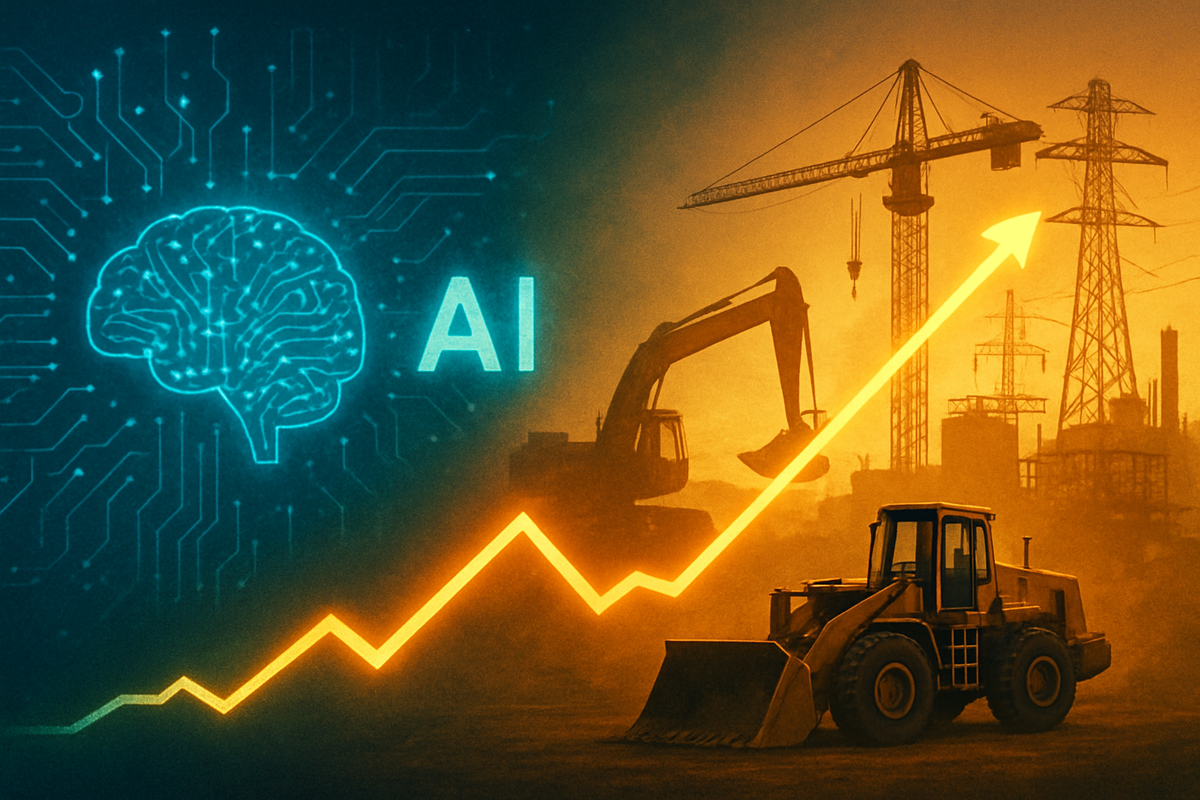
NEW YORK — The financial landscape is undergoing a tectonic shift as of February 18, 2026, with the "Great Valuation Rotation" reaching a fever pitch. After years of dominance by high-flying technology giants, a combination of cooling macroeconomic data and a sudden reassessment of artificial intelligence (AI) capital expenditures has triggered a massive migration of capital toward value-oriented sectors. Investors are increasingly favoring the "physical economy"—Industrials, Energy, and Consumer Staples—over the speculative growth multiples that defined the previous biennium.
The immediate implications are stark: while the tech-heavy indexes have stalled, the S&P 500 Equal Weight Index (RSP) is significantly outperforming its market-cap-weighted counterpart. This divergence suggests a healthier, albeit more volatile, broadening of market participation. As of today, the Cboe Volatility Index (VIX) has surged to a year-to-date high of 22.96, reflecting a "Warsh Shock" in interest rate expectations and a fundamental questioning of the return on investment for the hundreds of billions spent on AI infrastructure.
The Catalyst: A Hawkish Pause and the ‘DeepSeek’ Disruption
The rotation gained momentum following the Federal Reserve’s January 27–28 meeting, where the FOMC voted to hold the federal funds rate steady at 3.50%–3.75%. This "hawkish pause" signaled that the easing cycle seen in late 2025 has hit a plateau, as inflation remains "sticky" at 2.7%. The shift in sentiment was further accelerated in early February by a technological breakthrough dubbed the "DeepSeek Shock," which demonstrated that high-performance AI models could be trained at a fraction of the cost previously projected. This discovery sent shockwaves through the hardware sector, leading investors to question the longevity of the triple-digit growth once promised by semiconductor titans.
Simultaneously, the labor market has shown signs of cooling, with the unemployment rate trending higher even as GDP growth moderates to a 1.5%–2.6% range. This "late-cycle" environment has historically favored defensive and value sectors. By mid-February, the divergence was undeniable: the Vanguard Value Index Fund (VTV) had climbed 8.5% year-to-date, while the Vanguard Growth Index Fund (VUG) slumped 4.7% over the same period. The market's focus has shifted from the "builders" of the digital age to the "users" and the infrastructure that powers them.
Winners and Losers: From Silicon to Steel
The clear winners in this new regime are companies with tangible assets and reliable cash flows. Caterpillar Inc. (NYSE: CAT) hit 52-week highs this week, bolstered by a record $51 billion backlog driven by global demand for data center construction and power generation. Similarly, NextEra Energy, Inc. (NYSE: NEE) has emerged as a primary beneficiary of the "Power Bottleneck" narrative, as the massive electricity requirements of the AI era have turned utilities into growth-adjacent infrastructure plays. In the retail space, Walmart Inc. (NYSE: WMT) recently joined the exclusive $1 trillion market cap club, as its scale and defensive posture attracted investors fleeing tech volatility.
Conversely, the "Magnificent Seven" have faced a harsh reality check. Microsoft Corporation (NASDAQ: MSFT) saw its shares drop nearly 12% post-earnings despite strong cloud growth, as investors balked at a $37.5 billion quarterly bill for AI hardware. NVIDIA Corporation (NASDAQ: NVDA), the former undisputed market leader, has entered a period of consolidation as the market reassesses the ROI of the "AI build-out" phase. Even the financial sector saw mixed results; while JPMorgan Chase & Co. (NYSE: JPM) reported record net income, its stock faced an "expense shock" after the bank projected that 2026 AI automation costs would push total expenses to over $105 billion.
Analyzing the Shift: The ‘Physical Reality’ Trend
This event fits into a broader industry trend where the "Implementation Phase" of technology is superseding the "Build Phase." The market is moving away from purely digital growth and toward the physical constraints of the real world—energy, materials, and logistics. This mirrors the post-dot-com bubble era of 2000-2001, where value stocks outperformed as investors prioritized current earnings over future promises. The "DeepSeek Shock" has only exacerbated this, suggesting that the competitive moat for hardware might be shallower than previously believed, thus de-risking the "Old Economy" sectors.
There are also significant regulatory and policy implications. With inflation remaining above the Fed’s 2% target, fiscal spending on infrastructure and domestic manufacturing is under increased scrutiny. However, this same spending acts as a tailwind for industrial giants. Competitors in the energy sector, such as Exxon Mobil Corporation (NYSE: XOM) and Chevron Corporation (NYSE: CVX), are benefiting from a "flight to yield," with Chevron recently announcing a 4% dividend hike. These companies are now being viewed not just as cyclical plays, but as critical energy providers for a power-hungry digital world.
The Outlook: A Soft Landing or a Value Trap?
In the short term, the market remains on edge ahead of the March 17-18 Fed meeting. If the Fed maintains its hawkish stance, the rotation into value could intensify, potentially pushing the S&P 500 to new heights even as individual tech names flounder. However, some analysts warn that value sectors like Consumer Staples and Energy are becoming "extremely overbought" on a tactical basis. A strategic pivot may be required for investors who have been underweight in these sectors for years, as the "average" stock is finally catching up to the tech leaders.
Long-term scenarios suggest two possibilities: a "soft landing" where the rotation creates a more balanced and resilient market, or a broader slowdown where the cooling macro data eventually weighs on all sectors. The key will be whether the "AI users" in the industrial and service sectors can successfully translate their high-tech investments into margin expansion. Market opportunities are likely to emerge in "forgotten" sectors like mid-cap value and international markets, which have remained relatively cheap compared to US large-cap growth.
Wrap-Up: The New Market Equilibrium
The events leading up to February 18, 2026, represent a fundamental re-calibration of risk and reward. The "Great Valuation Rotation" has demonstrated that even the most powerful technological trends must eventually answer to the laws of macroeconomic gravity and fiscal reality. Key takeaways include the resilience of "Old Economy" giants like Procter & Gamble Co. (NYSE: PG) and the emergence of Utilities as a critical component of the AI ecosystem.
Moving forward, the market appears to be diversifying away from its tech-dependency. For investors, the coming months will require a watchful eye on the Fed’s next move and the Q1 2026 earnings reports from the industrial and energy sectors. The era of "growth at any price" has ended, replaced by a market that values tangible cash flows, dividend growth, and the physical infrastructure that sustains the global economy.
This content is intended for informational purposes only and is not financial advice.
MarketMinute Editorial Team February 18, 2026
Tags: #MarketRotation #ValueStocks #BigTech #MacroEconomy #FederalReserve #AI #EnergySector #IndustrialGrowth