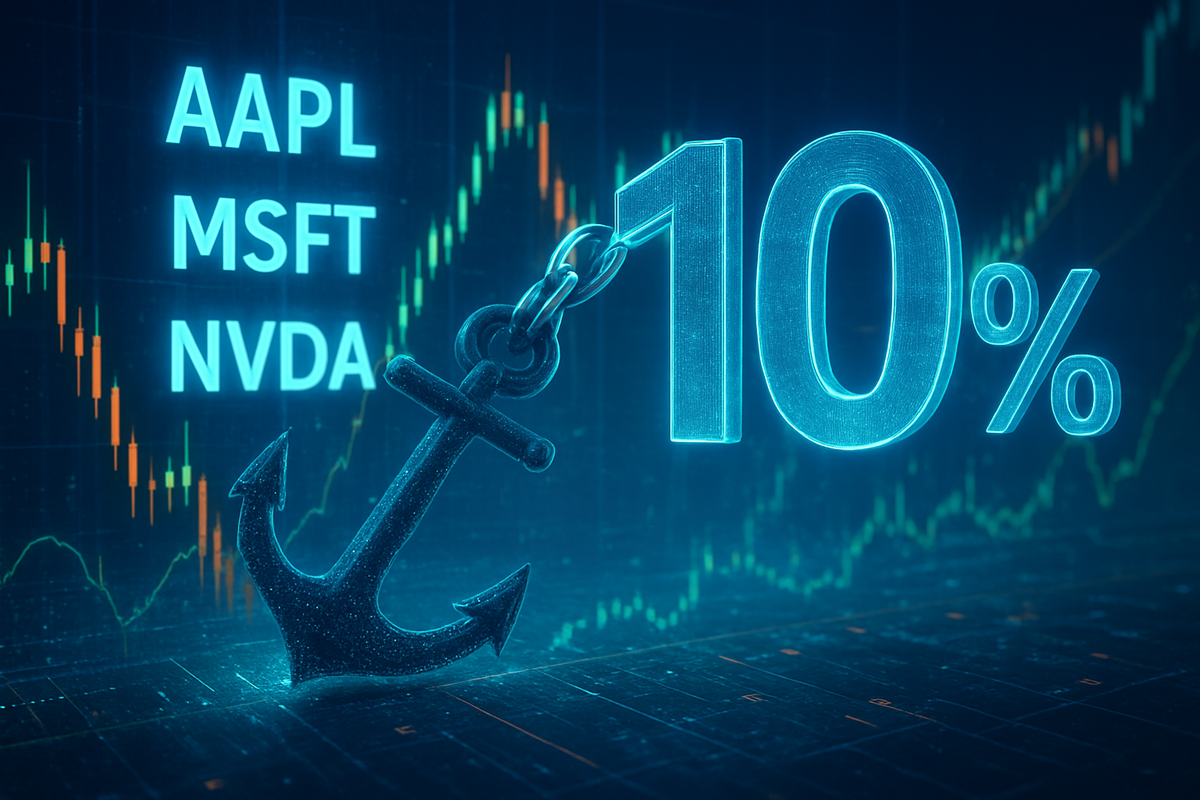
As of mid-February 2026, the financial markets find themselves in a delicate tug-of-war between resilient economic growth and the gravitational pull of the bond market. The 10-year Treasury yield, often referred to as the "world's most important interest rate," has become the primary arbiter of value for the technology-heavy Nasdaq Composite. After a volatile start to the year, the yield has settled into a range of 4.03% to 4.08%, providing a precarious "anchor" for high-growth stocks that have spent the last two years navigating a "higher-for-longer" interest rate environment.
The immediate implications are clear: the era of "easy money" valuation expansion is over, replaced by a regime where every basis point move in the Treasury market sends ripples through the valuations of the world’s largest companies. For investors in the Nasdaq, the current stabilization of yields represents a much-needed reprieve following a sharp January spike to 4.31%, which was driven by renewed concerns over tariff-driven inflation and a surprisingly robust labor market. As the market processes these developments, the relationship between the "risk-free" return on government debt and the projected earnings of Silicon Valley has never been more scrutinized.
The January Spike and the Path to the "Great Anchoring"
The current market landscape is the result of a tumultuous eighteen-month journey that began in late 2024. At that time, despite the Federal Reserve initiating short-term rate cuts, long-term yields experienced a "bear steepening," surging from 3.6% in September 2024 to over 4.5% by the end of that year. This phenomenon, driven by an increase in the "term premium"—the extra yield investors demand for holding long-duration debt—forced a painful re-rating of the Nasdaq-100. Throughout 2025, yields peaked near 5.0% as the market grappled with resilient economic data and shifting fiscal policies, before eventually receding to the 4.2% level by late 2025.
The timeline leading into February 18, 2026, was marked by a brief but intense period of "yield anxiety" in early January. Geopolitical tensions and rhetoric regarding new trade tariffs caused the 10-year yield to jump to 4.31% in a matter of days, leading to a sharp 5% correction in growth-oriented indices. However, the subsequent "insurance cuts" by the Federal Reserve and a cooling of inflationary fears have brought the 10-year back down to its current 4.05% neighborhood. This stabilization, which many analysts are calling "The Great Anchoring," has allowed tech giants and AI infrastructure providers to find their footing, though the market remains hypersensitive to any deviation from this range.
Winners and Losers in a 4% Yield World
In this environment, the impact of Treasury yields is not felt equally across the Nasdaq. Companies with high "rate sensitivity," particularly those whose valuations are predicated on aggressive future growth rather than current dividends, have been the primary victims of yield spikes. Tesla, Inc. (NASDAQ: TSLA) remains one of the most vulnerable, with a high beta to rates due to its heavy reliance on consumer financing for vehicle purchases and its long-duration growth story. Similarly, Super Micro Computer, Inc. (NASDAQ: SMCI), which saw explosive gains during the AI boom, has exhibited nearly 99% sensitivity to yield movements, as investors quickly discount its future cash flows when the risk-free rate rises.
Conversely, some "Big Tech" stalwarts have managed to "outrun" the negative impact of yields through sheer earnings power. Nvidia Corp. (NASDAQ: NVDA) continues to lead this group; even as yields topped 4.5% in late 2024 and fluctuated through 2025, Nvidia’s massive triple-digit revenue growth provided a buffer that justified its premium valuation. Giants like Apple Inc. (NASDAQ: AAPL) and Microsoft Corp. (NASDAQ: MSFT) have increasingly been viewed as "tech safe havens." While they still face multiple compression when yields rise, their massive cash reserves—often exceeding the GDP of small nations—allow them to benefit from higher interest income on their balance sheets, partially offsetting the valuation pressure. Meanwhile, companies like Amazon.com, Inc. (NASDAQ: AMZN) and Meta Platforms, Inc. (NASDAQ: META) have been forced into a period of disciplined capital expenditure, prioritizing high-ROI AI projects over speculative "moonshots" to satisfy a market that now demands a higher hurdle rate.
The DCF Mechanism and the Broader Valuation Shift
The mathematical pressure exerted by the 10-year Treasury yield is rooted in the Discounted Cash Flow (DCF) model, the gold standard for valuing growth stocks. In a DCF model, the "Net Present Value" (NPV) of a company is determined by discounting its future earnings back to the present day using a discount rate. Because this rate is closely tied to the 10-year yield, an increase in yields leads to an exponential decrease in the present value of earnings scheduled for 10, 15, or 20 years in the future. For the Nasdaq, which is dominated by "long-duration" assets, this means that even a small uptick in the 10-year yield can wipe out billions in market capitalization overnight.
This event fits into a broader industry trend of "valuation normalization." The 2020-2021 era of near-zero rates is now a distant memory, and the market has adjusted to a reality where the "hurdle rate"—the minimum return an investor requires to take on the risk of an equity investment—is substantially higher. This shift has also impacted the broader competitive landscape; venture capital and private equity firms have slowed their deployments, as the cost of capital for startups has skyrocketed in tandem with Treasury yields. This has effectively raised the barrier to entry for potential disruptors, inadvertently strengthening the moats of established incumbents who can self-fund their growth.
The 2026-2027 Outlook: What Lies Ahead
Looking forward into the remainder of 2026 and early 2027, the primary question for investors is whether the 10-year yield has truly found a permanent ceiling. Most market forecasts suggest the 10-year yield will drift toward 3.8% by early 2027, provided that inflation remains contained and the Federal Reserve continues its path of gradual normalization. If this downward drift occurs, it could serve as a powerful catalyst for a "catch-up" rally in the broader Nasdaq, particularly for mid-cap software and cybersecurity firms like Palo Alto Networks, Inc. (NASDAQ: PANW), which have historically traded inversely to yield trends.
However, the risk of a "second wave" of inflation remains a potential spoiler. If trade tensions escalate or if domestic productivity gains from AI fail to offset rising labor costs, yields could easily re-test the 4.5% to 5.0% levels seen in late 2024 and 2025. Such a scenario would likely trigger a strategic pivot for many tech firms, leading to further rounds of cost-cutting and a renewed focus on "efficiency" over "growth at all costs." Investors must remain vigilant for any signs of a "term premium" spike, which could occur if global buyers of U.S. debt demand higher returns to compensate for increasing fiscal deficits.
Final Assessment: Navigating the New Normal
The 10-year Treasury yield is no longer just a background metric; it is the central nervous system of the equity markets in 2026. The "Great Anchoring" around the 4% level has provided a floor for the Nasdaq, but it is a floor made of glass. For the high-growth technology sector to maintain its momentum, it must continue to deliver earnings growth that can outpace the high "hurdle rate" set by the bond market. The era where a rising tide of liquidity lifted all boats has been replaced by a "stock picker's market," where the distinction between companies with real cash flow and those with mere promises is laid bare by the math of interest rates.
Moving forward, investors should keep a close eye on monthly CPI reports and Federal Reserve commentary for any shifts in the "neutral rate" of interest. The stability of the 10-year yield is the single most important factor for Nasdaq valuations in the coming months. If the "yield anchor" holds, the technology sector could see a sustained expansion as AI investments begin to yield tangible productivity gains. If it breaks, the market may find itself in for another season of valuation volatility.
This content is intended for informational purposes only and is not financial advice.