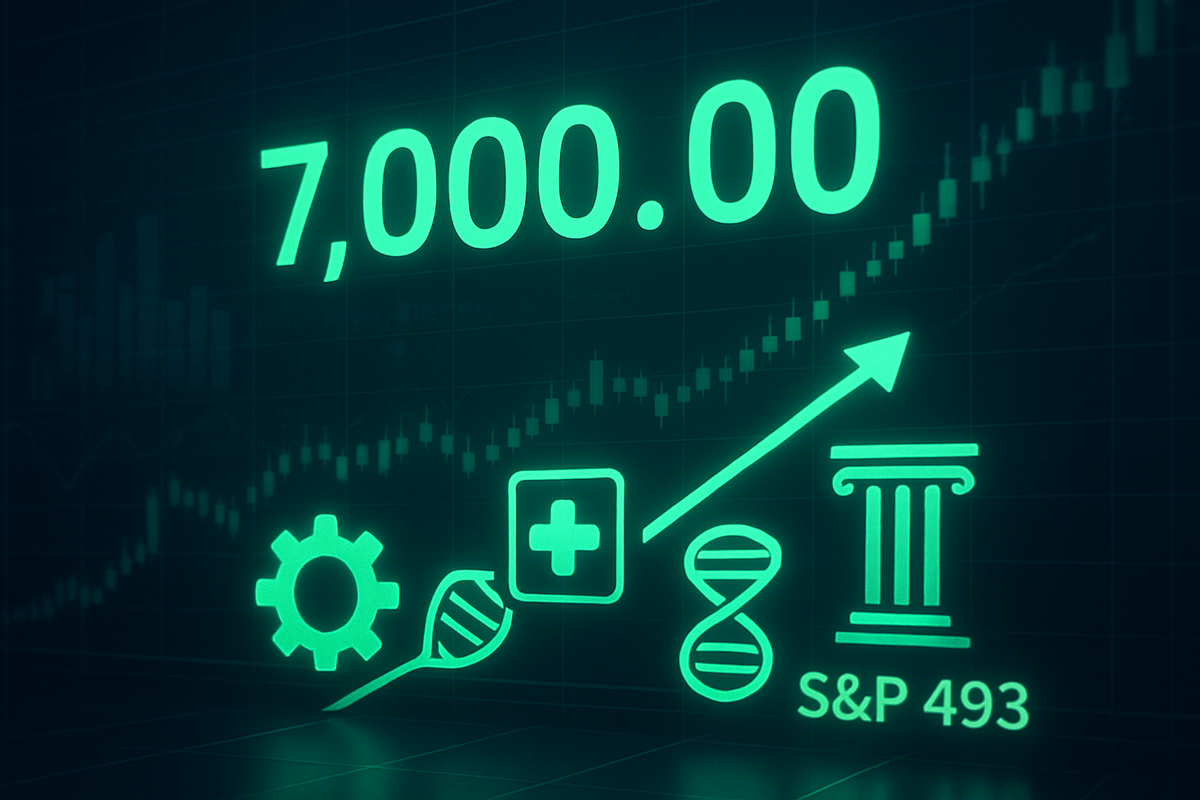
The era of the "two-speed" stock market, defined by a handful of tech titans dragging a sluggish index behind them, has officially come to a close. On January 28, 2026, the S&P 500 reached a historic milestone, breaching the 7,000-point threshold for the first time in history. While the move was once predicted to be the result of continued hyper-growth from the largest technology firms, the reality of the 7,000-point market is far more nuanced. This rally is no longer just about Silicon Valley; it is about the "Great Convergence," a structural shift where the earnings growth of the "S&P 493"—the remaining 493 companies in the index—has finally caught up with the high-flying "Magnificent Seven."
This broadening of market leadership represents a critical de-risking of the U.S. equity markets. For years, investors worried that the concentration of wealth in a few mega-cap stocks created a fragile "house of cards" scenario. However, as of February 2024, that narrative has flipped. The market is now witnessing a "universal participation" phase, where AI-driven productivity gains are filtering down into industrials, financials, and healthcare, allowing the broader index to carry the weight that was previously reserved for a select few.
The Breach of 7,000: A Timeline of the Broadened Rally
The journey to S&P 7,000 was marked by a rapid acceleration in late 2025, a mere 14 months after the index first crossed the 6,000 mark in November 2024. The official breach occurred during intraday trading on January 28, 2026, when the index hit a peak of 7,002.28. This surge was catalyzed by a "blockbuster" fourth-quarter 2025 earnings season, which proved that the massive capital expenditures (CapEx) in artificial intelligence over the previous two years were finally yielding tangible bottom-line results for non-technology sectors.
The timeline leading to this moment was shaped by significant legislative and monetary shifts. In July 2025, the passage of the Omnibus Balanced Budget and Business Act (OBBBA) provided sweeping tax incentives for domestic industrial expansion and power infrastructure. This coincided with a pivot in Federal Reserve policy, as expectations for rate cuts in mid-2026 began to take hold. Investors, sensing a more favorable environment for borrowing and capital-intensive projects, began rotating out of overextended tech valuations and into the cyclical sectors of the "real economy."
By the time the index hit 7,000, the "earnings chasm" that defined 2023 and 2024 had effectively vanished. In 2024, the earnings growth gap between the Magnificent Seven and the S&P 493 was a staggering 30 percentage points. By the close of Q4 2025, that gap narrowed significantly: while the Magnificent Seven’s growth "normalized" into the 11% to 15% range, the S&P 493 saw its aggregate earnings growth accelerate to 9%, up from near-zero levels just two years prior.
The New Market Hierarchy: Winners and Losers of the Pivot
The primary beneficiaries of this convergence have been the "old guard" of American industry and healthcare. Caterpillar Inc. (NYSE: CAT) and GE Vernova (NYSE: GEV) have emerged as the new engines of growth, as they provide the physical infrastructure—power generation, construction equipment, and grid technology—required for the ongoing global data center buildout. Caterpillar recently projected a 15% earnings-per-share growth for 2026, a figure that rivals some of the largest software companies but at a significantly lower valuation multiple.
The financial sector has also seen a resurgence, led by giants like JPMorgan Chase & Co. (NYSE: JPM) and Bank of America Corp (NYSE: BAC). A stable interest rate environment and a rebounding manufacturing sector have supported robust loan growth and a return of capital market activity. Furthermore, the healthcare sector, represented by the Health Care Select Sector SPDR Fund (NYSEARCA:XLV), has been dubbed the market’s "new crown jewel." De-risking of drug pricing regulations and the integration of generative AI into drug discovery have shortened clinical trial timelines by nearly 30%, fueling a 10% surge in the sector in the first seven weeks of 2026 alone.
Conversely, the "Magnificent Seven"—comprised of Apple Inc. (NASDAQ: AAPL), Microsoft Corp (NASDAQ: MSFT), Alphabet Inc. (NASDAQ: GOOGL), Amazon.com Inc. (NASDAQ: AMZN), Meta Platforms Inc. (NASDAQ: META), NVIDIA Corporation (NASDAQ: NVDA), and Tesla Inc. (NASDAQ: TSLA)—have faced a more challenging landscape. While NVIDIA and Microsoft remain essential "picks and shovels" providers for the AI era, their growth rates have naturally decelerated from the triple-digit explosions of 2023. Tesla, in particular, has faced headwinds, reporting its first-ever annual revenue decline in late 2025 as it struggles to pivot its narrative from electric vehicles toward robotics and autonomous software.
The Shift to Phase 2: AI as a Productivity Tool
The significance of the 7,000 milestone lies in what analysts call "AI Phase 2." While Phase 1 was dominated by the hardware and chip providers like NVIDIA, Phase 2 is characterized by the application of that technology across the broader economy. We are no longer simply building the AI; we are using it to cut costs, optimize supply chains, and improve margins in sectors that were previously thought to be technologically stagnant. This shift has allowed the S&P 493 to "capture the baton" of market leadership.
Historically, periods of extreme market concentration—such as the "Nifty Fifty" era of the 1960s or the Dot-com bubble of the late 1990s—ended in painful corrections for the leading stocks. However, the 2026 convergence appears to be a "soft landing" for market breadth. Rather than a total collapse of the tech titans, we are seeing a valuation compression where the price-to-earnings (P/E) multiples of the Magnificent Seven (which averaged 31x in late 2025) are contracting toward the more modest 20x average of the S&P 493.
This trend is reinforced by regulatory and policy implications. Increased scrutiny of Big Tech’s data practices and the passage of the OBBBA have redirected capital toward domestic manufacturing and infrastructure. As Bank of America’s Chief Equity Strategist Savita Subramanian recently noted, the market is shifting from a "consumption-driven" model to a "capital-expenditure-heavy" model, favoring those who build physical assets over those who simply provide digital services.
Looking Ahead: The Path to 8,000
The short-term outlook remains bullish as the rotation into value and cyclical stocks continues to provide a "rolling recovery." Analysts at Oppenheimer & Co. Inc. (NYSE: OPY) have already raised their 2026 year-end target for the S&P 500 to 8,100, citing the AI supercycle's continued impact on productivity. However, this path is not without challenges. Investors must now adapt to a market where "buying the dip" on a single tech name is no longer a guaranteed winning strategy. Strategic pivots will be required, with a greater focus on sector-specific expertise and the ability to identify companies that are successfully integrating AI into their operations.
One potential scenario is the emergence of new "mini-clusters" of growth. Instead of a single "Magnificent Seven," we may see the rise of "The Power Five" in the energy and industrial sectors or "The Bio-Tech Big Three." The market is becoming more fragmented, and while this requires more diligent research from investors, it also creates a more resilient overall ecosystem. The biggest challenge for 2026 will be navigating the transition as the Federal Reserve eventually moves toward rate cuts, which could either supercharge the industrial rally or reignite inflation concerns.
Summary: A More Balanced Bull Market
The breach of S&P 7,000 and the Great Convergence of 2026 mark a turning point in financial history. The market has moved past its reliance on a narrow set of technology companies, evolving into a more balanced and diversified bull market. The key takeaway for investors is that the "S&P 493" is no longer the "laggard" of the index; it is now the primary driver of earnings growth and market stability.
As we move forward, the focus will remain on the sustainability of this breadth. Investors should watch for continued margin expansion in the industrial and healthcare sectors, as well as the ability of Big Tech to maintain its cash flow in the face of decelerating growth. While the Magnificent Seven will likely remain integral to the global economy, their days of monolithic dominance over the stock market are behind us. The market has finally reached a state of "universal participation," and at 7,000, it looks stronger—and more stable—than it has in years.
This content is intended for informational purposes only and is not financial advice.