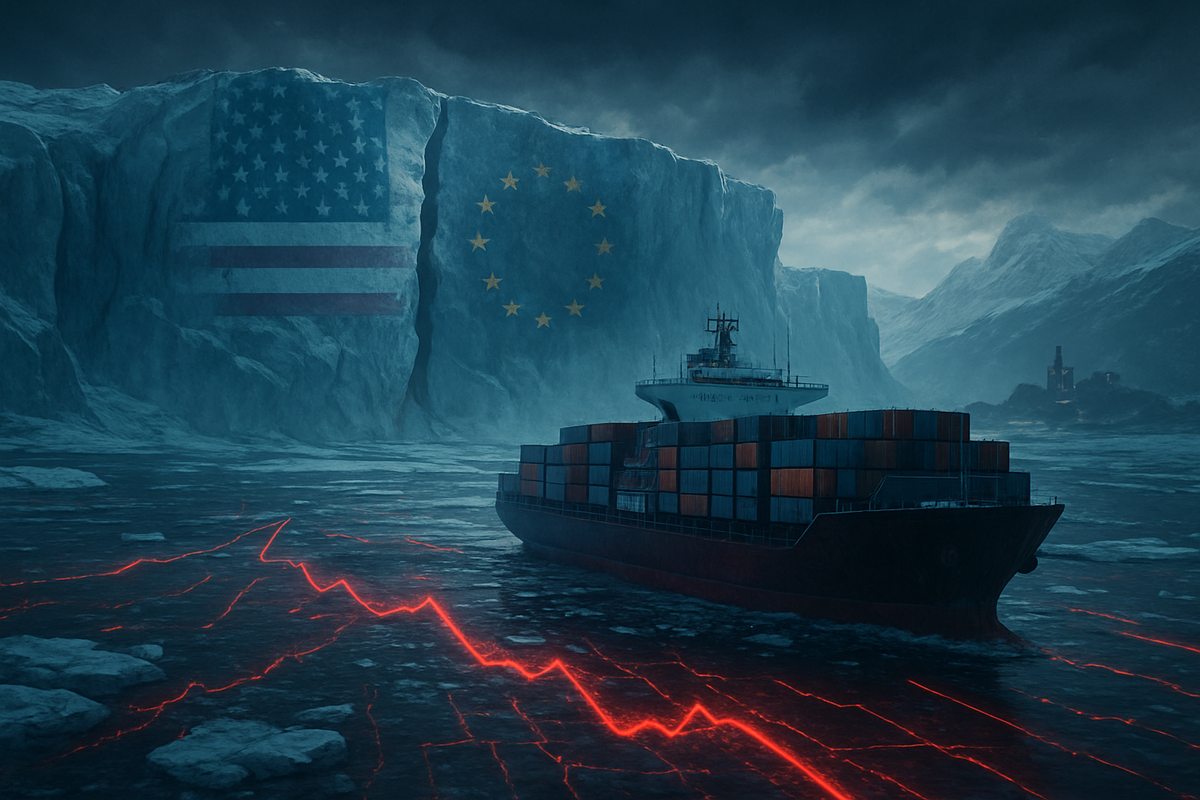
The geopolitical landscape was rocked in early 2026 by the so-called "Greenland Episode," a diplomatic and economic confrontation that has pushed the relationship between the United States and the European Union to its lowest point in decades. What began as a renewed U.S. strategic interest in the Arctic territory of Greenland—culminating in a formal purchase ultimatum in mid-January—has rapidly devolved into a high-stakes trade war. The fallout has already led to the suspension of major transatlantic trade frameworks and the implementation of significant tariffs, sending shockwaves through global markets and complicating the inflation outlook for central banks on both sides of the Atlantic.
The immediate implications are stark: supply chains already strained by post-pandemic restructuring are now facing a new era of "resource imperialism." By targeting the vast, untapped critical mineral reserves of Greenland, the U.S. has forced a defensive posture from the EU and Denmark, leading to a "trade bazooka" retaliation. For investors, this has meant a sudden pivot away from integrated global growth stocks toward speculative resource plays, all while the specter of "sticky inflation" reappears, threatening to keep interest rates higher for much longer than previously forecasted.
The Timeline of the Arctic Ultimatum
The crisis reached a boiling point on January 17, 2026, when the U.S. administration issued a formal ultimatum to the Danish government and its European allies. Citing urgent national security concerns and the necessity of securing the Arctic against Russian and Chinese influence, the U.S. demanded the "complete and total purchase" of Greenland. The timing was calculated to exploit Greenland’s recently confirmed reserves of rare earth elements, specifically neodymium and praseodymium, which are vital for the burgeoning AI and green energy industries.
The European response was swift and unyielding. On January 19, 2026, the European Parliament labeled the move an act of "resource imperialism" and immediately suspended the July 2025 Transatlantic Trade Framework. This framework had previously provided a stable roadmap for lowering tariffs on automotive and industrial goods. By January 21, the EU announced a retaliatory package worth €93 billion ($107.7 billion) in tariffs targeting American technology and agricultural exports.
The situation escalated further on February 1, 2026, when the U.S. implemented a 10% import duty on goods from eight key European nations, including Denmark, Germany, and France. The administration has threatened to increase these duties to 25% by June if a "joint-operating agreement" for Greenland’s minerals is not reached. While a brief pause in rhetoric occurred during the Davos Summit in late January, the underlying tension remains unresolved as of early February 2026, with both regions entrenched in their respective positions.
Key stakeholders in this dispute extend beyond government officials. The Greenlandic government has asserted its autonomy, stating that the island is "not for sale," while NATO Secretary General Mark Rutte has been forced into a difficult balancing act, trying to maintain military cohesion in the North Atlantic while its two largest economic pillars engage in a trade brawl. The market reaction has been one of extreme volatility, with the VIX "fear gauge" spiking 22% in the last two weeks as traders price in the cost of a prolonged trade disruption.
Winners and Losers: From Critical Minerals to Automotive Giants
In the wake of the Greenland Episode, the mining sector has emerged as a primary beneficiary of the geopolitical friction. Critical Metals Corp (NASDAQ: CRML) has seen its stock price surge over 150% as speculative interest grows in its Tanbreez project, which holds one of the world's largest rare earth deposits. Similarly, MP Materials (NYSE: MP), the leading U.S. rare earth producer, has seen increased valuation as the U.S. government looks to bolster domestic and "friendly" supply chains to reduce reliance on the European-controlled Arctic.
Conversely, the European automotive industry is facing a severe headwind. German automakers, which rely heavily on the U.S. market, are reeling from the new 10% tariffs. BMW (OTCMKTS: BMWYY) has already issued a profit warning, estimating that the Greenland-related trade barriers could hit its 2026 earnings by as much as $1.1 billion. Volkswagen (OTCMKTS: VWAGY) and Mercedes-Benz (OTCMKTS: MBGYY) are also seeing significant sell-offs, as the suspension of the 2025 trade framework removes the legal certainty they had banked on for their electric vehicle rollout in North America.
The energy sector presents a more complex picture. While European majors like Equinor (NYSE: EQNR) and TotalEnergies (NYSE: TTE) have seen minor stock declines due to fears of slowing global demand, U.S.-based LNG providers like Venture Global and Cheniere Energy (NYSE: LNG) have remained resilient. These companies are viewed as essential to European energy security, making them unlikely targets for EU retaliatory tariffs, though the general atmospheric tension has weighed on long-term infrastructure investment sentiment.
Industrial conglomerates are also feeling the squeeze. 3M (NYSE: MMM) recently estimated that the new tariff regime could add $30 million to $40 million in monthly costs, while GE Aerospace (NYSE: GE) is monitoring the situation closely for impacts on its European manufacturing partnerships. The common thread among the "losers" is a reliance on seamless transatlantic logistics, which the Greenland Episode has effectively dismantled overnight.
Resource Nationalism and the Return of Sticky Inflation
The Greenland Episode is not merely a diplomatic spat; it represents a significant acceleration of the "resource nationalism" trend that has been building since the early 2020s. By moving to secure Greenland's mineral wealth, the U.S. is signaling that the era of open-market procurement for critical materials is ending, replaced by a "strategic acquisition" model. This shift mirrors historical precedents like the 19th-century "Scramble for Africa," but modernized for the AI and semiconductor age.
The most profound economic consequence of this shift is the emergence of "sticky inflation." For most of 2025, central banks had hoped that price pressures would normalize; however, the new 10% to 25% tariffs act as a structural floor for prices. In the U.S., core inflation remains stubborn at 3.2% year-over-year, while European services inflation is hovering near 4.5%. With trade barriers increasing the cost of raw materials and finished goods, the Federal Reserve and the European Central Bank (ECB) are unlikely to pivot to the interest rate cuts that markets had expected in the first half of 2026.
Furthermore, this event highlights a growing rift in the regulatory landscape. The EU's "trade bazooka" approach suggests a more combative European Commission, willing to use its internal market as a weapon. This could lead to a decoupling of standards and regulations, forcing multinational companies to maintain two distinct supply chains—one for the U.S. sphere and one for the EU—further driving up operational costs and contributing to the inflationary cycle.
Scenarios for the Arctic Standoff
Looking ahead to the remainder of 2026, the market faces two primary scenarios. The first is a "Strategic Pivot," where the U.S. and Denmark agree to a joint-venture mineral extraction framework that allows the U.S. access to resources without a formal change in sovereignty. This would likely involve a de-escalation of tariffs and a restoration of the 2025 trade deals. Such an outcome would spark a massive relief rally in European equities and provide the necessary conditions for inflation to finally cool.
The second, more volatile scenario is a "Prolonged Trade Winter." If the U.S. proceeds with the 25% tariff hike scheduled for June, the EU has indicated it will target U.S. tech giants with a digital services tax that could cost billions. In this environment, companies would be forced to accelerate "near-shoring" and "friend-shoring" initiatives. This would create opportunities for emerging markets outside the US-EU friction zone but would ultimately result in a lower-growth, higher-inflation global economy for the next several years.
Strategic adaptations are already underway. Many companies are beginning to stockpile critical components, anticipating that the "Greenland tariffs" could remain in place for the foreseeable future. Investors should watch for a shift toward "inflation-proof" assets, such as commodities and high-margin luxury goods, which are less sensitive to the incremental costs of trade barriers than mass-market industrial products.
Conclusion: A New Era of Transatlantic Friction
The Greenland Episode has fundamentally altered the calculus for global trade. The transition from a partnership based on shared democratic values to one defined by competition over strategic resources marks a turning point in the post-WWII order. As of February 6, 2026, the immediate threat of a full-scale economic decoupling remains high, with the "trade bazooka" and mineral ultimatums serving as the primary drivers of market sentiment.
For investors, the key takeaway is that "sticky inflation" is no longer a theoretical risk but a present reality fueled by geopolitical policy. The persistence of trade barriers means that the high-interest-rate environment is likely to endure, favoring companies with strong balance sheets and direct access to raw materials over those reliant on complex, cross-border assembly lines.
In the coming months, the focus will shift to the June tariff deadline and any potential diplomatic breakthroughs in the Arctic Council. Until then, the "Arctic Chill" will likely continue to frost transatlantic relations, requiring a cautious and diversified approach to the markets. Watch the mining sector for signs of further resource-driven speculation and the automotive sector for early indicators of how deeply the trade war is cutting into global corporate earnings.
This content is intended for informational purposes only and is not financial advice.