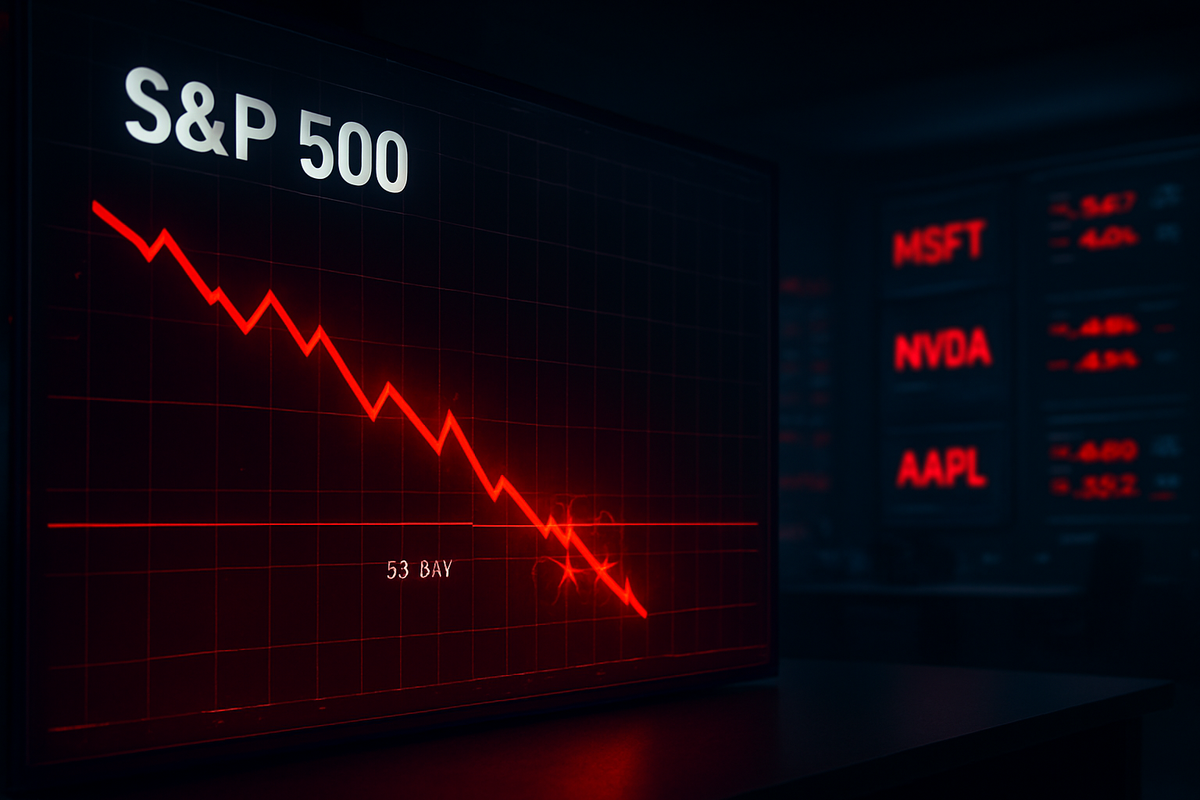
The optimistic start to 2026 has been abruptly halted as the S&P 500 index officially turned red for the year during a volatile trading session on February 6, 2026. After a promising January that saw the index climb 1.4%, a brutal three-day rout has wiped out nearly $1 trillion in market capitalization. This sudden reversal has sent shockwaves through Wall Street, as the benchmark index breached its critical 50-day moving average—a technical floor that had largely held firm since the closing months of 2025.
The sell-off represents the most significant period of wealth destruction in the equity markets since the mid-2024 correction. Driven by a combination of disappointing earnings in the "Mag 7" cohort and a hawkish shift in the Federal Reserve’s leadership, the downturn has forced institutional desks to aggressively deleverage. As investors digest the reality of a "negative YTD" screen, the market sentiment has pivoted from "buying the dip" to a frantic search for defensive havens.
The Breach of the 50-Day Floor and the 'Software-mageddon' Catalyst
The technical breakdown began in earnest earlier this week when the S&P 500 failed to maintain its support at the 50-day moving average, a move that triggered a wave of programmatic selling from quantitative hedge funds. The descent was accelerated by what traders are calling "Software-mageddon"—a massive repricing of the software and services sub-sector. Fears that advanced agentic AI tools from startups like Anthropic are beginning to cannibalize the revenue streams of established enterprise giants led to a localized $1 trillion loss in that sector alone before bleeding into the broader index.
The timeline of the collapse can be traced back to the final week of January, when major "hyperscalers" like Amazon.com Inc. (NASDAQ: AMZN) and Alphabet Inc. (NASDAQ: GOOGL) reported massive capital expenditure (CAPEX) increases that were not immediately met with the anticipated growth in cloud AI revenue. By February 3, the narrative shifted from AI-driven expansion to "CAPEX fatigue." When January's labor market data arrived on February 5, showing the highest level of monthly layoffs since 2009—over 108,000 jobs lost—the market's appetite for risk vanished entirely.
Stakeholders are now closely watching the CBOE Volatility Index (VIX), which has spiked to its highest levels of 2026. The reaction from the retail sector has been particularly sharp; brokerage platforms reported record-breaking outflows as the index dipped below the psychological "zero line" for the year. This synchronized bearish momentum has been further exacerbated by margin calls in the tech-heavy Nasdaq 100, which has seen even steeper declines than the broader S&P 500.
The Titans in Turmoil: Winners and Losers of the 2026 Correction
The primary victims of this market purge have been the former darlings of the AI boom. Microsoft Corp. (NASDAQ: MSFT) has entered a technical bear market, closing more than 27% below its October 2025 peak. Investors have begun to question whether Microsoft’s multi-billion dollar investments in OpenAI will yield the productivity gains required to justify its premium valuation, especially as its core Office suite faces potential disruption from decentralized AI agents. Similarly, Nvidia Corp. (NASDAQ: NVDA), which reached a staggering $4.5 trillion market cap in late 2025, saw its shares plummet toward its own 50-day moving average as institutional investors locked in gains to cover losses elsewhere.
Apple Inc. (NASDAQ: AAPL) has also faced a reckoning, with retail investors pulling over $4 billion in net outflows in the first week of February. The market’s skepticism regarding Apple’s "asset-light" AI strategy has intensified, with critics arguing that the company lacks the proprietary infrastructure to compete with more aggressive rivals. This perceived loss of "tech exceptionalism" has made Apple a primary target for short-sellers and defensive rotators.
Conversely, the "losers" of the tech trade have created a narrow class of "relative winners" in the defensive sectors. As capital fled the high-growth Nasdaq, it found a temporary home in consumer staples and traditional value plays. The Coca-Cola Company (NYSE: KO) and other low-beta stocks have outperformed the broader index on a relative basis, as fund managers seek to hide in companies with predictable cash flows and dividends. However, even these defensive havens have felt the gravity of the $1 trillion market cap evaporation, proving that few assets are truly immune when liquidity is being pulled from the system.
A Hawkish Pivot and Geopolitical Headwinds
The wider significance of this correction cannot be overstated, as it coincides with a fundamental shift in U.S. monetary policy. The nomination of Kevin Warsh to succeed Jerome Powell as Federal Reserve Chair has signaled a return to an "orthodox" inflation-fighting stance. Warsh’s known hawkish leanings have immediately adjusted market expectations toward "higher for longer" interest rates, deflating the speculative trades that had fueled much of the 2025 rally. This monetary tightening is occurring just as the U.S. Treasury pulls significant liquidity from the market to replenish the Treasury General Account (TGA).
Adding fuel to the fire is a deteriorating geopolitical landscape. Reports of "Operation Midnight Hammer," a targeted military action against Iranian nuclear facilities, sent Brent crude prices surging by 6% to over $72 per barrel. This energy price spike has revived fears of a second wave of inflation, potentially trapping the Fed in a position where they must keep rates high despite a weakening labor market. Historically, the combination of a hawkish Fed pivot, rising energy costs, and a breach of the 50-day moving average has often preceded a secular shift in market leadership.
The current event echoes the market turbulence of early 2022, where a similar "red start" to the year preceded a prolonged bear market. However, the scale of the 2026 correction is amplified by the sheer size of the companies involved. When trillion-dollar entities move by 5% or 10% in a week, the ripple effects through the global economy and retirement accounts are profound. This isn't just a technical correction; it is a test of the structural integrity of a market that has become increasingly concentrated in a handful of AI-driven names.
Navigating the 'Dead Cat Bounce' or a Deeper Dive?
In the short term, technical analysts are looking for a "dead cat bounce" as the index becomes oversold. Strategic pivots will be required from both retail and institutional investors; the "AI at any price" strategy of the last two years appears to be officially dead. Markets may see a rotation toward "AI pragmatism," where companies that provide actual, measurable cost-savings through automation are favored over those merely selling the hardware or the "hype" of the technology.
The primary challenge moving forward will be the "liquidity drain" scheduled for the remainder of Q1 2026. If the S&P 500 cannot reclaim its 50-day moving average within the next two weeks, the 200-day moving average becomes the next logical target, representing a significantly deeper correction. Potential scenarios include a "sideways grind" as the market awaits more clarity on the Warsh-led Fed, or a more systemic decline if the geopolitical situation in the Middle East escalates into a broader regional conflict.
Final Thoughts: The Market's New Reality
The events of early February 2026 serve as a stark reminder that market momentum is a fragile thing. The wiping out of $1 trillion in market cap in mere days has reminded a new generation of investors that "red for the year" is more than just a color on a screen—it is a signal of shifting economic tides. The breach of the 50-day moving average is the final technical confirmation that the trend has changed, and the "Software-mageddon" sell-off may just be the first chapter in a more rigorous valuation of the AI era.
As we move forward, investors should watch the Federal Reserve’s upcoming policy meetings and the price of oil with equal intensity. The era of easy gains driven by liquidity and AI promises has faced its first true challenge of 2026. Whether this is a healthy correction or the start of a prolonged downturn will depend on the resilience of the U.S. consumer and the ability of the tech titans to prove their value in a high-rate, high-risk world.
This content is intended for informational purposes only and is not financial advice.