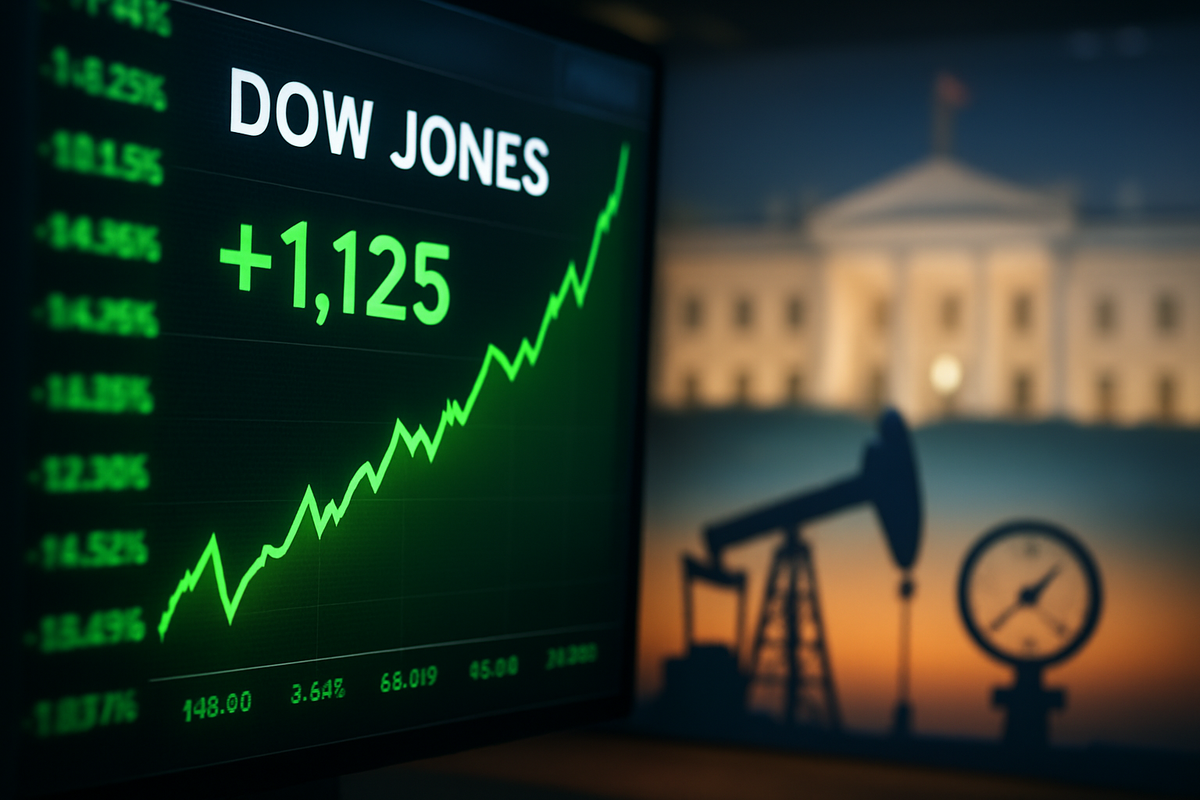
NEW YORK — U.S. equity markets witnessed a stunning reversal on Tuesday, March 10, 2026, as investors pivoted from geopolitical panic to a full-throttle "relief rally." The catalyst for the turnaround was a series of afternoon comments from President Donald Trump, who suggested that the intensifying conflict with Iran could reach a resolution "very soon." The prospect of a diplomatic breakthrough sent shockwaves through the energy markets, causing crude oil prices to collapse from their recent highs and providing a much-needed tailwind for a broad spectrum of domestic equities.
The market's reaction was swift and decisive. After an opening session defined by deep uncertainty and safe-haven buying, the major indices pivoted sharply upward following the President’s remarks. This shift underscores the market’s extreme sensitivity to energy costs and Middle Eastern stability, as the threat of a prolonged conflict had previously stoked fears of a 1970s-style stagflationary environment. With oil prices retreating, the narrative on Wall Street has shifted from "crisis management" to "recovery positioning" in a matter of hours.
A Tale of Two Sessions: The 1,125-Point Swing
The trading day began under a cloud of volatility, with the Dow Jones Industrial Average (INDEXDJX:.DJI) initially plunging as news of escalated skirmishes in the Persian Gulf reached the floor. However, the momentum shifted entirely when President Trump, speaking from the White House, indicated that backchannel negotiations were yielding "significant progress" and that the hostilities could conclude much faster than analysts had anticipated. Following these comments, the Dow staged a massive 1,125-point intraday swing, eventually closing up 0.5% at 47,740.
The broader markets mirrored this optimism. The S&P 500 (INDEXSP:.INX) and the tech-heavy Nasdaq Composite (INDEXNASDAQ: .IXIC) both finished in positive territory, clawing back losses sustained earlier in the week. The most dramatic move occurred in the commodities pits, where global benchmarks Brent Crude and West Texas Intermediate (WTI) saw their steepest one-day declines in months. Brent fell below the psychologically significant $100 mark, while WTI plummeted beneath $90 per barrel. This retreat in energy costs acted as a release valve for a market that had been pricing in a "worst-case scenario" for global supply chains.
Energy Retreat Creates New Winners and Losers
The sudden cooling of the "war premium" in oil prices has created a starkly divided landscape for public companies. For the integrated energy giants, the rally is a double-edged sword. ExxonMobil (NYSE: XOM) and Chevron (NYSE: CVX), which had been trading near multi-year highs due to the supply squeeze, saw their shares temper as the prospect of $150 oil evaporated. While these companies remain highly profitable—with break-even points in the Permian Basin far below current levels—investors began rotating out of the energy sector and back into growth-oriented names that benefit from lower overhead.
Conversely, the transportation and retail sectors emerged as the day's primary beneficiaries. Airlines, which are notoriously sensitive to jet fuel costs, saw a massive surge in buying activity. Delta Air Lines (NYSE: DAL) and United Airlines (NASDAQ: UAL) both saw gains exceeding 3% as the threat to their 2026 earnings guidance began to fade. Similarly, retail heavyweights like Walmart (NYSE: WMT) and Target (NYSE: TGT) closed higher, as lower prices at the pump act as an effective "tax cut" for the American consumer, freeing up discretionary income for household spending.
Shifting the Macroeconomic Narrative
This event marks a potential turning point in the broader 2026 economic outlook. Before today’s rally, the prevailing market sentiment was one of "defensive hunker-down," with many institutional investors bracing for a "Stagflationary Slump" driven by high energy costs and stalled global trade. The President's hint at a "very soon" resolution has revived the "Disinflationary Growth" narrative that characterized the early part of the year. This shift fits into a broader trend of markets prioritizing geopolitical stability over the "windfall gains" seen in specific commodity-linked sectors.
The ripple effects of this de-escalation extend beyond the U.S. borders. A stabilized Middle East ensures the continued flow of commerce through the Strait of Hormuz, a critical artery for global trade. Historically, periods of rapid oil price spikes followed by sharp retreats—similar to the patterns seen in 1991 and 2008—often lead to a period of consolidation where the Federal Reserve has more "breathing room" to manage interest rates without the immediate pressure of skyrocketing energy-induced inflation.
Looking Ahead: The Path to 50,000
In the short term, market participants will be looking for concrete evidence that the President’s "very soon" timeline is more than just rhetoric. Any sign of a formal ceasefire or a diplomatic summit will likely act as the fuel needed to push the Dow toward the elusive 50,000 milestone. However, the market remains "headline-sensitive," and any reversal in the diplomatic tone could see a return of the volatility that characterized the morning's early trading. Strategic pivots may be required for fund managers who over-indexed into defensive energy positions during the initial weeks of the conflict.
The long-term scenario hinges on whether the global energy market can return to its fundamental balance. Analysts suggest that if oil prices remain below the $90–$100 range, it could stimulate a broader economic expansion throughout the remainder of 2026. The key challenge for investors will be navigating the transition from a "war-footing" portfolio to one geared toward sustained growth. Market opportunities are likely to emerge in sectors like technology and consumer discretionary, which were disproportionately punished during the recent energy spike.
Closing Thoughts for the Modern Investor
The events of March 10, 2026, serve as a potent reminder of the stock market’s ability to "climb a wall of worry." The 1,125-point swing in the Dow is a testament to the influence of presidential communication on global liquidity and investor confidence. While the threat of conflict in the Middle East has not entirely vanished, the market has clearly signaled its preference for peace and the lower energy costs that come with it. The return of the Dow to the 47,740 level suggests that the underlying fundamentals of the U.S. economy remain resilient, provided they are not choked by excessive oil prices.
Moving forward, investors should keep a close eye on weekly EIA petroleum status reports and any further diplomatic communiqués from the White House. The "energy tax" on the U.S. consumer has been momentarily lifted, but the permanence of this relief remains to be seen. For now, Wall Street is content to celebrate the reprieve, even as it keeps one eye on the geopolitical horizon.
This content is intended for informational purposes only and is not financial advice.