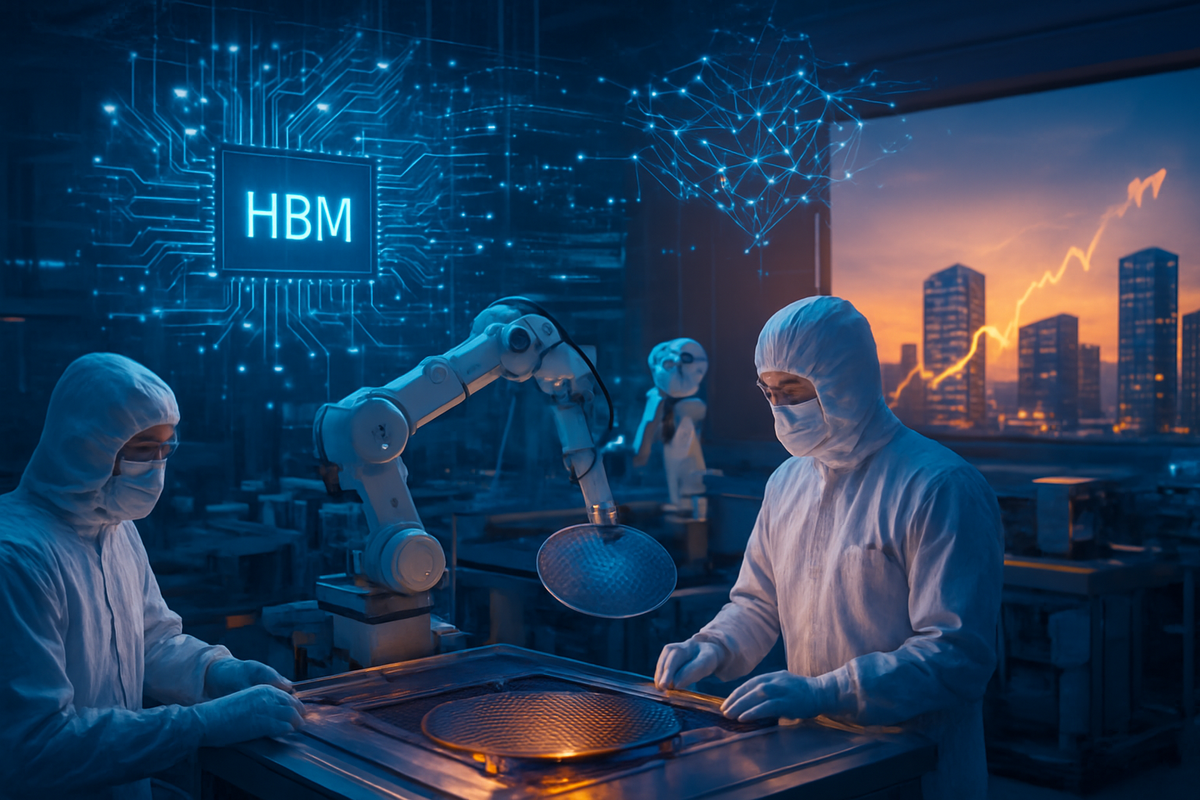
In a move that underscores the relentless demand for high-performance artificial intelligence (AI) infrastructure, Micron Technology (NASDAQ: MU) has officially finalized the acquisition of a major manufacturing facility in Taiwan from Powerchip Semiconductor Manufacturing Corporation (TWSE: 6770). The $1.8 billion deal for the P5 facility in Tongluo, Miaoli County, marks a critical pivot for Micron as it aggressively scales its production of High Bandwidth Memory (HBM) and next-generation DRAM to meet a market that is essentially sold out through the end of the year.
The acquisition comes at a fever-pitch moment for the company’s valuation. Ahead of its fiscal second-quarter earnings report scheduled for March 18, 2026, Wall Street analysts have turned exceptionally bullish. Most notably, Wedbush Securities has catapulted its price target for Micron to a staggering $500, citing a "generational inflection point" in memory pricing and a supply-demand imbalance that favors Micron’s premium HBM3E and HBM4 product lines. With revenue guidance sitting at a record $18.7 billion for the quarter, the industry is witnessing Micron’s transition from a cyclical commodity player to a structural pillar of the global AI economy.
Detailed Coverage of the Powerchip Acquisition
The acquisition of the P5 facility is more than just a real estate transaction; it is a strategic land grab in the heart of the world’s most advanced semiconductor ecosystem. Located just 15 miles from Micron’s existing "mega campus" in Taichung, the Tongluo site provides 300,000 square feet of high-grade 300mm cleanroom space. Micron has already begun the process of retrofitting the facility with extreme ultraviolet (EUV) lithography equipment, intended to manufacture HBM3E and the upcoming HBM4 chips.
The timeline for this expansion is aggressive but necessary. While the deal closed in mid-March 2026, Micron intends to have the first wafers of advanced DRAM coming off the line by early fiscal 2028. Furthermore, the company has already greenlit a second phase for the site, which will add another 270,000 square feet of capacity. This "Taiwan DRAM Center of Excellence" is intended to give Micron a vertically integrated edge, allowing them to control the manufacturing process from silicon to the sophisticated stacking required for HBM modules.
Industry reaction to the deal has been overwhelmingly positive. Analysts note that by acquiring an existing facility rather than building a greenfield site from scratch, Micron has shaved at least 12 to 18 months off its capacity expansion timeline. This is vital because, according to internal company reports, Micron’s HBM capacity is already completely booked through the remainder of 2026, with orders now stretching deep into 2027.
Winners and Losers in the Memory Supercycle
Micron Technology is the primary winner in this scenario. By securing the P5 facility, they are effectively locking out competitors from a prime piece of Taiwanese manufacturing real estate and talent. The massive $18.7 billion revenue guidance—nearly triple what the company reported in the same quarter two years ago—suggests that Micron is successfully capturing the lion's share of the premium AI memory market. Investors who followed the Wedbush upgrade are seeing their conviction rewarded as the stock approaches the $500 mark.
On the other side of the ledger, competitors like SK Hynix (KRX: 000660) and Samsung Electronics (KRX: 005930) face intensifying pressure. While SK Hynix was an early leader in the HBM space, Micron’s rapid expansion in Taiwan threatens their market share. Samsung, meanwhile, has struggled with yield issues on its latest HBM generations; Micron’s seamless acquisition and scaling could leave Samsung playing catch-up in the high-margin server DRAM segment for several quarters.
Furthermore, NVIDIA (NASDAQ: NVDA) and other AI chipmakers stand to benefit as "winners" because a more robust HBM supply chain reduces the bottleneck for their H100 and Blackwell-series GPUs. However, the sheer cost of this memory—which Wedbush estimates has seen pricing inflation of 30% to 50% in early 2026—means that the "losers" might ultimately be the tier-two cloud providers and enterprise customers who are forced to pay exorbitant premiums for AI hardware as Micron and its peers exercise immense pricing power.
Broad Industry Significance and Historical Context
The current state of the memory market represents a departure from historical norms. Historically, the semiconductor memory industry was notoriously cyclical—booms in demand led to oversupply, which crashed prices in a "bust" phase. However, the AI revolution has introduced a structural shift. HBM requires significantly more wafer capacity than standard DDR5 memory (often a 3:1 ratio), meaning that even as fab capacity increases, the net "bit growth" remains constrained. This "structural undersupply" is what is driving the $500 price targets and record-breaking revenue figures.
This event also highlights the growing geopolitical importance of Taiwan. Despite efforts by the U.S. government to move manufacturing stateside via the CHIPS Act, Micron’s decision to double down on Taiwan underscores the region's unmatched infrastructure and engineering expertise. It reflects a reality where the "Silicon Shield" of Taiwan remains the central nervous system of the global tech industry, even as companies diversify their geographical footprints.
Comparing this to the 2017-2018 memory boom, the current environment is far more concentrated. In the past, the boom was driven by general cloud computing and smartphones. Today, the demand is concentrated in the highest-value segment of the market—AI data centers. This concentration allows Micron to achieve non-GAAP earnings per share (EPS) of $8.42, a figure that would have been unthinkable during previous cycles.
The Road Ahead: What to Watch
In the short term, all eyes are on the March 18 earnings call. Investors will be looking for confirmation that the $18.7 billion revenue guidance is not just a peak, but a new baseline. Any commentary regarding the yield rates of HBM4 at the newly acquired Tongluo site will be scrutinized, as that technology will define the competitive landscape for the late 2020s.
Long-term, the challenge for Micron will be managing this massive capital expenditure. The $1.8 billion for the PSMC site is just the beginning; the cost of outfitting those cleanrooms with the latest lithography tools will run into the billions more. Micron must balance this aggressive growth with the risk of an eventual cooling in AI capital expenditures. However, with the industry sold out through 2026, that "cooling" seems years away. The next strategic pivot may involve further integration of "Processing-in-Memory" (PIM) technologies, where the memory chip itself handles some AI calculations, further blurring the lines between storage and processing.
Conclusion and Investor Takeaways
Micron Technology’s acquisition of the PSMC facility and the subsequent bullishness from firms like Wedbush signal a new era for the semiconductor industry. The company has successfully navigated the transition from a supplier of commodity PC components to a critical provider of the most sought-after hardware in the world. The $18.7 billion revenue target and the $500 price projection are testaments to the sheer scale of the AI infrastructure build-out.
Moving forward, investors should closely monitor memory contract prices and any shifts in the HBM roadmap. While the current momentum is undeniably positive, the high stakes of the $1.8 billion Taiwan expansion mean that execution is paramount. If Micron can successfully integrate the P5 site and maintain its technological lead in HBM4, it will likely remain the gold standard for growth in the semiconductor sector. For now, the "Sold Out" sign on Micron's order book is the most important metric for the market to consider.
This content is intended for informational purposes only and is not financial advice.