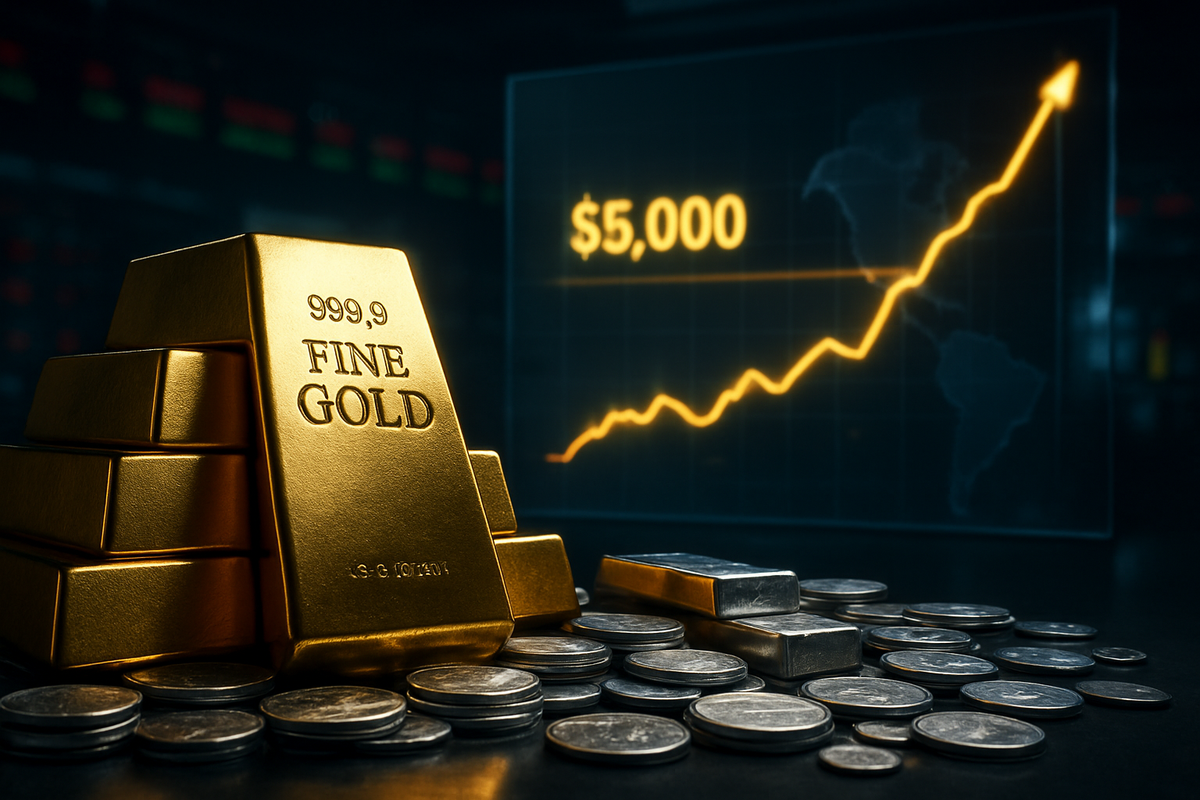
In a historic moment for global financial markets, gold prices have firmly established a new floor above the psychological $5,000 per ounce mark this week, while silver continues its relentless climb toward $90, currently trading at approximately $85. As of March 18, 2026, the precious metals sector is experiencing an unprecedented surge, driven by a volatile cocktail of geopolitical instability and a fundamental shift in how global central banks perceive the U.S. dollar. The "yellow metal" has officially transitioned from a defensive asset to the cornerstone of a new multipolar monetary regime.
The current market environment is defined by a high-stakes "tug-of-war" between record-breaking safe-haven demand and a surprisingly resilient, albeit rebounding, U.S. dollar. While the greenback has attempted to claw back ground on the back of rising Treasury yields, the sheer intensity of the current geopolitical crisis has rendered traditional currency strength secondary to the safety of hard assets. Investors across the globe are currently in a state of "strategic waiting," holding their breath as they weigh imminent inflation data against the escalating risks of a broader systemic conflict.
A Ten-Day Tsunami: The Path to $5,000 Gold
The march toward $5,000 began in earnest ten days ago, following a sharp escalation in Middle Eastern hostilities that has now entered its second week of high-intensity conflict. What started as a regional flare-up has evolved into a standoff involving major global powers, threatening key energy transit routes and pushing Brent Crude oil prices comfortably above $115 per barrel. This energy shock acted as the primary catalyst for gold’s final sprint from $4,200 to the current $5,000 level, as traders factored in the "double-whammy" of geopolitical risk and cost-push inflation.
Leading up to this milestone, the market witnessed a structural shift throughout 2025. Central banks, led by those in Poland, China, and India, moved away from U.S. Treasuries at a record pace, purchasing a combined 900 tons of gold in the last calendar year alone. This "de-dollarization" trend provided an unshakeable floor for prices, allowing the current crisis to act as a springboard rather than a temporary spike. By the time the conflict reached its tenth day on March 18, the breach of $5,000 was no longer viewed as a fluke, but as a reflection of a devalued global currency landscape.
Initial reactions on the trading floors in London and New York were characterized by frantic covering of short positions and a massive rotation out of high-growth tech stocks into commodities. The physical market has also seen extreme tightness; silver, in particular, has seen its premiums reach 30% over spot prices in some jurisdictions. This "silver squeeze" is being exacerbated by its dual role as a monetary metal and a critical industrial component in the burgeoning AI and green energy sectors, leading to the current $85 valuation.
Mining Giants Reap the Rewards of the 'Super-Margin' Era
The primary beneficiaries of this price explosion are the major mining houses, which are now operating with profit margins that were unthinkable only two years ago. Newmont Corporation (NYSE: NEM) has emerged as a clear leader, reporting record free cash flow as its All-In Sustaining Costs (AISC) remain disciplined around $1,550 per ounce. With gold at $5,000, Newmont is essentially generating a gross margin of nearly 70% per ounce, a figure that has allowed the company to announce a massive special dividend and an aggressive share buyback program.
Similarly, Barrick Gold Corporation (NYSE: GOLD) has seen its stock price double since the start of the year. The company’s focus on "Tier One" assets—mines that produce more than 500,000 ounces of gold annually at low costs—has positioned it perfectly to capitalize on the $5,000 gold environment. Meanwhile, Agnico Eagle Mines Limited (NYSE: AEM) is being rewarded by investors for its low-risk jurisdictional profile, with its operations primarily based in Canada and Finland. As geopolitical risks mount, the premium on "safe" mining jurisdictions has widened the valuation gap between Agnico and its peers with exposure to more volatile regions.
On the silver side, First Majestic Silver Corp. (NYSE: AG) and Pan American Silver Corp. (NYSE: PAAS) have become the darlings of the retail and institutional sectors alike. Pan American Silver, following its successful integration of MAG Silver assets in 2025, is now on track to produce over 26 million ounces of silver annually. With silver at $85, the company's leverage to the metal's price is profound, given that its production costs have not risen at nearly the same rate as the spot price. However, the news is not all positive for the industrial sector; companies like Apple Inc. (NASDAQ: AAPL) and Tesla, Inc. (NASDAQ: TSLA), which rely heavily on silver for electronics and EV components, are facing significant margin pressure as their raw material costs skyrocket.
The Structural Shift: Beyond the Safe Haven Narrative
The significance of gold at $5,000 and silver at $85 extends far beyond the immediate headlines of war. This event marks a potential "Bretton Woods in reverse," where the world’s reliance on the U.S. dollar as the sole reserve currency is being actively challenged by a return to tangible assets. Unlike the brief gold spikes of 1980 or 2011, the current rally is supported by a sixth consecutive year of silver supply deficits and a fundamental shortage of new gold discoveries. The "Gold-to-Silver Ratio," which historically sat at 80:1, has compressed to roughly 58:1, signaling silver's emergence as a dominant industrial commodity in the AI-driven world.
Regulatory and policy implications are also coming into focus. With inflation "stuck" at 3.4% despite high interest rates, the Federal Reserve faces a grueling dilemma: raise rates further and risk a systemic banking collapse, or allow gold to continue its ascent as a signal of dollar debasement. Many analysts believe we are witnessing the end of the "Post-Cold War" economic era, where cheap energy and stable currencies were the norm. The historical precedent most cited today is the 1970s stagflationary period, though the current scale of global debt makes the 2026 crisis far more complex.
Furthermore, the "silver super-cycle" is being driven by the physical requirements of the AI revolution. Every high-performance data center and solar farm requires significant amounts of silver, creating a price floor that is independent of investor sentiment. This "industrial-monetary hybrid" status for silver has changed the mechanics of the market, making it less susceptible to the paper-market manipulation that many investors complained of in decades past.
What Lies Ahead: Inflation Data and Strategic Pivots
Looking forward, the immediate focus for the remainder of March 2026 will be the release of the U.S. Consumer Price Index (CPI) data. If inflation remains hot, the $5,000 level for gold could quickly become the new support level, with $6,000 coming into view by year-end. Conversely, if the Federal Reserve signals an aggressive "higher-for-longer" stance that successfully boosts the dollar, we could see a healthy consolidation in metals. However, many strategists suggest that any "dip" will be aggressively bought by central banks looking to diversify away from Western-aligned assets.
In the long term, mining companies will likely undergo a strategic pivot toward "organic growth" and exploration. With gold at these prices, previously uneconomical deposits are suddenly viable. We expect a surge in M&A activity as the "majors" look to acquire junior explorers to replenish their dwindling reserves. Investors should keep a close eye on companies like Wheaton Precious Metals Corp. (NYSE: WPM), which uses a streaming model to gain exposure to metal prices without the operational risks of direct mining. Their model is particularly robust in an inflationary environment where labor and fuel costs for traditional miners could eventually eat into margins.
Closing the Chapter on the Old Monetary Order
The events of mid-March 2026 will likely be remembered as the moment the "commodity-backed" economy returned to the forefront of global finance. Gold at $5,000 and silver at $85 are not just numbers on a screen; they represent a fundamental lack of confidence in traditional fiat systems and a realization that the supply of essential metals is finite. For the market, this move signifies a transition from growth-at-all-costs to a focus on wealth preservation and tangible value.
As we move into the second quarter of 2026, the key takeaways are clear: the geopolitical risk premium is here to stay, and the structural deficit in silver production remains the most undervalued story in commodities. Investors should watch for further central bank gold reserve announcements and any signs of a "ceasefire premium" that might lead to temporary volatility. However, the era of "cheap" precious metals appears to have ended, replaced by a new reality where $5,000 gold is the benchmark for a world in transition.
This content is intended for informational purposes only and is not financial advice.