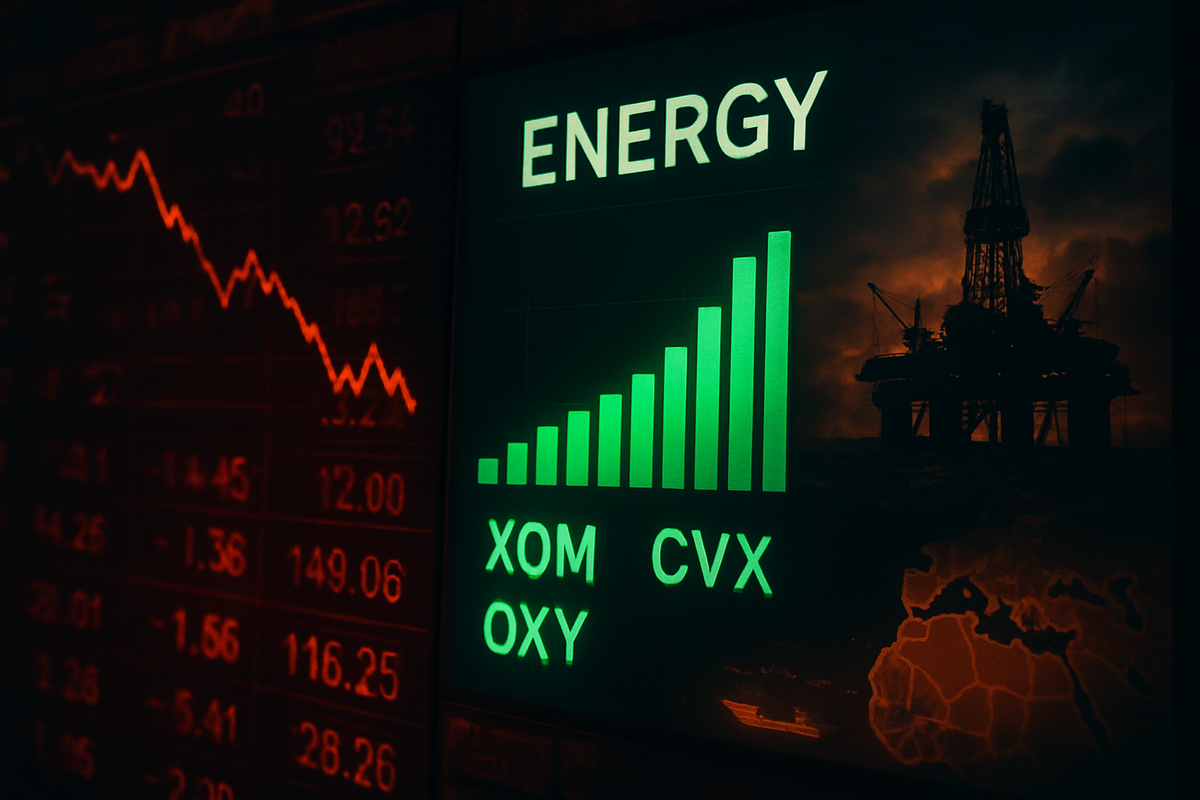
In a day of stark contrast on Wall Street, the S&P 500 Energy sector emerged as the sole bastion of growth during early trading on March 2, 2026. As broad market indices like the S&P 500 and the Nasdaq Composite (INDEXNASDAQ: .IXIC) buckled under the weight of escalating geopolitical instability, energy stocks surged, driven by a violent spike in crude oil prices. This sudden divergence highlights a massive "flight to safety" as investors ditch high-growth technology and financial assets in favor of the tangible, high-margin returns currently offered by the fossil fuel industry.
The immediate implications are profound: while the rest of the economy braces for "war-flation"—a toxic mix of conflict-driven inflation and slowing growth—the energy sector is reaping the benefits of a global supply crunch. With Brent Crude and West Texas Intermediate (WTI) benchmarks leaping nearly 10% in a single session, the financial landscape of 2026 has been fundamentally altered in a matter of hours, positioning energy giants as the primary beneficiaries of a world suddenly starved for stable fuel sources.
Strategic Chokepoints and Regional Conflict Trigger Market Panic
The catalyst for this market upheaval was a series of dramatic events over the weekend of February 28 to March 1, 2026. Tensions in the Middle East transitioned from a simmering proxy conflict into an active "hot war" involving major regional powers and the United States. The most critical blow to global markets came when Iran initiated a de facto closure of the Strait of Hormuz, a maritime chokepoint through which approximately 20% of the world's oil and liquefied natural gas (LNG) transits. This move effectively removed nearly 15 million barrels of oil per day from the immediate global reach, sending traders into a speculative frenzy.
The situation was further exacerbated by reported drone and missile strikes targeting energy infrastructure in Saudi Arabia and the United Arab Emirates. Specifically, reports indicated significant damage to Qatar Energy’s Ras Laffan LNG facility, forcing an immediate halt in production. These strikes, combined with news of a leadership vacuum in Tehran following the reported death of the Iranian Supreme Leader, have led analysts to fear a prolonged and uncontrollable regional escalation. By the time the opening bell rang on March 2, Brent Crude was trading between $79 and $82 per barrel, hitting 14-month highs, while European natural gas prices saw a catastrophic spike of over 30%.
Initial market reactions were swift and defensive. The Energy Select Sector SPDR Fund (NYSEARCA:XLE) rallied as much as 3.4% in early trading, while the Dow Jones Industrial Average (INDEXDJX:.DJI) shed over 500 points. The sentiment on the floor of the New York Stock Exchange was one of grim realization; the "peace dividend" that had supported the tech-heavy rally of 2025 has evaporated, replaced by a "conflict premium" that is currently being priced into every barrel of oil and cubic foot of gas.
Oil Giants Surge as Domestic Assets Become Strategic Shelters
In this environment of scarcity, major integrated energy firms and domestic producers have seen their valuations soar. Occidental Petroleum (NYSE: OXY) was among the standout performers on March 2, with its stock price jumping nearly 7%. Investors are flocking to Occidental due to its significant exposure to the Permian Basin and its strategic focus on U.S.-based shale production, which is shielded from the physical disruptions currently plaguing the Persian Gulf.
ExxonMobil (NYSE: XOM) also saw robust gains, advancing roughly 5% as the market sought the security of its diversified global footprint and massive refining capacity. As an integrated giant, ExxonMobil is uniquely positioned to capture profits from both the high price of crude and the widening margins in the downstream sector as gasoline and jet fuel prices begin to climb. Similarly, Chevron (NYSE: CVX) advanced over 4%, bolstered by its recent efforts to diversify supply lines into South America. Chevron’s presence in Venezuela and Guyana is now viewed as a critical non-Middle Eastern supply buffer, a factor that has made it a darling for institutional investors looking to hedge against geopolitical risk.
Conversely, the losers of this event are plentiful. High-growth tech companies, which rely on low interest rates and stable consumer spending, have seen their share prices crater. The sudden spike in energy costs acts as a "stealth tax" on consumers, threatening to dampen discretionary spending. Shipping and logistics firms are also under immense pressure; for instance, A.P. Moller - Maersk (CPH:MAERSK-B) and other major carriers have announced the suspension of routes through the Middle East, leading to skyrocketing insurance premiums and freight costs that will eventually be passed down to the global consumer.
Historical Precedents and the Specter of "War-flation"
The current surge in the energy sector draws uncomfortable parallels to the oil shocks of the 1970s and the initial market reaction to the 2022 invasion of Ukraine. In both historical instances, a sudden supply disruption led to a prolonged period of energy outperformance relative to the broader market. The 2026 event, however, is complicated by the fact that global inventories were already lean following a period of underinvestment in new drilling projects. This "energy transition gap"—where renewables are not yet ready to replace the missing fossil fuel capacity—has left the global economy uniquely vulnerable to this type of shock.
This event fits into a broader industry trend of "reshoring" and "friend-shoring" energy supplies. The market is clearly signaling that energy security now trumps cost efficiency. We are likely to see a shift in regulatory and policy focus, as governments in the West face pressure to fast-track domestic drilling permits and LNG export terminals to mitigate the loss of Middle Eastern supply. For the S&P 500 Energy sector, this represents a fundamental shift from being a cyclical play to a strategic necessity for any balanced portfolio.
The ripple effects on competitors are also notable. While traditional oil and gas companies are winning today, the surge in prices may provide a secondary boost to the renewable energy sector in the long term. Companies focusing on nuclear, solar, and wind may see renewed investment as the "national security" argument for green energy becomes undeniable. However, in the immediate term, the hardware and raw materials needed for these transitions are also rising in price due to higher transportation and manufacturing costs, creating a complex inflationary environment.
The Road Ahead: Short-Term Volatility and Strategic Pivots
As we look toward the remainder of 2026, the short-term outlook for the energy sector remains bullish, though fraught with extreme volatility. If the Strait of Hormuz remains blocked for more than a few weeks, many analysts, including those at Goldman Sachs and Morgan Stanley, suggest that Brent Crude could easily breach the $100 per barrel mark. This would likely solidify the Energy sector's position as the market leader for the year, but at a significant cost to the global economy.
Strategic pivots are already underway. Major energy players are likely to accelerate their capital expenditure on "short-cycle" projects—wells that can be brought online in months rather than years—to capture these high prices. We may also see a wave of consolidation, as larger firms like ExxonMobil or Chevron use their massive cash reserves to acquire smaller, domestic-focused producers that have become essential pieces of the energy security puzzle.
However, the risk of a "demand destruction" event looms large. If energy prices remain too high for too long, the resulting global recession would eventually sap the demand for oil, leading to a sharp correction. Investors must watch for signs of a slowdown in industrial activity or a significant pivot in central bank policy. The Federal Reserve, which had been considering interest rate cuts in early 2026, may now be forced to hold rates higher for longer to combat the inflationary pressure of $80+ oil.
Closing Thoughts: A New Reality for Investors
The performance of the S&P 500 Energy sector on March 2, 2026, serves as a stark reminder of the fragile nature of global supply chains and the enduring power of geopolitical risk. While the broader market mourns the end of a period of relative stability, the energy sector has proven once again that in times of crisis, "commodities are king." The day's events have rewarded those who maintained exposure to traditional energy assets, providing a hedge that few other sectors could offer.
Moving forward, the market will likely remain in a state of high alert. The primary takeaway for investors is the importance of diversification into tangible assets during times of geopolitical transition. The dominance of companies like Occidental Petroleum and ExxonMobil in today's trading isn't just a fluke of the daily charts; it is a reflection of a world where energy security is now the most valuable currency.
Investors should closely watch for updates on the Strait of Hormuz and any potential de-escalation efforts in the Middle East. Furthermore, monitoring the weekly U.S. inventory reports will be crucial to see if domestic production can ramp up quickly enough to offset the global shortfall. For now, the "green" on the energy boards is a lonely but bright light in an otherwise darkened market landscape.
This content is intended for informational purposes only and is not financial advice.