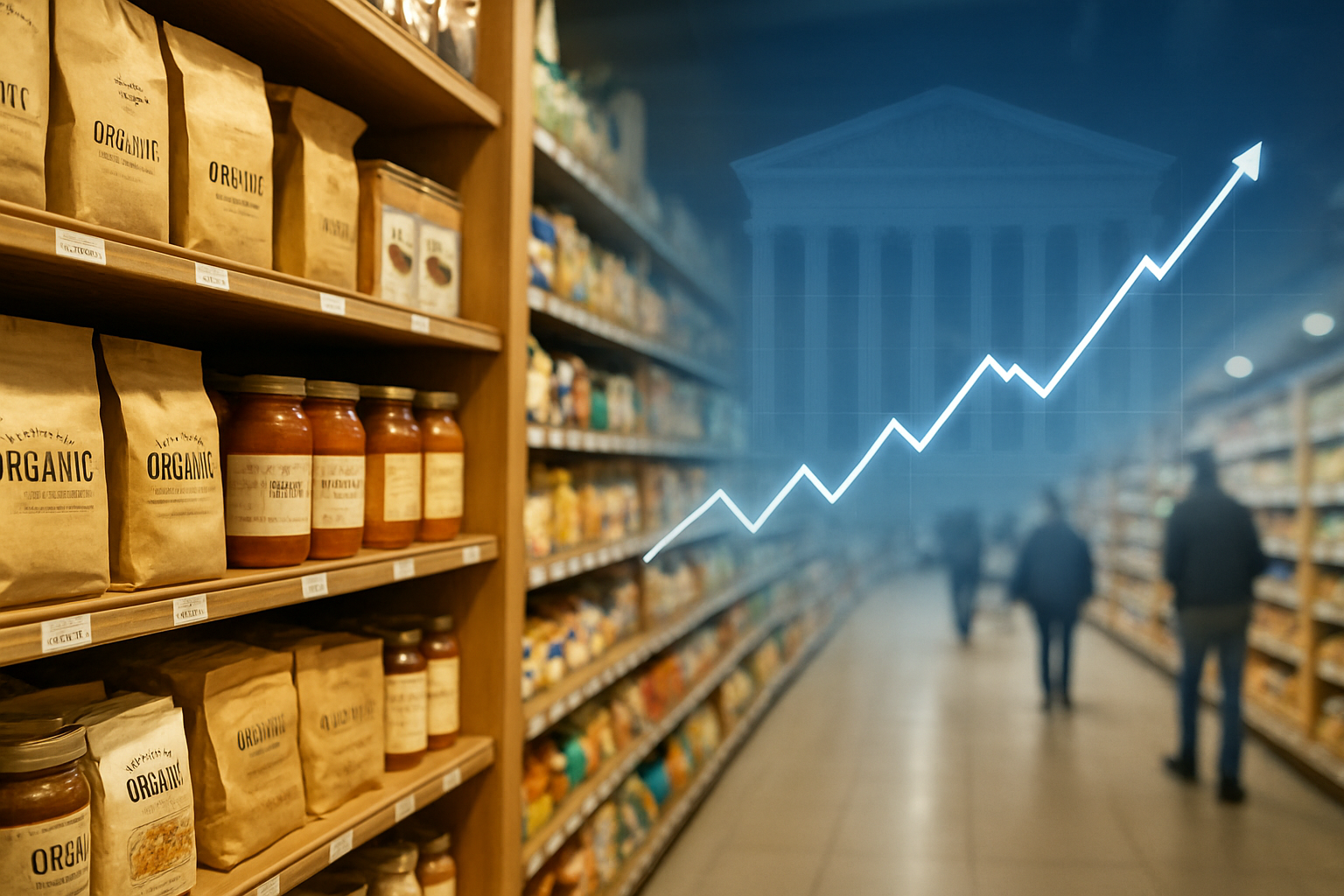
As of March 3, 2026, the equity markets are witnessing a profound rotation that has placed traditional grocery titans at the forefront of investor interest. The Kroger Co. (NYSE: KR) has emerged as a top gainer in recent sessions, with its stock price climbing to approximately $69.05, marking a nearly 10.5% gain since the start of the year. This surge comes at a time when the broader S&P 500 has faced significant downward pressure, retreating roughly 1.2% in early March as geopolitical tensions in the Middle East and a spike in global oil prices reignite fears of persistent inflation.
The immediate implications of Kroger’s ascent are two-fold: it signals a renewed investor appetite for the "safe haven" qualities of the consumer staples sector and reflects a strategic market reaction to a landmark legal shift. A recent Supreme Court ruling regarding executive tariff authority has provided an unexpected tailwind for large-scale retailers, offering a potential path to billions in refunds and a more predictable—if still complex—cost environment. With Kroger scheduled to release its fourth-quarter earnings later this week, the market is betting heavily that the grocer’s focus on value-oriented private labels and supply chain agility will allow it to outperform in an increasingly volatile macroeconomic climate.
The current momentum behind Kroger is the culmination of several weeks of intense market activity and legal drama. The primary catalyst arrived on February 20, 2026, when the U.S. Supreme Court issued a 6-3 ruling in Learning Resources, Inc. v. Trump. The Court held that the executive branch lacked the authority under the International Emergency Economic Powers Act (IEEPA) to impose sweeping, across-the-board global tariffs without explicit Congressional authorization. This ruling sent shockwaves through the retail sector, as it challenged the legality of the 16% effective tariff rate that had been a cornerstone of trade policy.
While the administration moved swiftly to reimpose 10% (and later 15%) tariffs under alternate legal statutes, the SCOTUS decision has opened the door for a massive refund process. Industry analysts estimate that up to $175 billion in business refunds could be unlocked for companies that had been paying these duties under the now-contested IEEPA framework. Kroger, which has been aggressively diversifying its sourcing to mitigate "inflationary friction," is viewed as a major beneficiary of this legal pivot. The timeline of this rally was further accelerated on March 2, when Kroger announced the launch of over 20 new premium meal products under its private-label brands, signaling a move to capture market share from dining-out expenditures as consumers tighten their belts.
The market reaction has been swift. Investors are rotating out of high-growth technology shares—many of which have suffered from "AI exhaustion" and high valuations—and into defensive stalwarts. The Consumer Staples Select Sector SPDR Fund (NYSE Arca: XLP) has risen roughly 14% year-to-date, far outstripping the performance of the tech-heavy indices. This flight to safety is driven by a confluence of risks: a 10-year Treasury yield hovering near 4.04% and a Federal Reserve that appears unlikely to cut interest rates at its upcoming March meeting.
In this shifting landscape, the "winners" are those with the scale to navigate complex customs litigation and the brand strength to offer affordable alternatives to national labels. The Kroger Co. stands at the top of this list, alongside other retail giants like Walmart (NYSE: WMT) and Costco Wholesale Corporation (NASDAQ: COST). These companies benefit from the "double-whammy" of potential tariff refunds and a consumer base that is increasingly price-sensitive. Walmart and Costco have also seen their stocks hover near all-time highs as they leverage their massive purchasing power to keep shelf prices lower than those of smaller, regional competitors.
Conversely, national consumer packaged goods (CPG) brands may find themselves in the "losing" column. Companies that rely on imported raw materials but lack the direct-to-consumer infrastructure of a grocer like Kroger may struggle to maintain margins. As Kroger expands its "Simple Truth" and "Private Selection" lines, it effectively competes against its own suppliers. If these national brands pass on the costs of the 15% tariffs to consumers, they risk losing shelf space to Kroger’s in-house brands, which can be priced more aggressively.
Other potential losers include high-growth, high-multiple companies that are highly sensitive to interest rates and oil prices. As fuel costs rise following recent military strikes in the Middle East, companies with heavy logistics exposure that cannot pass costs on to the consumer—such as certain e-commerce players and smaller logistics firms—are seeing their valuations compressed. Even Amazon.com, Inc. (NASDAQ: AMZN) faces a dual challenge: while its grocery business benefits from the same trends as Kroger’s, its broader retail and cloud segments are more exposed to the general economic slowdown and energy costs.
The wider significance of this event lies in the structural shift of the U.S. economy toward a more protectionist but legally constrained trade environment. The SCOTUS ruling represents a significant check on executive power, echoing historical precedents where the judiciary has stepped in to define the limits of trade-related emergency powers. For the grocery industry, this means that while tariffs are likely here to stay in some form, the "blank check" era of executive trade action may be over, forcing a more deliberative and perhaps more stable policy approach via Congress.
This event also highlights a broader industry trend: the "premiumization" of the private label. No longer just a "generic" budget option, private labels are being positioned as high-quality alternatives that drive loyalty. Kroger’s strategy under the leadership of CEO Greg Foran—who brought his Walmart-honed cost-cutting expertise to the company—is to use these brands to insulate the bottom line from external shocks like tariffs. By controlling the entire lifecycle of a product, from sourcing to the shelf, Kroger can absorb or shift costs in ways that a middleman cannot.
Furthermore, the ripple effects are being felt in the labor market and digital integration. Kroger’s "turnaround" phase has focused heavily on digital efficiency to compete with Amazon. The current market volatility has only accelerated the need for these investments. As the labor market softens, the efficiency gains from automated fulfillment and better inventory management are becoming the primary drivers of margin expansion in the grocery sector, rather than simple price increases.
Looking ahead, the next several months will be defined by the "refund battle" and the execution of Q4 earnings strategies. In the short term, the market will be laser-focused on Kroger’s March 5 earnings report. Wall Street is expecting an Earnings Per Share (EPS) of $1.20 on revenues of $35.1 billion. If Kroger can demonstrate that its private-label growth has successfully offset the 15% tariff pressure, it could see another leg up in its stock price, potentially reaching analyst targets of $73.00 or higher.
In the longer term, the litigation involving the $175 billion refund pool will be a protracted affair. Kroger and its peers will need to engage in complex filings through the U.S. Court of International Trade. This could lead to a series of one-time "windfall" gains over the next two years, providing capital for further acquisitions or stock buybacks. However, the strategic pivot to domestic or near-shore sourcing will be the more permanent adaptation. Companies are likely to continue moving supply chains out of high-tariff regions, a process that is costly in the short term but provides greater stability in the long run.
The market may also see a wave of consolidation. If regional grocers cannot keep up with the digital and sourcing advantages of the "Big Three" (Kroger, Walmart, Costco), they may become acquisition targets. The challenge for Kroger will be navigating the regulatory hurdles of further consolidation, especially in a midterm election year where "food inflation" is a hot-button political issue.
To wrap up, The Kroger Co.’s emergence as a market leader on March 3, 2026, is a testament to the enduring power of the defensive retail model during times of global uncertainty. The combination of a favorable Supreme Court ruling on tariffs and a general rotation into consumer staples has created a "perfect storm" for the grocer’s stock. Investors have clearly signaled that in an era of 4% yields and geopolitical instability, the reliability of a company that provides daily essentials is more valuable than the speculative promise of high-growth tech.
Moving forward, the market will likely remain volatile as it digests the 15% tariffs and the shifting interest rate outlook. The key takeaways for investors are the importance of "margin of safety" provided by private labels and the potential for a massive capital return through tariff refunds. Kroger has positioned itself as more than just a grocery store; it is now a sophisticated supply-chain and brand-management engine that appears well-equipped to weather the storms of 2026.
As we move into the spring, investors should watch for the actual realization of tariff refunds and any shifts in consumer spending patterns that might indicate a deeper economic slowdown. For now, Kroger remains a standout performer, proving that in a market defined by chaos, the staples of life remain the safest bet.
This content is intended for informational purposes only and is not financial advice.