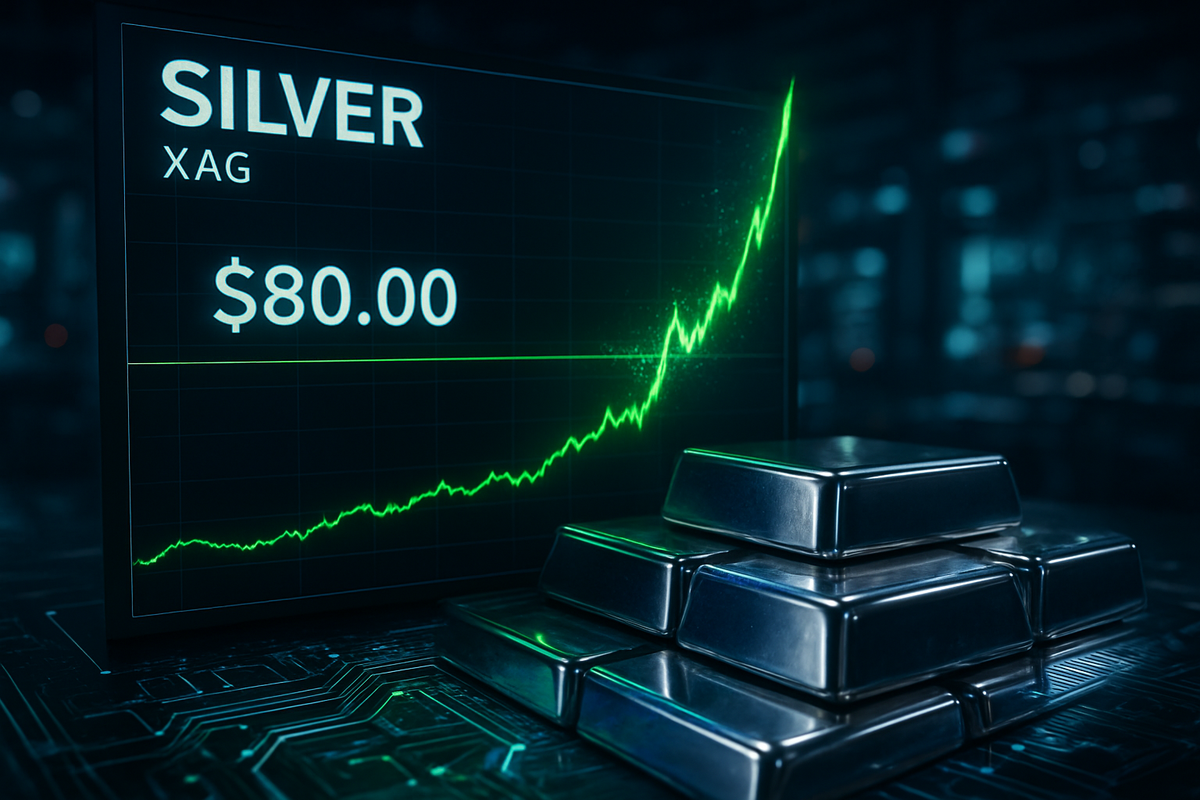
LONDON / NEW YORK — In a historic shift for the commodities markets, silver has decisively shattered the $80 per ounce psychological ceiling, trading at $83.60 as of March 3, 2026. This "fast and furious" rally, which accelerated through the first two months of the year, marks a fundamental re-rating of silver from a traditional precious metal to a mission-critical industrial asset. The breakout has sent shockwaves through global exchanges, as the metal successfully transitioned from a multi-decade resistance zone into a new era of price discovery.
The immediate implications are profound for both Wall Street and Main Street. While gold continues to trade near record highs, silver’s outperformance has compressed the gold-to-silver ratio to levels not seen in a generation. With industrial fabrication now accounting for nearly 60% of global demand, the squeeze is being felt most acutely in the high-tech and green energy sectors, where "non-negotiable" demand from AI infrastructure and next-generation battery manufacturing has stripped global inventories to their lowest levels in decades.
The Perfect Storm: A Timeline of the $80 Breakout
The path to $80 was paved by a series of structural shifts that began in late 2024 and intensified throughout 2025. After spending years range-bound below $30, silver finally cleared the long-standing $50–$54 resistance barrier in late 2025, triggered by the Federal Reserve’s decisive shift to a rate-cutting cycle. This macro tailwind collided with a worsening supply-demand imbalance, as the silver market entered its sixth consecutive year of structural deficit, with an accumulated shortfall exceeding 800 million ounces since 2021.
By January 2026, the rally turned parabolic. Technical analysts pointed to a massive "cup-and-handle" pattern on the monthly charts—a formation decades in the making—that projected a measured move well into triple digits. The breakout was further fueled by news from Mexico, the world’s largest producer, where Fresnillo plc (LSE: FRES) reported significant production downgrades due to declining ore grades and the closure of the San Julián mine. As the London and Zurich vaults reported physical shortages, a "short squeeze" of institutional proportions drove prices through $70 in February, culminating in the current $83.60 support floor established this week.
Key players in this drama include central banks, which have pivoted back to hard assets amid rising global debt, and industrial giants who are now competing for physical delivery. Analysts from J.P. Morgan and Bank of America (NYSE: BAC) have revised their 2026 price targets upward, suggesting that $80 is no longer a peak, but rather the "new normal" for a metal that is increasingly difficult to pull from the ground.
Winners and Losers in the High-Silver Era
The surge to $80/oz has created a stark divide between the commodity’s producers and its largest consumers. Primary silver miners have seen their valuations explode as profit margins expand exponentially. Companies like Pan American Silver (NASDAQ: PAAS), First Majestic Silver (NYSE: AG), and MAG Silver (NYSE: MAG) have become the darlings of the resource sector, with their share prices tracking the metal's ascent. Junior producers like Aya Gold & Silver (TSX: AYA) and Silvercorp Metals (NYSE: SVM) have also seen record inflows as investors seek leveraged exposure to the silver price.
Conversely, industrial consumers are grappling with a "demand bomb" that threatens to erode margins. In the solar sector, leaders such as JinkoSolar (NYSE: JKS) and Canadian Solar (NASDAQ: CSIQ) are facing a crisis of input costs. Despite years of "thrifting"—the process of using less silver per cell—the industry’s shift to high-efficiency N-Type TOPCon and Heterojunction (HJT) cells has actually increased silver intensity. With silver now representing a significant double-digit percentage of total module costs, solar manufacturers are being forced to pass these increases on to utility-scale project developers.
The automotive and tech sectors are equally exposed. Tesla (NASDAQ: TSLA) and BYD (OTC: BYDDF) are seeing the cost of power electronics and high-voltage wiring harnesses spike. However, the most significant long-term loser may be the "cheap tech" sector, as the silver required for 5G infrastructure and AI data center hardware becomes a luxury expense. Nvidia (NASDAQ: NVDA), while still dominant in the AI space, is overseeing a supply chain where silver-coated connectors and high-speed busbars are becoming critical bottlenecks in the production of next-generation H200 and Vera Rubin GPU architectures.
A Strategic Re-Rating: Beyond the Speculative Bubble
This 2026 rally is fundamentally different from the speculative "corners" of the market seen in 1980 or 2011. While those peaks were driven by financial manipulation or temporary safe-haven flows, the current breakout is rooted in silver’s irreplaceable role in the "AI-Multiplier" and "Energy Transition" megatrends. For the first time in history, silver has surpassed its 2011 inflation-adjusted peak of approximately $72/oz, signaling that the market is valuing it as a strategic mineral rather than just a monetary hedge.
The emergence of Samsung’s (OTC: SSNLF) solid-state battery technology has been a primary catalyst. These batteries utilize a silver-carbon composite anode that requires approximately 1 kg (32.15 oz) of silver per vehicle. As these batteries move toward mass production in late 2026 and 2027, the automotive sector alone could theoretically consume half of the world’s annual mine supply. This "non-discretionary" demand from high-tech industries means that traditional price-sensitivity has vanished; data centers and EV manufacturers must buy silver regardless of the price to maintain performance standards.
Historical precedents such as the Hunt Brothers' attempt to corner the market in 1980 saw silver hit an inflation-adjusted $173/oz. While the current price of $83.60 is high, it remains well below that historical peak in real terms. This suggests to many analysts that the rally still has significant room to run, especially as the "Green Revolution" enters its most silver-intensive phase.
The Road to $100: What Lies Ahead
In the short term, the market is watching the $80 level for signs of consolidation. Any successful retest of this support will likely embolden bulls to target the psychological $100 mark by mid-summer. However, a "fast and furious" rally often invites volatility; a sharp correction toward $70 cannot be ruled out if industrial users begin to announce production slowdowns due to cost constraints.
Long-term, the industry is bracing for a potential "supply shock." With no major silver mines expected to come online before 2028, and existing mines facing regulatory hurdles in South America, the structural deficit is expected to persist. Strategic pivots are already underway; some tech companies are exploring copper-based alternatives for lower-voltage applications, but silver’s superior conductivity and oxidation resistance make it nearly impossible to replace in high-stakes environments like 800V EV architectures and AI cooling systems.
Investors should prepare for a volatile but upwardly biased market. The potential for "super-premium" EVs—featuring 600-mile ranges and 9-minute charging—depends entirely on the availability of silver. If the transition to solid-state batteries accelerates, the scramble for physical metal could drive prices toward the Fibonacci extension targets of $115 to $130 per ounce before the end of the decade.
Wrapping Up: The New Silver Standard
The breakout above $80/oz is a watershed moment for global commodities. It confirms that the years of "cheap silver" are firmly in the past, replaced by a reality where the metal’s industrial utility is the primary driver of its value. The key takeaway for the market is the breakdown of the historical relationship between silver and traditional economic indicators; silver is now decoupled from the broader slowdowns as it powers the specific sectors—AI and Green Tech—that are growing regardless of the macro environment.
Moving forward, the silver market will be defined by scarcity. Investors should keep a close eye on exchange inventory levels and the guidance of major miners like Pan American Silver and Fresnillo. As $100 moves from a dream to a distinct possibility, the "White Metal" has finally emerged from the shadow of gold to claim its place as the most critical commodity of the mid-2020s.
This content is intended for informational purposes only and is not financial advice.