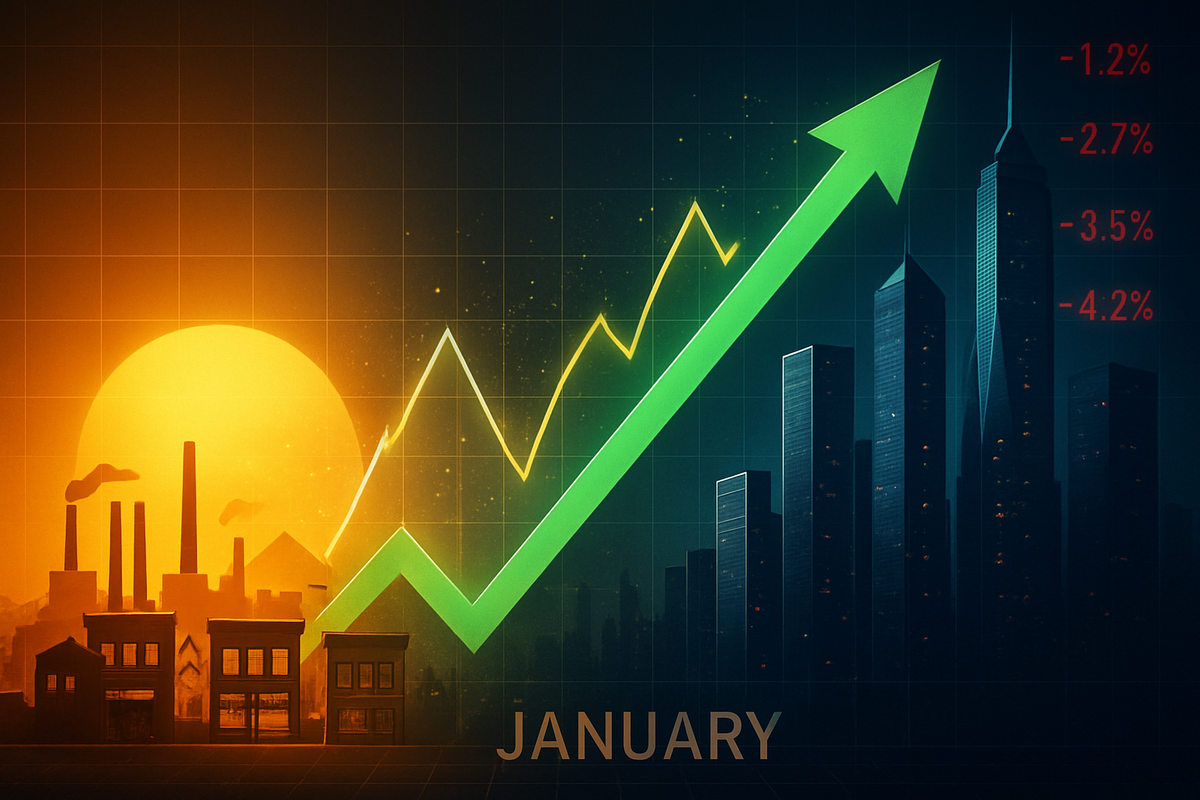
The financial markets have undergone a seismic shift in the first quarter of 2026, as the long-anticipated "January Effect" manifested not merely as a seasonal bounce, but as a full-scale regime change. For years, the "Magnificent 7" mega-cap technology stocks held an iron grip on market leadership, but the narrative has flipped. As of March 3, 2026, the iShares Russell 2000 ETF (NYSE Arca: IWM) has emerged as the clear victor of the year's opening months, dramatically outperforming its large-cap peers and signaling a broader diversification of investor interest into the domestic "real economy."
This rotation, which began as a technical "mean reversion" following a difficult 2025 for small-caps, has gained unexpected momentum. While the tech-heavy Nasdaq 100 (Nasdaq: QQQ) struggled to find its footing amid valuation concerns and "AI fatigue," small-cap value stocks have surged nearly 9% year-to-date. This divergence marks the widest performance gap between small and large caps in over three decades, fundamentally altering the portfolio strategies of institutional and retail investors alike.
The 14-Day Streak and the 'Coiled Spring' Reversal
The seeds of this rotation were sown in late 2025, during a period of heavy tax-loss harvesting. As investors dumped underperforming small-cap positions to offset gains in the soaring AI sector, the Russell 2000 reached a critical valuation floor, trading at a 31% discount to the S&P 500 on a forward price-to-earnings basis. By the time the calendar turned to 2026, the index was described by analysts as a "coiled spring" ready to snap back as those same positions were repurchased in January.
The rebound was historic. Starting January 2, 2026, the Russell 2000 outperformed the S&P 500 for 14 consecutive trading sessions—a streak not seen since 1996. The momentum was bolstered by the Federal Reserve's pivot in late 2025, which saw three consecutive rate cuts bringing the target range to 3.50%–3.75%. Because small-cap companies typically carry higher levels of floating-rate debt, the lower cost of capital provided an immediate fundamental tailwind that large-cap tech, sitting on massive cash piles, simply did not need.
Furthermore, the mid-2025 passage of the "One Big Beautiful Bill Act" (OBBBA) began to bear fruit in early 2026. The legislation’s permanent tax cuts for domestic manufacturing and 100% bonus depreciation favored the domestic-focused components of the Russell 2000 over multi-national giants like Apple (Nasdaq: AAPL), which faced mounting regulatory headwinds and margin pressure from rising global component costs.
Winners and Losers: Small-Cap Heroes vs. Tech Titans
The performance dispersion across individual stocks has been stark. In the small-cap arena, energy and industrial names led the charge. Kosmos Energy (NYSE: KOS) saw its stock price climb a staggering 161% by late February, fueled by domestic production incentives. Similarly, offshore driller Valaris Limited (NYSE: VAL) surged over 83% year-to-date. Even in the tech space, smaller, more specialized players outperformed; Fastly, Inc. (NYSE: FSLY) registered a massive 107% gain in February alone, as investors pivoted from general AI hype toward the practical infrastructure of edge computing.
In contrast, the "Magnificent 7" have faced a grueling start to 2026. Microsoft (Nasdaq: MSFT), formerly the market's darling, has plummeted nearly 20% YTD. Investors were spooked by the company’s staggering $37.5 billion quarterly capital expenditure on AI infrastructure, alongside a revelation that nearly half of its backlog was tied to a single partner, OpenAI.
Nvidia (Nasdaq: NVDA) has also felt the sting of "AI gravity." Despite reporting 73% revenue growth in February, the stock fell 5.5% on the news as shareholders reacted poorly to a decrease in capital returns. Meanwhile, Tesla (Nasdaq: TSLA) is down over 11% for the year, and Apple (Nasdaq: AAPL) has struggled with reports of delayed AI features and margin contraction, losing roughly $200 billion in market value in a single day in mid-February.
A Structural Shift Toward the 'Real Economy'
This event is more than a simple calendar anomaly; it reflects a broader industry trend away from speculative growth and toward tangible assets. The outperformance of the Russell 2000 is intrinsically linked to the resurgence of domestic manufacturing and infrastructure. Companies like Willdan Group (Nasdaq: WLDN), an engineering firm specializing in grid upgrades, have become the new "AI plays" by providing the physical power and cooling infrastructure that the digital revolution requires.
Historically, periods of extreme market concentration—like the one dominated by large-cap tech in 2023-2025—are followed by periods of "catch-up" for the rest of the market. This "Great Rotation" mirrors the post-DotCom bubble era, where small-cap value outperformed for years after the initial tech crash. The Bank of America February Global Fund Manager Survey confirmed this sentiment, showing that institutional investors are now the most overweight in small caps relative to large caps since April 2021.
The ripple effects are being felt across the financial sector as well. Business development companies like Ares Capital Corp (Nasdaq: ARCC) are seeing increased demand for middle-market lending, as smaller firms use their improved equity valuations to fund expansion. This suggests that the "January Effect" has transitioned into a fundamental cycle of growth for the middle market.
The Road Through March and Beyond
As we move through March 2026, the critical question for investors is whether this trend is sustainable. Short-term, the Russell 2000 faces a "hawkish tilt" from the Federal Reserve. While the Fed held rates steady in January, February’s Producer Price Index (PPI) surged by 0.5%, raising fears of sticky inflation. If the Fed signals a pause or a reversal in its rate-cutting cycle, the high-leverage components of the small-cap index could see their momentum stall.
However, the long-term outlook remains tilted toward small-cap resilience. The valuation gap, while narrowing, still favors the Russell 2000. For large-cap tech to reclaim leadership, companies like Alphabet (Nasdaq: GOOGL) and Meta (Nasdaq: META) will likely need to demonstrate clear, high-margin ROI from their massive AI investments—something the market is increasingly skeptical of in the "show me" environment of 2026.
Strategic pivots are already underway. Many large-cap tech firms are expected to shift from aggressive "land grab" spending toward aggressive buybacks and dividends to appease disgruntled shareholders. Conversely, small-caps must now prove they can handle the "curse of winning" by executing on their growth plans amid a slightly firmer inflation backdrop.
Final Assessment: A New Market Regime
The 2026 January Effect has rewritten the playbook for the modern investor. The era of blind indexing into a few mega-cap tech names is, for now, over. The key takeaway from the first two months of the year is that the "real economy"—manufacturing, energy, and domestic services—is no longer taking a backseat to Silicon Valley’s promises.
The market moving forward will likely be more fragmented and valuation-sensitive. Investors should watch the upcoming Federal Reserve minutes and the March Consumer Price Index (CPI) report closely; these will determine if the Russell 2000's lead can hold through the end of the quarter. While the "Magnificent 7" are far from obsolete, their days of effortless outperformance have hit a significant roadblock. For the first time in a decade, the "little guys" of the Russell 2000 are the ones setting the pace on Wall Street.
This content is intended for informational purposes only and is not financial advice.