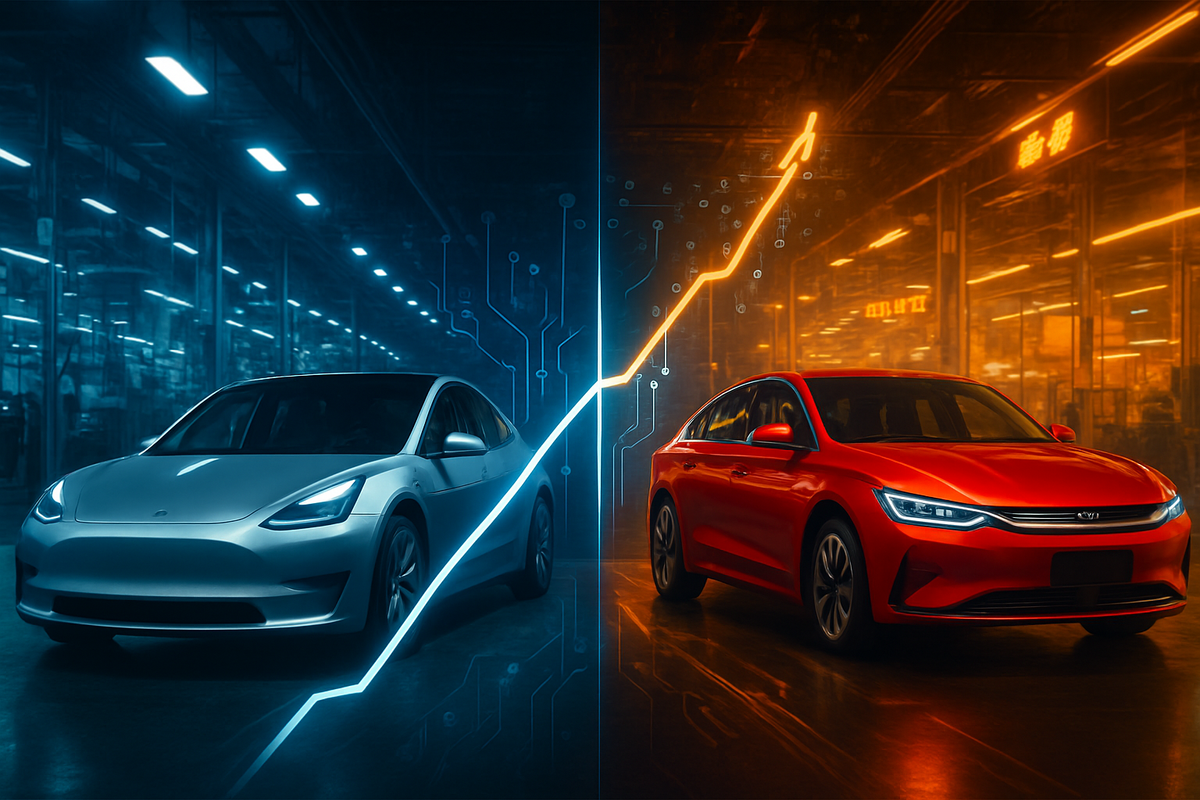
The global electric vehicle landscape has reached a historic inflection point this March 2026, as the "Changing of the Guard" is no longer a forecast but a documented reality. BYD (OTC:BYDDY), the Chinese automotive titan, has officially concluded 2025 as the world's largest producer of battery electric vehicles (BEVs), definitively unseating Tesla (NASDAQ: TSLA). While the two companies have traded blows in quarterly reports for years, the full-year 2025 data and the grim outlook for Q1 2026 signal a structural shift in the industry: BYD is scaling through industrialization and global manufacturing, while Tesla is pivoting away from high-volume auto manufacturing toward a speculative future in robotics and artificial intelligence.
The immediate implications for the market are stark. As of March 3, 2026, the EV sector is grappling with a "challenging outlook" defined by cooling consumer demand in Western markets and a intensifying trade war. Tesla’s struggle to maintain its volume targets—coupled with a significant delivery miss expected for the current quarter—has sent ripples through the NASDAQ, forcing investors to re-evaluate whether the pioneer of the EV revolution can maintain its premium valuation as its core automotive business plateaus.
The 2025 Reversal and the Q1 2026 Demand Vacuum
The data from the 2025 fiscal year tells a story of divergent paths. BYD delivered a staggering 4.6 million New Energy Vehicles (NEVs) in 2025, with its pure BEV sales reaching 2.26 million units. In contrast, Tesla reported a "missing year," with annual deliveries falling 8.6% to 1.64 million units—the first time the company has seen consecutive annual declines. This reversal was cemented in the fourth quarter of 2025, when Tesla’s 418,227 deliveries missed even the most conservative analyst estimates by over 15%.
The timeline leading to this moment was accelerated by the expiration of the $7,500 U.S. federal tax credit in September 2025. This policy shift created a massive "demand pull-forward" into the third quarter of last year, leaving the first quarter of 2026 in a significant vacuum. Current market sentiment for Q1 2026 is bearish, with a 75% probability that Tesla will report fewer than 350,000 deliveries this month. Industry insiders point to "product fatigue" in the aging Model 3 and Model Y lineups as a primary driver of this slump, particularly as Tesla recently discontinued the Model S and Model X to focus on newer, non-volume projects.
Market reaction has been swift and unforgiving. While BYD has faced its own domestic hurdles—including a 41% sales dip in February 2026 due to the Lunar New Year and new Chinese purchase taxes—its aggressive export strategy has cushioned the blow. For the first time, BYD’s monthly exports have begun to rival its domestic sales, indicating that its global expansion is finally gaining traction despite rising protectionism in the West.
Winners, Losers, and the 'Survival of the Fittest'
In this reshuffled deck, BYD (OTC:BYDDY) emerges as the clear volume winner, leveraging a vertically integrated supply chain that allows it to undercut Western competitors on price. However, the "winner" circle is small. Lucid (NASDAQ: LCID) has remained a rare bright spot among startups, managing to double its production to 18,000 units in 2025. Though it remains a niche luxury player, its technological edge in battery efficiency has kept it relevant while others faltered. Rivian (NASDAQ: RIVN) also showed signs of resilience, reporting a modest gross profit of $144 million in 2025, though the company continues to bleed cash as it prepares for the critical launch of its R2 SUV later this year.
On the losing side, legacy American automakers are in full retreat. General Motors (NYSE: GM) took a massive $7.1 billion restructuring charge in late 2025, reflecting a significant scale-back of its EV ambitions. Ford (NYSE: F) has similarly moderated its production targets, pivoting back toward hybrid models as pure EV demand softened in the U.S. heartland. Even Chinese premium brands are not immune; Nio (NYSE: NIO) recently admitted to "fundamental mistakes" in its European strategy, struggling with high infrastructure costs and a vehicle lineup that proved too large for dense European urban centers.
Tesla (NASDAQ: TSLA) finds itself in a category of its own. By sacrificing its volume lead to focus on the "Cybercab" and the Optimus robot, the company is effectively betting the house on a breakthrough in Level 5 autonomy. While this could lead to massive long-term gains, the short-term reality is a shrinking market share in the very industry it created, leaving it vulnerable to more traditional automotive valuation metrics.
Geopolitics and the End of the EV Honeymoon
The wider significance of this shift lies in the "decoupling" of the global automotive market. The era of free-flowing EV trade has been replaced by a fortress-like trade environment. On February 24, 2026, the U.S. administration implemented Section 122 tariffs, a 10–15% global surcharge on all imports, which sits atop the existing 100% tariffs on Chinese-made EVs. The European Union has followed suit with its own countervailing duties, currently totaling approximately 27% for BYD vehicles.
This regulatory environment is forcing a strategy of "Globalization via Industrialization." BYD is no longer just a Chinese exporter; it is becoming a local manufacturer in Hungary, Brazil, and Thailand. This mirrors the historical precedents set by Japanese automakers in the 1980s, who bypassed U.S. import restrictions by building "transplant" factories in the American Midwest. The 2026 market is proving that to survive, EV makers must not only master battery chemistry but also navigate a minefield of geopolitical protectionism.
Furthermore, the cooling of global EV growth—dropping from over 30% annually to just 20% in 2025—suggests that the industry has moved past the "early adopter" phase and is now hitting the "chasm" of the mainstream consumer. Issues like "range anxiety" in rural areas and the lack of a robust, unified charging infrastructure remain the primary barriers to the next leg of growth, a challenge that neither BYD’s low prices nor Tesla’s FSD software has fully solved.
What Lies Ahead: The 'FSD or Bust' Era
The next twelve months will be a period of intense strategic pivoting. For Tesla, the focus is squarely on the "Cybercab," which saw its first production units roll off the line in February 2026. If Tesla can prove that its autonomy software is ready for commercial robotaxi use, the delivery misses of early 2026 will be seen by history as a footnote. If not, the company faces a grueling period of re-tooling its business model to compete as a mid-tier luxury automaker against a wave of fresher, cheaper competition.
For BYD and other Chinese firms, the challenge will be successfully integrating into foreign markets. The opening of the Szeged factory in Hungary later this year will be a litmus test for whether BYD can maintain its margin advantage while paying European wages and adhering to stricter EU labor laws. Meanwhile, the industry is watching Rivian (NASDAQ: RIVN) and its R2 launch; as the "last man standing" among the high-profile 2021-era startups, Rivian's ability to scale could provide a blueprint for a post-Tesla Western EV brand.
Closing Thoughts for the 2026 Investor
As we move deeper into 2026, the key takeaway is that the EV market has matured into a traditional, high-stakes manufacturing war. The days of "easy growth" fueled by government subsidies and novelty are over. BYD’s ascent to the number one spot is a testament to the power of vertical integration and manufacturing scale, while Tesla’s decline in deliveries reflects a company in the throes of a high-risk identity crisis.
For investors, the coming months will be defined by two metrics: the actual Q1 2026 delivery numbers (due in early April) and the progress of global trade negotiations. The "Electric Winter" of early 2026 may eventually give way to a spring of renewed growth, but the players who emerge on the other side will likely look very different from the leaders of the previous decade. Watching for stability in interest rates and the successful deployment of secondary-market battery recycling programs will also be crucial as the industry seeks to lower the total cost of ownership for the wary mainstream consumer.
This content is intended for informational purposes only and is not financial advice.