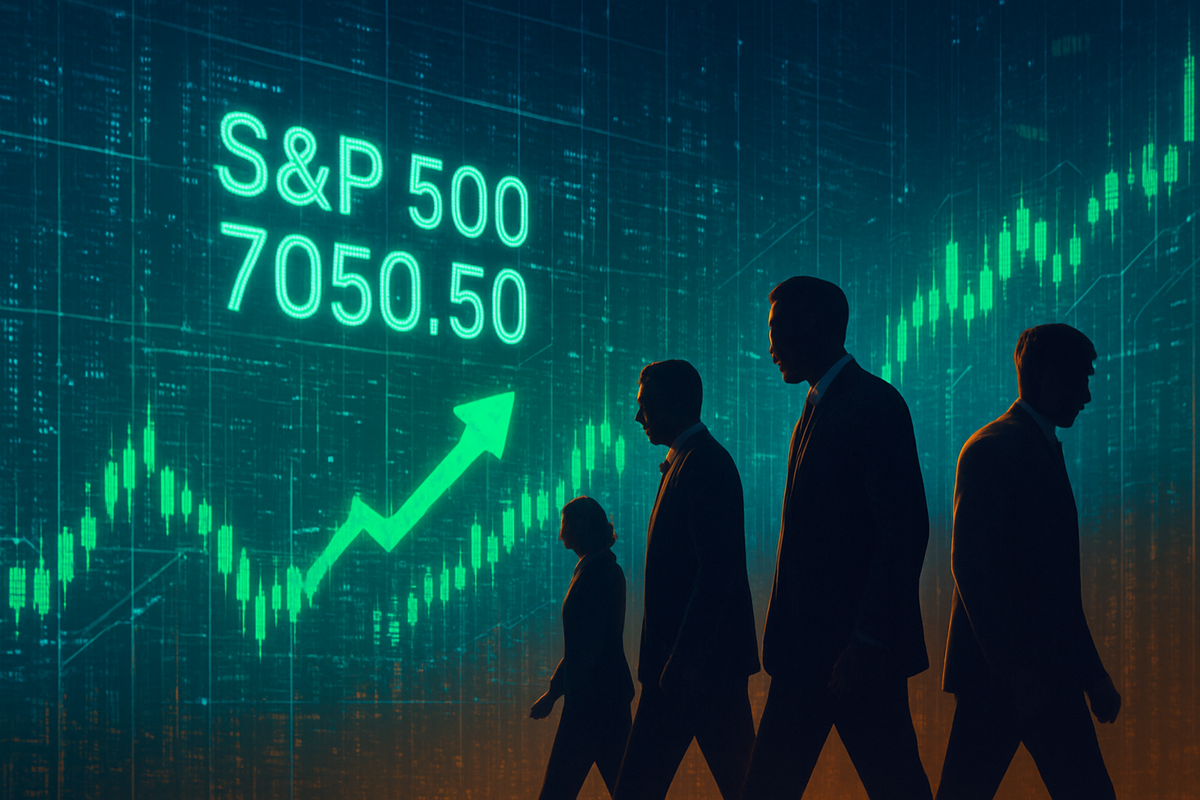
As the S&P 500 index flirted with the historic 7,000-point milestone in early 2026, a quieter but more significant trend has emerged behind the scenes of the world’s most powerful boardrooms. A massive wave of insider selling has seen the architects of the modern tech economy—billionaire founders and veteran CEOs—liquidate more than $16 billion in shares over the past 14 months. This coordinated retreat by the "smart money" occurs even as retail and institutional optimism remains high, creating a stark contrast between those who built these companies and those currently bidding up their valuations.
The scale of this divestment is unprecedented in the post-pandemic era. While market indices like the S&P 500 and the NASDAQ-100 have been propelled to record highs by the relentless "AI gold rush," the very leaders responsible for the AI revolution, such as Jensen Huang and Jeff Bezos, have been systematically trimming their stakes. This $16 billion exodus raises critical questions about whether the current market peak is a sustainable plateau or a dangerous "melt-up" fueled by irrational exuberance.
The $16 Billion Liquidation: A Timeline of the Great Exit
The acceleration of insider selling began in late 2024 and reached a fever pitch throughout 2025. Leading the charge was Jeff Bezos, founder of Amazon (NASDAQ: AMZN), who executed a masterclass in market timing. After relocating to Florida—a move widely seen as a tax-optimization strategy—Bezos offloaded approximately $5.7 billion in shares during 2025 alone. This followed a massive $8.5 billion sale in early 2024, bringing his multi-year total to levels rarely seen in corporate history. Much of these proceeds have been earmarked for his space venture, Blue Origin, and personal philanthropic endeavors.
He was not alone. Safra Catz, the formidable Vice Chair and former CEO of Oracle (NYSE: ORCL), capitalized on the company’s AI-driven resurgence by liquidating roughly $2.5 billion in stock, primarily through the exercise of performance-based options. Meanwhile, Michael Dell, Chairman of Dell Technologies (NYSE: DELL), took advantage of the surging demand for AI-optimized servers to sell $2.2 billion in 2025. Even the face of the AI movement, Jensen Huang of NVIDIA (NASDAQ: NVDA), sold over $1 billion in stock as his company’s market capitalization briefly surpassed $5 trillion in late 2025. Mark Zuckerberg of Meta Platforms (NASDAQ: META) also maintained a steady selling program, offloading $945 million via the Chan Zuckerberg Initiative as Meta’s shares hit all-time highs.
The market's initial reaction to these sales has been surprisingly muted, largely because the majority of these transactions were conducted via 10b5-1 trading plans. These pre-arranged schedules are designed to protect insiders from allegations of trading on non-public information. However, the sheer volume of "locked-in" profits across the "Magnificent Seven" has begun to weigh on sentiment in early 2026. By mid-February, despite the S&P 500 reaching a peak of 6,977.32, several Big Tech stalwarts—including Microsoft (NASDAQ: MSFT) and Tesla (NASDAQ: TSLA)—began to show negative year-to-date returns, signaling that the "insider floor" might be shifting.
Winners and Losers in the Post-AI Hype Rotation
The immediate winners of this shift appear to be the "Bulletmakers"—the companies providing the essential infrastructure and raw materials that sustain the digital economy. As capital rotates out of the hyper-extended valuations of the Magnificent Seven, investors have begun flocking to energy, materials, and specialized data-center REITs. Companies like NextEra Energy (NYSE: NEE) and Caterpillar (NYSE: CAT) have seen renewed interest as the market recognizes that AI monetization requires massive physical infrastructure and power generation, not just sophisticated algorithms.
Conversely, the "losers" in this environment are the latecomers to the AI trade—retail investors and momentum-chasing funds that entered the market in late 2025. With the Forward P/E ratio of the S&P 500 standing at a rich 21.6 in March 2026, well above the 10-year average of 18.8, these investors are now holding assets with "little room for error." The Magnificent Seven, which accounted for nearly 40% of the S&P 500's total market cap at the end of 2025, are now facing "valuation fatigue." As founders take their chips off the table, the burden of maintaining these valuations falls entirely on earnings growth that must now meet near-impossible expectations.
The Significance of Valuation Fatigue and Market Sentiment
This $16 billion selling trend fits into a broader historical pattern where founders exit as a technology matures from "hype" to "utility." Analysts from firms like Morgan Stanley and Goldman Sachs note that the 2025–2026 period mirrors previous cycles where the "builders" of a bubble are the first to recognize its ceiling. While the current market is supported by real cash flows and AI integration, the disconnect between insider confidence and market pricing is becoming impossible to ignore. A late 2025 survey of institutional investors revealed that while many remain structurally bullish, roughly 80% anticipate a correction of 10% to 20% in the first half of 2026.
The ripple effects are also being felt in the regulatory sphere. The sheer scale of these sales, particularly those by Michael Dell and Jeff Bezos, has caught the eye of the SEC, leading to renewed calls for stricter 10b5-1 cooling-off periods. Critics argue that even pre-arranged plans can be timed to coincide with broader market "melt-ups," potentially leaving public investors to hold the bag when the cycle turns. This environment shares some DNA with the early 2000s, though today’s tech giants are far more profitable than their dot-com predecessors. The primary concern today isn't a total collapse, but rather a "lost decade" of returns for the tech sector as it grows into its current, massive valuations.
Looking Ahead: A Volatile Road to 7,000 and Beyond
In the short term, the market is likely to experience increased volatility as it attempts to break and hold the 7,000 level on the S&P 500. The disappearance of insider buying, coupled with the aggressive selling seen in 2025, suggests that the "easy money" phase of the AI cycle has concluded. Investors should expect a strategic pivot from "AI promise" to "AI monetization" in upcoming quarterly reports. Companies that cannot show clear revenue growth from their AI investments—beyond just cost-cutting—may see their share prices punished as the market's patience wears thin.
Over the long term, the $16 billion exit may be viewed as a healthy rebalancing of billionaire portfolios. However, it also signals a transition for the S&P 500. We are moving from a market dominated by a handful of tech behemoths to a more diversified landscape where value and defensive sectors regain their footing. The challenge for the market in 2026 will be to absorb the supply of shares being dumped by insiders without triggering a panic. If the broader economy remains resilient and inflation continues to hover near the 2.7% mark seen in early 2026, the market may manage a "soft landing" rotation rather than a hard crash.
Summary and Investor Outlook
The $16 billion insider selling spree of 2025 and early 2026 is a clarion call for caution. When the individuals with the most intimate knowledge of a company’s future prospects decide to lock in billions in profits, the broader market should take note. The key takeaways are clear: the "Magnificent Seven" are no longer a monolith of growth, valuation fatigue is real, and the market is undergoing a thematic shift toward infrastructure and energy.
Moving forward, the S&P 500 will likely find it difficult to sustain its record-breaking trajectory without a broader base of participation from the other 493 stocks in the index. Investors should watch for the next round of 10b5-1 filings in Q2 2026; a continuation of the selling trend would suggest that the founders believe the peak is still in the rearview mirror. For now, the message from the billionaire class is loud and clear: it is time to harvest the gains of the AI era, leaving the risks of the next chapter to the rest of the market.
This content is intended for informational purposes only and is not financial advice.