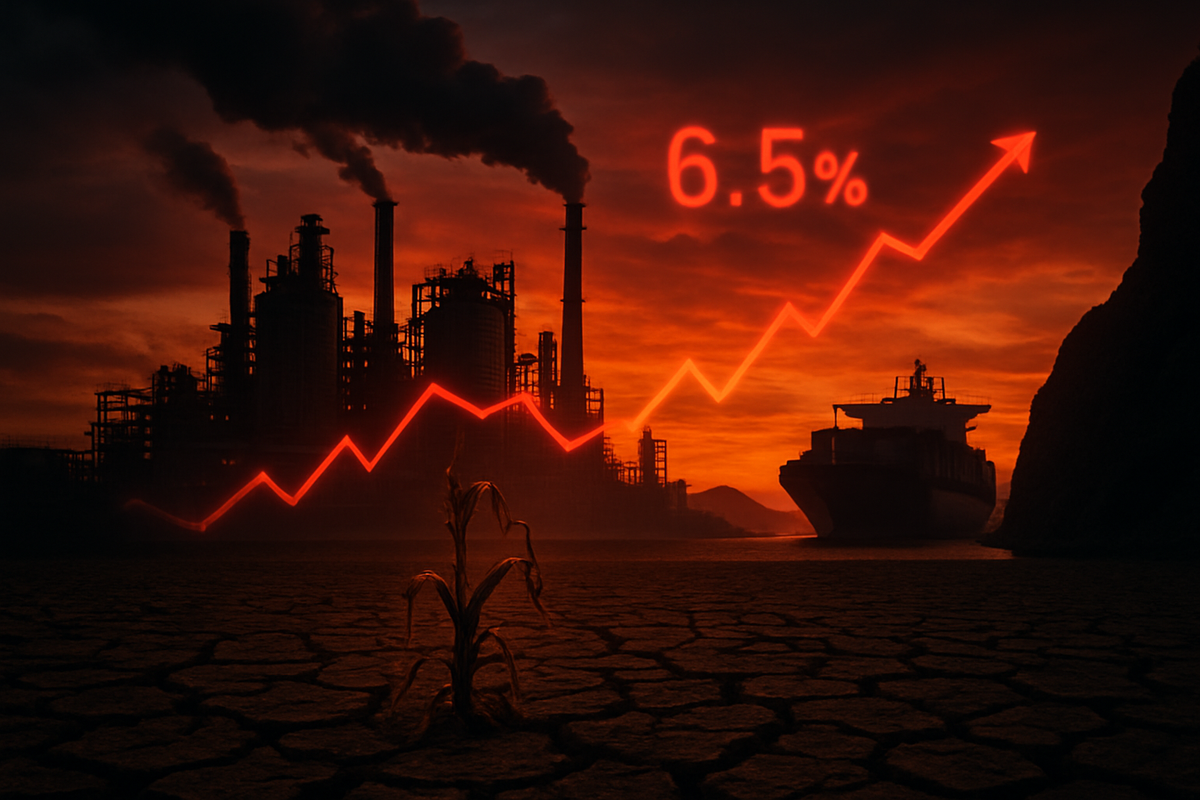
The global agricultural sector was sent into a tailspin this week following reports of a staggering 6.5% spike in fertilizer prices for February 2026, a surge that coincides with a 2.1% month-over-month rise in consumer food prices. This inflationary double-whammy has left farmers and commodity traders bracing for a "perfect storm" of rising input costs and supply shortages just as the Northern Hemisphere prepares for the critical spring planting season. The immediate implications are dire: with fertilizer being the literal bedrock of modern crop yields, any prolonged disruption threatens to ignite a multi-year cycle of food insecurity and retail price hikes.
The primary catalyst for this market upheaval is the sudden and violent escalation of conflict in the Middle East, specifically the U.S.-led military campaign dubbed "Operation Epic Fury." As of early March 2026, the closure of the Strait of Hormuz—the world’s most sensitive maritime chokepoint—has effectively stranded nearly a third of the world’s traded fertilizer and 20% of global oil supplies. With the "just-in-time" logistics of the agricultural industry now fractured, market volatility has reached levels not seen since the early days of the 2022 energy crisis, leaving the global food supply chain more fragile than ever.
A Perfect Storm: Operation Epic Fury and the Strait of Hormuz Blockade
The crisis reached a tipping point in the early hours of February 28, 2026, when the United States launched "Operation Epic Fury," a coordinated preemptive strike against Iranian ballistic missile and nuclear infrastructure. The operation, which reportedly resulted in the death of Supreme Leader Ali Khamenei, triggered an immediate and ferocious retaliation. Iran’s "Operation True Promise IV" saw hundreds of drones and missiles targeted at regional ports and U.S. bases in Qatar and Bahrain. By March 2, the Islamic Revolutionary Guard Corps (IRGC) had effectively declared the Strait of Hormuz closed to commercial traffic, immediately paralyzing the flow of energy and chemical exports.
This geopolitical earthquake struck a fertilizer market that was already reeling from high natural gas prices and production cuts in Europe. Natural gas is the primary feedstock for ammonia-based fertilizers like urea; when Iranian drone strikes reportedly hit Qatar’s LNG production facilities—the world's largest export hub—global gas prices skyrocketed. In the U.S. Midwest, nitrogen-based urea prices jumped nearly 13% in a single 48-hour window, moving from $475 to over $600 per ton. Fertilizer retailers have reacted with panic, pulling price quotes and refusing to lock in future commitments for farmers who are only weeks away from heading into the fields.
The timeline of the collapse has been remarkably swift. Throughout the first three weeks of February, prices were already trending upward due to seasonal demand. However, the military escalation served as an accelerant, turning a steady climb into a vertical spike. Key stakeholders, including the United Nations Food and Agriculture Organization (FAO) and various national grain grower associations, have issued urgent warnings that the blockade must be resolved within weeks to avoid a catastrophic failure of the 2026 harvest in major exporting regions like the United States, Brazil, and the European Union.
Market Winners and Losers: A Deep Dive into Corporate Impact
The sudden supply shock has created a stark divide between the winners and losers of the agricultural markets. Among the primary beneficiaries are domestic nitrogen producers with assets far removed from the Middle Eastern theater. CF Industries Holdings, Inc. (NYSE: CF) saw its stock surge by more than 10% in early March as investors identified it as a primary "geopolitical hedge." Because CF relies on North American shale gas rather than volatile Middle Eastern LNG, the company is poised to capture massive margins as global nitrogen prices rise while its own input costs remain relatively stable. Similarly, The Mosaic Company (NYSE: MOS) and Nutrien Ltd. (NYSE: NTR) have seen gains ranging from 3% to 6%, driven by the reality that a third of the world’s urea—much of it sourced from the Persian Gulf—is currently inaccessible.
Conversely, the "middlemen" of the agricultural world—the massive grain processors and traders—face a more precarious situation. Archer-Daniels-Midland Company (NYSE: ADM) and Bunge Global SA (NYSE: BG) have seen their shares underperform or even decline as the market weighs the risk of reduced farmer demand. While high prices can sometimes help trading margins, the extreme volatility makes it difficult for these firms to hedge their positions effectively. Analysts at major banks have noted that if farmers cut back on fertilizer applications due to costs, the resulting lower crop yields will eventually lead to lower volumes for ADM and Bunge to process, creating a "pincer effect" on their long-term profitability.
The shipping and energy sectors have also seen a dramatic re-rating. Shipping giants like A.P. Møller - Mærsk A/S (CPH: MAERSK-B) and Hapag-Lloyd AG (ETR: HLAG) have surged as they implement "emergency freight surcharges" for rerouting vessels around the Cape of Good Hope, a move that adds 10 to 14 days to transit times. In the energy space, oil majors such as Exxon Mobil Corporation (NYSE: XOM) and Chevron Corporation (NYSE: CVX) have seen their stocks climb alongside Brent crude, which hit a 52-week high above $83 per barrel following the start of the military operations. These companies benefit from higher global prices while their primary production assets in the Permian Basin remain insulated from physical disruption.
Wider Significance: Regulatory Reversals and Global Inflation Risks
This event represents a significant pivot point in global economic policy, particularly regarding the "Green Transition" and trade protectionism. In a stunning reversal, the European Commission recently announced a retroactive suspension of its Carbon Border Adjustment Mechanism (CBAM) charges for fertilizers. The CBAM, which was fully implemented on January 1, 2026, was initially intended to tax high-carbon imports, but the sudden price spike forced the EU to abandon the policy to prevent a full-scale food price crisis. This move signals that, in times of war, food security will invariably take precedence over climate goals.
In the United States, the Trump administration has responded with equally aggressive measures. On February 19, 2026, an executive order designated phosphorus and glyphosate as "national security risks," fast-tracking domestic production and exempting most fertilizer types from "reciprocal tariffs" to ease the burden on American farmers. This represents a rare moment where trade barriers are being lowered, illustrating the severity of the supply shortage. However, this has also brought renewed antitrust scrutiny to the sector, with the Department of Justice intensifying its probe into what it calls a "duopoly" between Nutrien and Mosaic, following complaints that these majors are benefiting excessively from the chaos.
Historically, this event mirrors the 1973 oil embargo and the 2008 food price crisis, where geopolitical shocks translated directly into "kitchen table" inflation. The 2.1% rise in food prices for February is likely just the beginning; as the 6.5% fertilizer hike works its way through the production cycle, the "inflation tail" could last well into 2027. This creates a difficult environment for central banks, which were hoping to pivot toward lower interest rates in 2026 but now face a renewed surge in "cost-push" inflation that they cannot easily control with monetary policy alone.
The Road Ahead: Short-Term Pain and Long-Term Adaptation
In the short term, the market's focus remains entirely on the military situation in the Persian Gulf. If Operation Epic Fury transitions into a prolonged occupation or if the Strait of Hormuz remains closed through the end of March, the Northern Hemisphere's "just-in-time" fertilizer delivery system will effectively fail. Farmers in the U.S. Corn Belt may be forced to switch to less nitrogen-intensive crops, such as soybeans, which would lead to a massive imbalance in global grain markets by late 2026. This scenario would likely see corn futures reach record highs as the reality of a smaller harvest sets in.
Longer term, this crisis will likely accelerate the decoupling of the agricultural supply chain from the Middle East. We can expect to see a surge in "friend-shoring," with North American and North African producers expanding capacity to fill the void left by Iran and its neighbors. Strategic pivots are already underway; agricultural technology firms are seeing increased investment in "precision application" tools that allow farmers to use less fertilizer more efficiently. These technological adaptations, while expensive in the short term, may offer the only viable path to resilience in an increasingly unstable geopolitical landscape.
Furthermore, a significant market opportunity may emerge in "blue ammonia" and domestic phosphorus mining. As governments prioritize national security over global trade, subsidies for domestic production are expected to flood the market. Companies that can quickly bring new capacity online in stable jurisdictions will likely be the primary beneficiaries of the next decade of agricultural investment.
Conclusion: A High-Stakes Game for Investors and Policymakers
The 6.5% spike in fertilizer prices reported in February 2026 is far more than a statistical anomaly; it is a clear warning sign of a global economy under extreme geopolitical stress. The convergence of "Operation Epic Fury," the closure of the Strait of Hormuz, and rising food prices has created a high-stakes environment where the margin for error is razor-thin. For the market, the immediate takeaways are clear: volatility is the new baseline, and the geography of production is now just as important as the cost of production.
Moving forward, the market will remain highly sensitive to any news regarding the reopening of the Strait or the potential for a ceasefire. Investors should keep a close watch on weekly USDA planting reports and the profit margins of nitrogen-heavy producers like CF Industries. The central question remains whether the global supply chain can adapt fast enough to prevent the current "price spike" from turning into a "production collapse."
As we move deeper into March 2026, the resilience of the agricultural sector will be tested as never before. While the market has shown signs of stabilization in the last 24 hours, the underlying risks remain. For the public and investors alike, the coming months will be a period of intense scrutiny, as the world watches to see if the breadbaskets of the world can overcome the firestorm in the Middle East.
This content is intended for informational purposes only and is not financial advice.