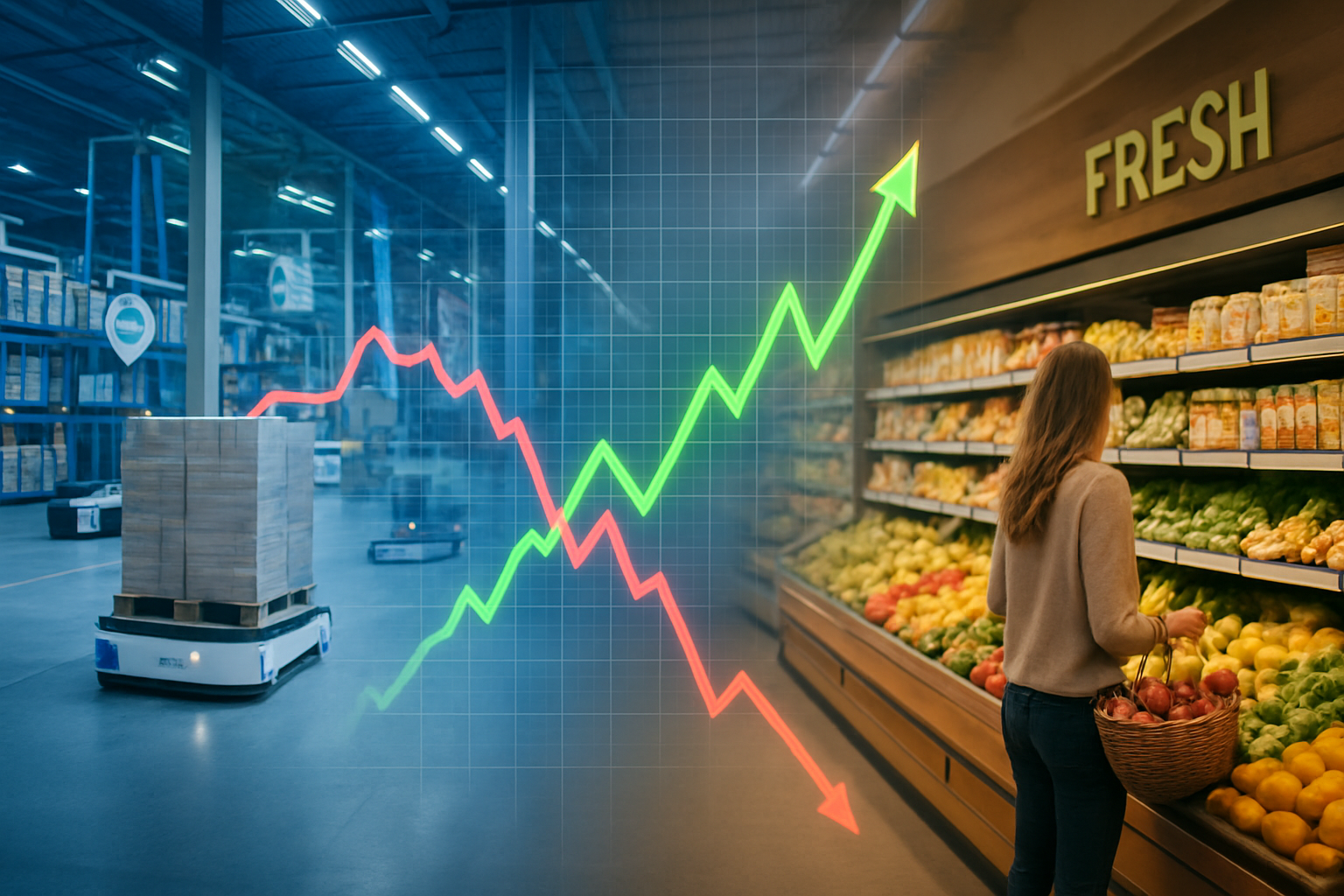
The U.S. retail landscape witnessed a dramatic split in fortune during the first week of March 2026, as the nation’s two largest grocery powerhouses moved in opposite directions. While the broader market grappled with shifting consumer sentiment, Kroger (NYSE: KR) emerged as a standout performer, fueled by a robust fourth-quarter earnings report and optimistic forward-looking guidance. Conversely, Walmart (NYSE: WMT), long the darling of the "flight to value" trade, found itself among the market’s "top losers" as investors recalibrated their expectations for the retail behemoth.
This divergence marks a pivotal moment in the "post-inflationary" retail era. As price hikes cease to be the primary engine for revenue growth, the market is aggressively rewarding operational efficiency and digital profitability over sheer scale. The immediate implication is a tightening race for the "share of stomach," where Kroger’s focus on fresh food and private-label dominance is currently outshining Walmart’s broader, tech-heavy diversification strategy.
A Tale of Two Tickers: The March 5 Market Pivot
On March 5, 2026, the retail sector's hierarchy was briefly upended by a series of high-stakes financial disclosures. Walmart shares plummeted between 3.5% and 4.3% in a single session, dragging down the Dow Jones Industrial Average. The sell-off was triggered primarily by a valuation correction; analysts at firms like Erste Group downgraded the stock to "Hold," noting that its price-to-earnings ratio had reached a "frothy" 47—a level historically reserved for high-growth tech firms rather than big-box retailers. Furthermore, despite beating revenue estimates in late February, Walmart’s conservative projection of 3.5% to 4.5% sales growth for the upcoming fiscal year failed to satisfy a market that had priced in perfection.
In stark contrast, Kroger’s stock surged over 4% on the same day, following the release of its Q4 2025 results. The Cincinnati-based grocer reported an adjusted earnings per share (EPS) of $1.28, handily beating the $1.20 consensus. More importantly, Kroger issued a bullish FY 2026 guidance, projecting an EPS range of $5.10 to $5.30, well above analyst expectations. Under the leadership of CEO Greg Foran—the former Walmart U.S. chief who took the helm following the resolution of the Albertsons merger saga—Kroger has pivoted toward a "store-first" strategy that emphasizes fresh category leadership and a $2 billion share repurchase program.
The timeline leading to this divergence includes a series of logistical and regulatory hurdles for Walmart. In late February 2026, the company agreed to a $100 million settlement with the FTC regarding its Spark Driver delivery program, amid allegations of misrepresented driver earnings. This legal friction, combined with pre-planned stock sales by high-level executives including CEO Doug McMillon and EVP John Rainey, created a perfect storm of bearish signals that overshadowed the company’s otherwise solid fundamental performance.
Winners and Losers in the Grocery Arms Race
The primary winner in this recent session is undeniably Kroger (NYSE: KR). By successfully defending its urban market share and reporting a 20% jump in adjusted e-commerce sales, the company has proven that "pure-play" grocers can achieve digital profitability. Kroger’s "Our Brands" private-label portfolio continues to be a margin savior, as nearly 80% of U.S. shoppers have traded down to store brands in early 2026 to combat the lingering effects of high living costs.
On the losing end, Walmart (NYSE: WMT) faces a period of cooling sentiment. While the company remains the undisputed leader in total e-commerce volume and retail media through its "Connect" platform, its heavy investment in automated fulfillment centers and international expansion is currently being weighed against a "valuation ceiling." Investors are signaling that Walmart’s pivot into a high-margin advertising and tech company may take longer to yield the "alpha" required to justify its current premium.
Secondary losers include traditional mid-tier grocery chains and competitors like Target (NYSE: TGT), which are feeling the squeeze from both ends. Target, in particular, remains sensitive to discretionary spending lulls, an area where Walmart's general merchandise mix has also struggled. Meanwhile, Amazon (NASDAQ: AMZN) continues to be a formidable "omnichannel" threat, though Kroger’s recent "eCommerce Strategic Review"—which forecasted a $400 million profit improvement—suggests the grocery gap is closing in favor of the specialized operators.
The Era of "The Great Disinflation" and Retail Media
The current market volatility reflects a broader industry shift toward "The Great Disinflation." In 2026, food-at-home inflation has flattened, meaning retailers can no longer rely on rising prices to bolster top-line growth. Success is now measured by volume—capturing the "weekly shop" from competitors through personalized loyalty data and digital coupons. Kroger has excelled here, utilizing its deep data analytics to drive "identical sales" growth of 2.4% even in a low-inflation environment.
Historically, this era draws comparisons to the post-2008 recovery, where consumers became hyper-fixated on value, but with a modern twist: the rise of Retail Media. Both Walmart and Kroger are now acting as advertising agencies, selling access to their vast troves of consumer data. However, as of March 2026, the market is scrutinizing the "operational friction" of these new ventures. Walmart’s recent FTC settlement serves as a cautionary tale of the regulatory scrutiny that accompanies the gig-economy-style delivery models that support these tech ambitions.
Furthermore, the "flight to value" has evolved. While Walmart traditionally captures low-to-middle-income shoppers, Kroger’s "Fresh" initiative has allowed it to retain high-income households who are increasingly seeking quality along with value. This "share of stomach" battle is intensifying as the boundary between a grocery store and a tech company continues to blur, leading to higher capital expenditure requirements across the entire sector.
Looking Ahead: Strategic Pivots and Scenarios
In the short term, Walmart is likely to enter a period of consolidation. The company must prove that its investments in high-margin services like delivery-as-a-service and advertising can scale without further regulatory or operational hiccups. A key scenario to watch is whether Walmart will issue a mid-year guidance raise if its automated fulfillment centers begin to deliver the promised margin expansion faster than anticipated. If the "frothy" valuation persists without an earnings acceleration, further downward pressure is probable.
For Kroger, the challenge lies in maintaining momentum. The "Foran Era" is characterized by operational excellence, but the company must navigate a post-merger landscape where organic growth is the only lever left. The successful execution of the $2 billion share buyback will be critical in supporting the stock price if the broader retail sector faces a macro slowdown. Analysts will be watching the "Our Brands" penetration rates closely to see if Kroger can continue to peel away market share from national brands and big-box rivals alike.
Market Outlook and Investor Takeaways
The divergence between Walmart and Kroger in early March 2026 underscores a vital lesson for retail investors: valuation matters as much as dominance. While Walmart remains a foundational "mega-cap" retail force, its recent status as a "top loser" is a reminder that even the most successful companies are susceptible to price corrections when expectations outpace immediate reality. Kroger, conversely, has demonstrated that a focused, disciplined approach to core grocery strengths—bolstered by a credible digital strategy—can lead to significant alpha.
Moving forward, the market will be characterized by a "show-me" attitude regarding digital profitability and unit volume growth. Investors should watch for upcoming retail sales data and any shifts in the FTC's stance on retail delivery programs. As we head into the second half of 2026, the primary question will be whether Walmart can reclaim its momentum by leveraging its tech stack, or if "pure-play" grocery leaders like Kroger will continue to dominate the defensive-growth narrative in a disinflationary world.
This content is intended for informational purposes only and is not financial advice.