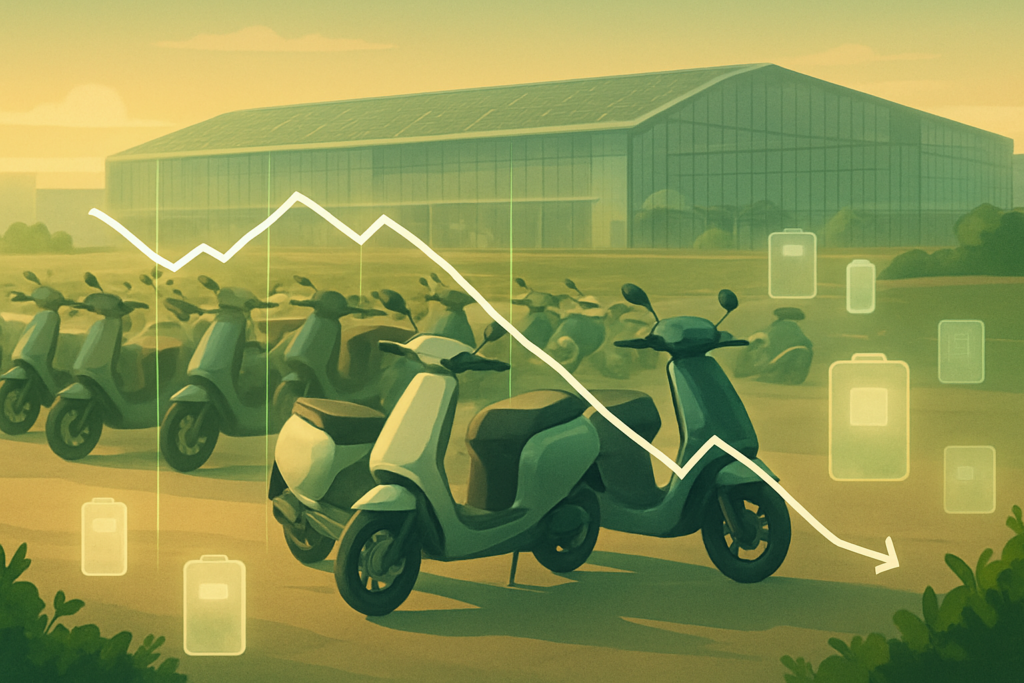
As of December 18, 2025, Ola Electric Mobility Ltd. (NSE: OLAELECTRIC; BSE: 544230) finds itself at a critical crossroads. Once the poster child of India’s electric vehicle (EV) revolution, the company has transitioned from a market-dominating disruptor to a embattled player fighting for its place in an increasingly crowded arena.
The stock, which debuted with much fanfare in August 2024, has faced a grueling 2025, characterized by a sharp erosion in market share and persistent service-quality concerns. This week, the narrative took another dramatic turn as founder and CEO Bhavish Aggarwal executed a substantial share sale through open market transactions. This move, intended to clear promoter-level debt and eliminate share pledges, has sparked intense debate among institutional investors and retail traders alike. With the stock trading at a significant discount to its IPO price and legacy manufacturers gaining ground, this deep-dive examines whether Ola Electric is a falling knife or a generational value opportunity.
Historical Background
Ola Electric was born out of the ride-hailing giant Ola (ANI Technologies) in 2017, initially as a pilot project for electric mobility. By 2019, it was spun off into a separate entity with a bold mission: to end the era of internal combustion engine (ICE) two-wheelers in India.
The company’s rise was meteoric. In 2021, it launched the S1 and S1 Pro scooters, backed by a massive marketing campaign and a "Futurefactory" in Tamil Nadu designed to be the world's largest two-wheeler plant. Despite early hiccups with delivery timelines and software glitches, Ola Electric successfully captured over 50% of the Indian electric two-wheeler (E2W) market by early 2024. Its initial public offering (IPO) in August 2024 was seen as a litmus test for the Indian tech ecosystem, raising ₹6,145 crore and valuing the company at roughly $5 billion. However, the post-IPO period has been marked by operational growing pains and a resurgent challenge from India’s traditional automotive giants.
Business Model
Ola Electric operates an uniquely integrated business model that distinguishes it from traditional OEMs:
- Vertical Integration: Unlike competitors who source cells and components, Ola is betting heavily on its Ola Gigafactory. By manufacturing its own battery cells (the "Bharat Cell"), the company aims to control the most expensive part of the EV value chain.
- Direct-to-Consumer (D2C): Ola bypasses the traditional dealership model, selling directly to customers via its app and a network of company-owned "Experience Centers." This allows for higher margins but places the entire burden of service and logistics on the company.
- Product Ecosystem: The core revenue is driven by the S1 series of scooters (Air, X, and Pro). Recently, the company has diversified into electric motorcycles and is exploring a nascent cell-manufacturing business for external sales.
- Software and Services: Revenue is also generated through its proprietary software (MoveOS) and subscription-based service packages, though these remain a smaller fraction of the total pie.
Stock Performance Overview
The stock’s journey since its August 2024 IPO at ₹76 per share has been a volatile descent.
- 1-Year Performance (Dec 2024 – Dec 2025): The stock has plummeted over 55% during this period. After peaking briefly above its IPO price in late 2024, the shares entered a steady decline throughout 2025 as monthly sales figures began to slip and service-related complaints went viral on social media.
- Recent Trends: Over the last 30 days, the stock has been under extreme pressure, currently trading between ₹31 and ₹35. The recent share sale by Bhavish Aggarwal in mid-December 2025 (totaling 6.8 crore shares) initially triggered a 10% intraday drop before stabilizing as the company clarified the purpose was to achieve a "zero-pledge" promoter status.
- Market Context: Relative to the Nifty 50, OLAELECTRIC has significantly underperformed, trailing the broader auto index by nearly 70% in 2025.
Financial Performance
Ola Electric’s financials for the fiscal year ending March 2025 (FY25) and the first half of FY26 reflect a company in a difficult transition.
- Revenue Decline: For FY2025, consolidated revenue stood at ₹4,514 crore, a 10% decline from the previous year. This was largely due to intensified competition and a cooling of early-adopter demand.
- Widening Losses: Net losses for FY25 surged to ₹2,276 crore, up from ₹1,584 crore in FY24. High R&D spending and the capital-intensive nature of the Gigafactory have weighed heavily on the bottom line.
- Q2 FY2026 Snapshot: In the quarter ended September 2025, revenue was approximately ₹720 crore, a staggering 43% YoY decline. However, a small silver lining appeared: the auto segment reported a slim positive EBITDA margin of 0.3%, suggesting that the core manufacturing process is becoming more efficient even as volumes drop.
- Debt and Liquidity: Following the December share sale, the company successfully repaid a ₹260 crore promoter-level loan. While corporate-level cash reserves remain adequate for the next 12-18 months, the burn rate remains a concern for long-term investors.
Leadership and Management
Bhavish Aggarwal, the visionary founder, remains the central figure and primary driver of the company’s strategy. Known for his aggressive timelines and "first-principles" thinking, Aggarwal is both Ola's greatest asset and a point of scrutiny for governance experts.
The management team has seen some turnover in 2025, as the company pivoted from a "growth-at-all-costs" phase to a "service-and-cell" focus. The recent share sale by Aggarwal was officially characterized as a strategic move to clean up the promoter balance sheet. However, analysts note that the optics of the founder selling a large stake while the share price is at record lows has hurt retail investor confidence. Governance reputation remains a "work in progress," with the board recently adding more automotive veterans to provide a steady hand during the production ramp-up.
Products, Services, and Innovations
Innovation is the pillar upon which Ola Electric’s bull case rests.
- The Bharat Cell (4680): Ola has commenced commercial production of its 4680-format lithium-ion cells. If successful, this vertical integration could reduce the Bill of Materials (BOM) for their scooters by up to 20% by 2026.
- Electric Motorcycles: In late 2025, Ola teased its upcoming "Roadster" and "Cruiser" motorcycle lineups. This segment is significantly larger than the scooter market in India and represents the company's next major growth frontier.
- MoveOS 5.0: The latest iteration of their software includes AI-driven range optimization and advanced predictive maintenance, aimed at curbing the service issues that plagued earlier models.
Competitive Landscape
The competitive environment has shifted drastically. In 2023, Ola was the clear leader. In late 2025, it has fallen to 5th place in market share.
- The Legacy Attack: TVS Motor Company (NSE: TVSMOTOR) and Bajaj Auto (NSE: BAJAJ-AUTO) have aggressively ramped up production of their iQube and Chetak models, respectively. These players benefit from decades of service infrastructure and deep customer trust.
- The Premium Rival: Ather Energy, which is nearing its own IPO, has successfully defended the premium segment, often being cited by enthusiasts as having superior build quality and software stability.
- Hero MotoCorp (NSE: HEROMOTOCO): Through its VIDA brand, the world’s largest two-wheeler maker is finally seeing volume growth, further squeezing Ola’s market share to a record low of 7.2% as of November 2025.
Industry and Market Trends
- Subsidy Cliff: The transition from FAME-II to the current FAME-III subsidy scheme has reduced the direct financial incentives for EV buyers, making price sensitivity a major factor.
- Infrastructure Maturity: Charging infrastructure in Tier-2 and Tier-3 cities remains a bottleneck, slowing the mass adoption that Ola’s 20-GWh factory plans were built upon.
- Consolidation: The Indian E2W market is moving toward a 4-5 player oligopoly. Ola’s ability to remain in that top tier depends on its move from a tech company that makes bikes to a bike company that uses tech.
Risks and Challenges
- Service Quality: Persistent complaints regarding spare part availability and repair turnaround times have severely damaged the brand’s NPS (Net Promoter Score).
- Execution Risk: The Gigafactory expansion to 5.9 GWh is non-negotiable for cost leadership. Any delays here would be catastrophic for margins.
- Promoter Distraction: Aggarwal’s heavy involvement in Krutrim AI has led some investors to question if his focus is being divided at a time when Ola Electric requires 100% of his attention.
- Liquidity: With losses still significant, the company may need another capital raise in late 2026 if the motorcycle launch does not achieve immediate scale.
Opportunities and Catalysts
- Cell Monetization: If Ola can successfully sell its Bharat Cells to other OEMs or energy storage providers, it transforms from a scooter company into a green energy platform.
- Motorcycle Launch: A successful entry into the 150cc-equivalent electric motorcycle segment in early 2026 could provide a massive volume boost.
- Operational Break-even: If the auto segment can sustain positive EBITDA and reach net profitability by FY2027, the stock could see a significant re-rating.
Investor Sentiment and Analyst Coverage
Sentiment is currently Bearish to Neutral.
- Institutional Views: Major brokerages like Goldman Sachs and BofA have maintained cautious stances, citing market share loss as the primary concern. The consensus 12-month price target is approximately ₹45.88, suggesting some upside from current lows, but far below the IPO enthusiasm.
- Retail Chatter: Retail sentiment is largely negative, fueled by frustration over the stock price and service issues. However, some "contrarian" investors see the current sub-₹35 price as a deep-value play on India's inevitable EV future.
Regulatory, Policy, and Geopolitical Factors
The Indian government remains committed to its 2030 EV targets, providing a strong tailwind. Ola is a major beneficiary of the Production Linked Incentive (PLI) scheme for both Advanced Chemistry Cell (ACC) battery storage and automobile manufacturing. These incentives are expected to start hitting the income statement in late 2025 and 2026, providing a much-needed buffer for the bottom line.
Conclusion
Ola Electric’s story in late 2025 is one of "disruption interrupted." The company’s bold vision of vertical integration and market dominance has been tempered by the harsh realities of automotive manufacturing and a fierce counter-attack from legacy players.
The founder’s recent share sale, while logically aimed at cleaning up the balance sheet, serves as a poignant symbol of the company's current struggle for stability. Investors should watch two key metrics in 2026: the yield and cost-benefit of the Bharat Cell and the market reception of their electric motorcycles. If Ola can fix its service reputation and leverage its Gigafactory to win the price war, it may yet reclaim its crown. For now, it remains a high-beta, high-risk bet on the future of Indian mobility.
This content is intended for informational purposes only and is not financial advice. Today's date: 12/18/2025.