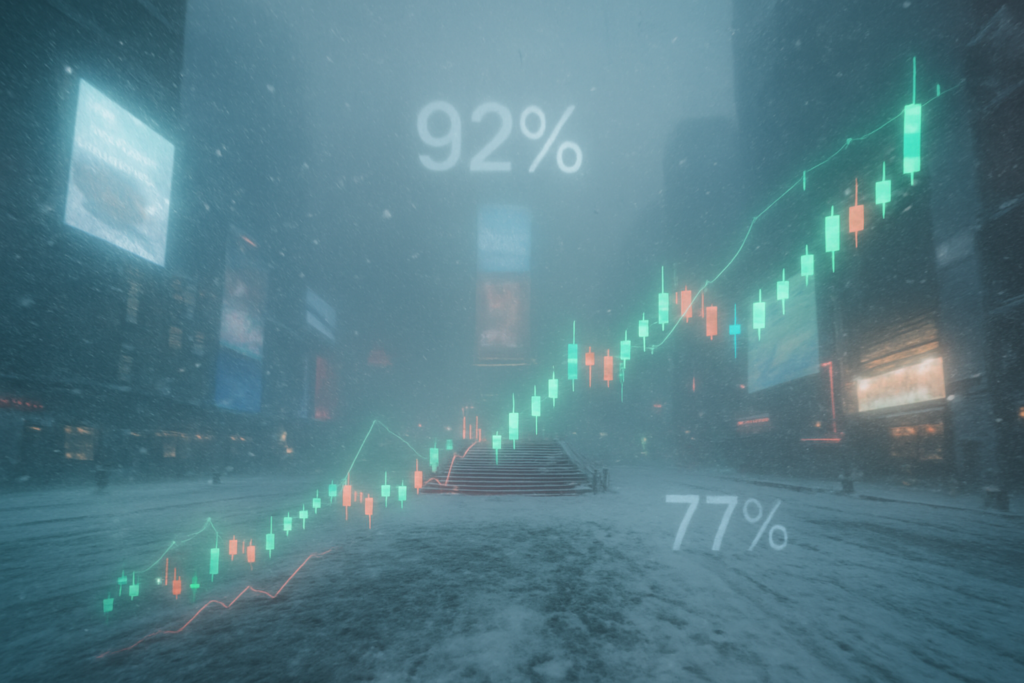
As Winter Storm Fern barrels toward the Northeast, New York City is bracing for its most significant snowfall in years, and prediction markets are reflecting the high stakes. On Kalshi, the CFTC-regulated exchange, traders have aggressively bid up the probability of a major event, with the consensus now pointing toward a heavy accumulation that could shut down the city through Monday, January 26, 2026.
Current market data indicates a staggering 92% probability that New York City will see more than 6 inches of snow by the time the storm concludes. Perhaps more surprisingly, the "long tail" of the forecast—the chance of a true blizzard scenario—is seeing significant action. Traders are currently pricing in a 77% chance that snowfall exceeds 10 inches, a sharp increase from just 48 hours ago as meteorological models began to align. This surge in betting activity has turned the weather into one of the most liquid and volatile markets on the platform this week.
The Market: What's Being Predicted
The primary hub for this activity is Kalshi, where the "Snow in NYC this month?" markets have seen a massive influx of capital. Total monthly volume for NYC snowfall contracts has surpassed $720,000, driven largely by the high-conviction trades surrounding this specific weekend window. The market is structured around tiered thresholds, allowing participants to hedge or speculate on specific accumulation levels as measured by the National Weather Service (NWS) at Central Park.
As of Saturday morning, January 24, the odds for various thresholds are:
- Above 6.0 inches: 92% ($0.92)
- Above 8.0 inches: 86% ($0.86)
- Above 10.0 inches: 77% ($0.77)
- Above 12.0 inches: 65% ($0.65)
The specific "6 to 10 inch" bracket has become a focal point for conservative bettors, though the implied probability for the storm stalling in this range is actually shrinking (now at approximately 15%) because traders are increasingly "over-betting" the higher totals. If the storm exceeds 10 inches, the "Above 6" and "Above 10" contracts both pay out, but the rapid appreciation of the "Above 12" contract—now at 65%—suggests that the market anticipates a historic over-performance rather than a moderate dusting.
Why Traders Are Betting
The primary driver for the recent market movement is the rare convergence of the two major global forecasting systems: the American GFS and the European ECMWF. Early in the week, the models were divided, with the European model suggesting a "glancing blow" of light snow and sleet. However, as of the 18z runs on January 23, the models have harmonized, both showing a powerful coastal low-pressure system deepening rapidly as it moves past the Jersey Shore.
Beyond pure speculation, there is evidence of significant hedging activity. Large positions have been observed from entities likely tied to the logistics and service industries. For example, snow removal contractors and local logistics hubs often use these markets to offset the increased operational costs—such as overtime pay and salt procurement—that a major storm triggers.
Public companies are already reacting to the forecast. The Home Depot (NYSE: HD) has reported a surge in emergency preparedness sales in the Tri-State area, while logistics giants like FedEx (NYSE: FDX) and UPS (NYSE: UPS) have issued service disruption alerts. For a professional trader or a business owner, a $0.77 contract on a "10-inch plus" event acts as an insurance policy against the inevitable economic slowdown that follows a city-wide standstill.
Broader Context and Implications
This flurry of activity highlights a growing trend: the shift of weather forecasting from a public service announcement to a high-stakes financial instrument. While traditional meteorology provides the "what" and "where," prediction markets provide a "wisdom of the crowd" assessment of the "how likely." The $720,000 monthly volume on Kalshi for a single city's snowfall suggests that these markets are moving past their niche origins and becoming essential tools for local economic planning.
Historically, weather prediction markets have shown a remarkable ability to filter out the "hype" often found in sensationalist media coverage. Because traders have real capital at risk, they tend to react only to hard data—such as model shifts or barometric pressure changes—rather than the "doom-scrolling" narratives often seen on social media. In this case, the fact that the "Above 12 inches" market is trading as high as 65% serves as a louder warning to city officials than a standard weather advisory might.
Furthermore, the regulatory environment for these markets has matured. Kalshi’s oversight by the CFTC provides a level of security and transparency that encourages larger institutions to participate. This liquidity, in turn, makes the market's "price" more accurate, creating a feedback loop where the market price becomes a reliable data point for emergency management and retail supply chain adjustments.
What to Watch Next
The most critical window for the market occurs between 1:00 AM on Sunday, January 25, and Monday afternoon. The New York City Department of Sanitation (DSNY) has already issued a high-level "Snow Alert," deploying over 2,000 workers and 700 salt spreaders. Traders should monitor the "warm nose" phenomenon—a layer of warm air that the ECMWF model suggests could sneak into the city center. If this happens, snow could turn to sleet, causing the "Above 12 inch" contracts to crash while the "6 to 10 inch" bracket potentially pays out.
Another key milestone is the official measurement at Central Park. Because prediction markets resolve based on specific, verifiable data sources, any discrepancy between localized neighborhood totals and the Central Park reading can lead to late-stage market volatility. Traders will be glued to the NWS hourly updates throughout the night on Sunday to see if the rate of accumulation matches the aggressive 1-to-2-inches-per-hour rates currently being priced in.
Bottom Line
The NYC snowfall market for January 24-26, 2026, is a textbook example of how prediction markets can aggregate complex scientific data into a single, actionable price. With over $720,000 in monthly volume, the "crowd" is signaling a high-conviction belief that Winter Storm Fern will be a transformative event for the city. The 77% probability of exceeding 10 inches is a clear indicator that the market is leaning toward a severe scenario.
For residents and businesses, these odds are more than just numbers; they are a signal to finish preparations. Whether it’s Walmart (NYSE: WMT) prepping its supply chain or a local delivery service bracing for delays, the market’s aggressive pricing of the 10-to-12-inch range suggests that the window for "hoping for the best" has closed. As the first flakes begin to fall late Saturday, the markets have already spoken: New York should prepare for a long, white weekend.
This article is for informational purposes only and does not constitute financial or betting advice. Prediction market participation may be subject to legal restrictions in your jurisdiction.
PredictStreet focuses on covering the latest developments in prediction markets.
Visit the PredictStreet website at https://www.predictstreet.ai/.