Construction materials company Vulcan Materials (NYSE: VMC) fell short of the market’s revenue expectations in Q4 CY2025 as sales rose 3.2% year on year to $1.91 billion. Its non-GAAP profit of $1.70 per share was 19.5% below analysts’ consensus estimates.
Is now the time to buy Vulcan Materials? Find out by accessing our full research report, it’s free.
Vulcan Materials (VMC) Q4 CY2025 Highlights:
- Revenue: $1.91 billion vs analyst estimates of $1.94 billion (3.2% year-on-year growth, 1.7% miss)
- Adjusted EPS: $1.70 vs analyst expectations of $2.11 (19.5% miss)
- Adjusted EBITDA: $518 million vs analyst estimates of $603.8 million (27.1% margin, 14.2% miss)
- EBITDA guidance for the upcoming financial year 2026 is $2.5 billion at the midpoint, below analyst estimates of $2.65 billion
- Operating Margin: 19.8%, down from 21.6% in the same quarter last year
- Free Cash Flow Margin: 18.7%, up from 15% in the same quarter last year
- Tons Shipped: 55.1 million, up 1.2 million year on year
- Market Capitalization: $43.29 billion
Ronnie Pruitt, Vulcan Materials' Chief Executive Officer, said, "Our aggregates-led business delivered another year of strong earnings growth and margin expansion. Adjusted EBITDA for the full year improved 13 percent over the prior year, and margin expanded 160 basis points. Through a consistent focus on commercial and operational execution, we continue to deliver attractive organic growth and expand our industry-leading aggregates cash gross profit per ton, which increased to $11.33 per ton. The resulting strong cash generation, coupled with disciplined M&A and portfolio management, positions us well to continue compounding results and creating value for our shareholders in 2026 and beyond."
Company Overview
Founded in 1909, Vulcan Materials (NYSE: VMC) is a producer of construction aggregates, primarily crushed stone, sand, and gravel.
Revenue Growth
Examining a company’s long-term performance can provide clues about its quality. Even a bad business can shine for one or two quarters, but a top-tier one grows for years. Over the last five years, Vulcan Materials grew its sales at a solid 10.3% compounded annual growth rate. Its growth beat the average industrials company and shows its offerings resonate with customers.
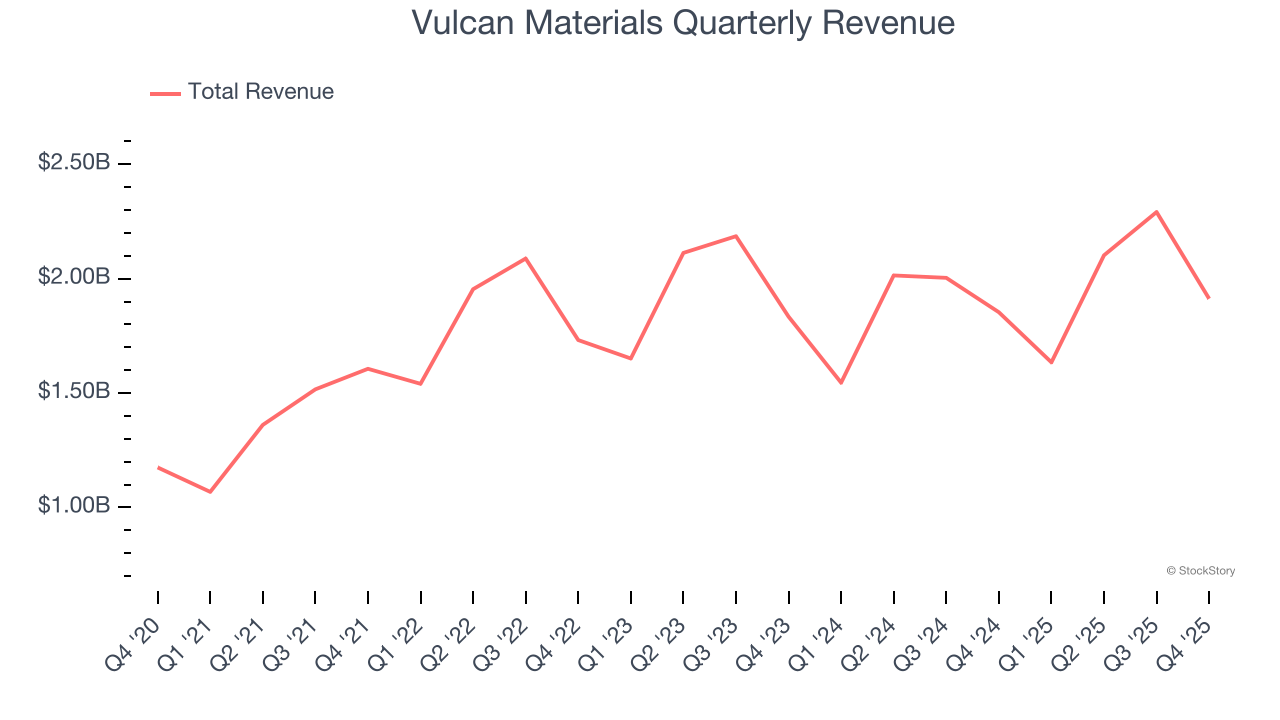
Long-term growth is the most important, but within industrials, a half-decade historical view may miss new industry trends or demand cycles. Vulcan Materials’s recent performance shows its demand has slowed as its annualized revenue growth of 1% over the last two years was below its five-year trend. We’re wary when companies in the sector see decelerations in revenue growth, as it could signal changing consumer tastes aided by low switching costs. 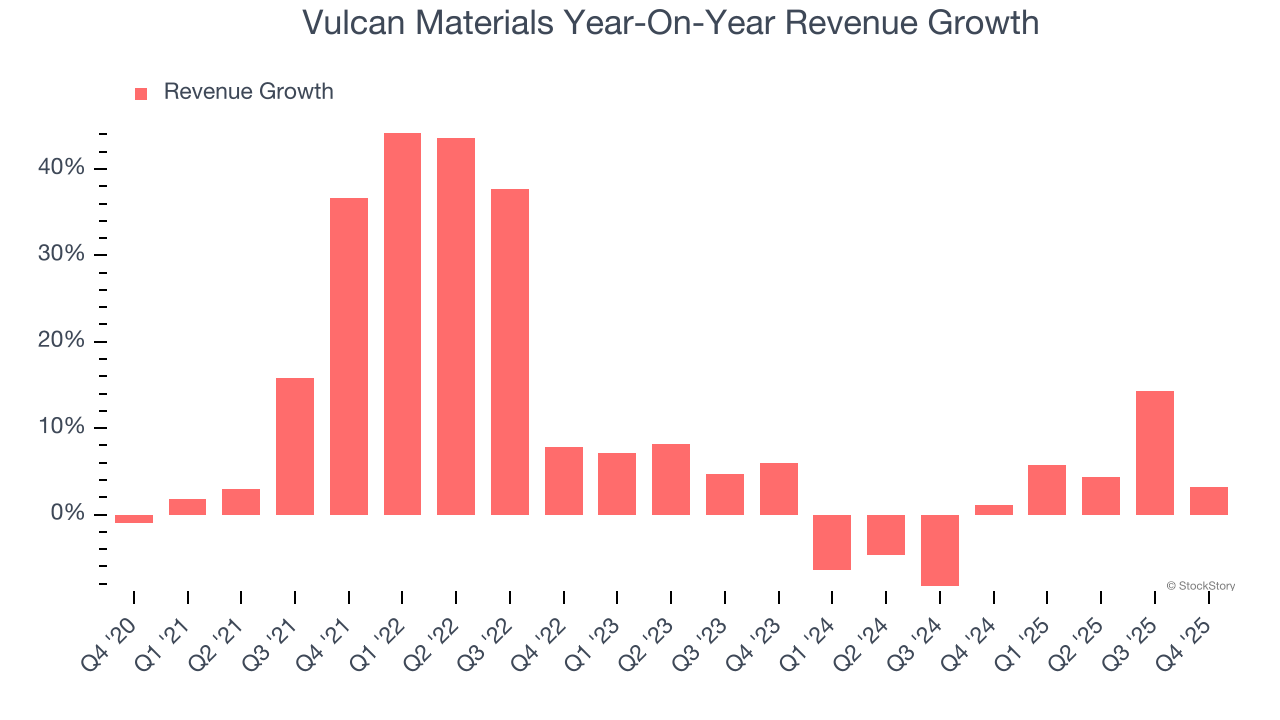
We can better understand the company’s revenue dynamics by analyzing its number of tons shipped, which reached 55.1 million in the latest quarter. Over the last two years, Vulcan Materials’s tons shipped averaged 2% year-on-year growth. Because this number aligns with its revenue growth during the same period, we can see the company’s monetization was fairly consistent. 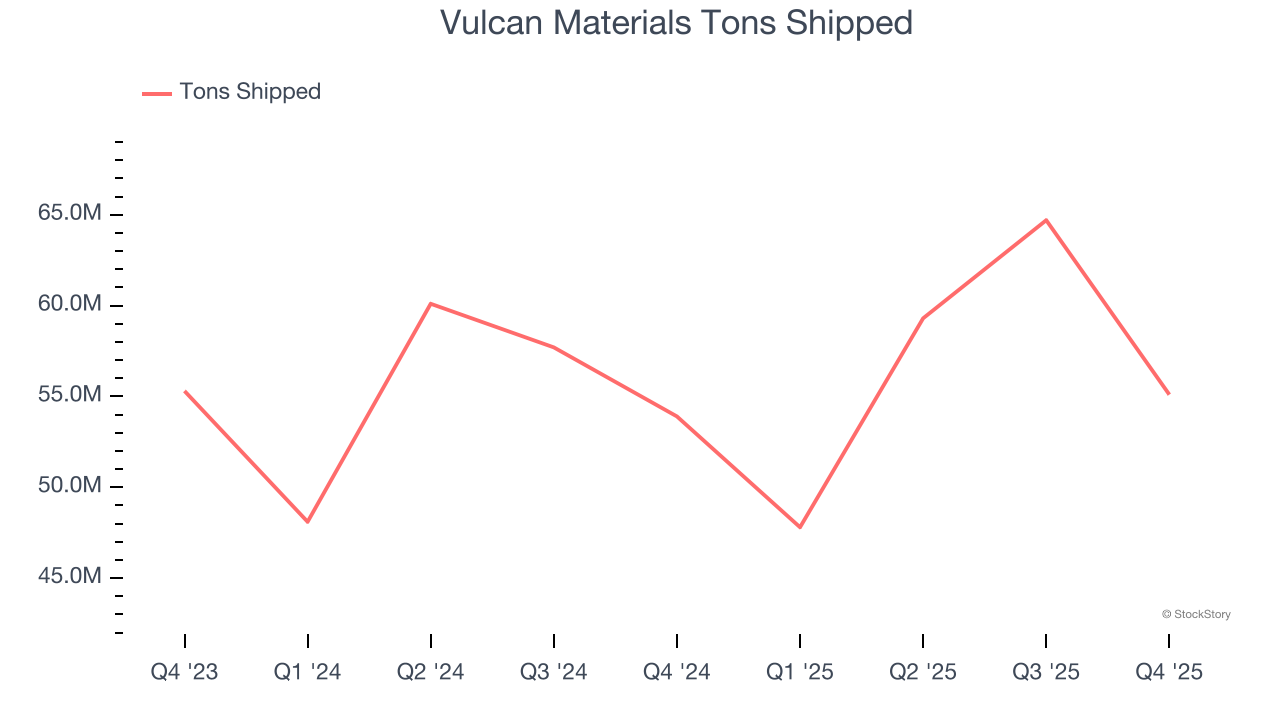
This quarter, Vulcan Materials’s revenue grew by 3.2% year on year to $1.91 billion, falling short of Wall Street’s estimates.
Looking ahead, sell-side analysts expect revenue to grow 5% over the next 12 months. While this projection implies its newer products and services will catalyze better top-line performance, it is still below the sector average.
Microsoft, Alphabet, Coca-Cola, Monster Beverage—all began as under-the-radar growth stories riding a massive trend. We’ve identified the next one: a profitable AI semiconductor play Wall Street is still overlooking. Go here for access to our full report.
Operating Margin
Vulcan Materials has been a well-oiled machine over the last five years. It demonstrated elite profitability for an industrials business, boasting an average operating margin of 17.7%. This result was particularly impressive because of its low gross margin, which is mostly a factor of what it sells and takes huge shifts to move meaningfully. Companies have more control over their operating margins, and it’s a show of well-managed operations if they’re high when gross margins are low.
Analyzing the trend in its profitability, Vulcan Materials’s operating margin rose by 2.2 percentage points over the last five years, as its sales growth gave it operating leverage.
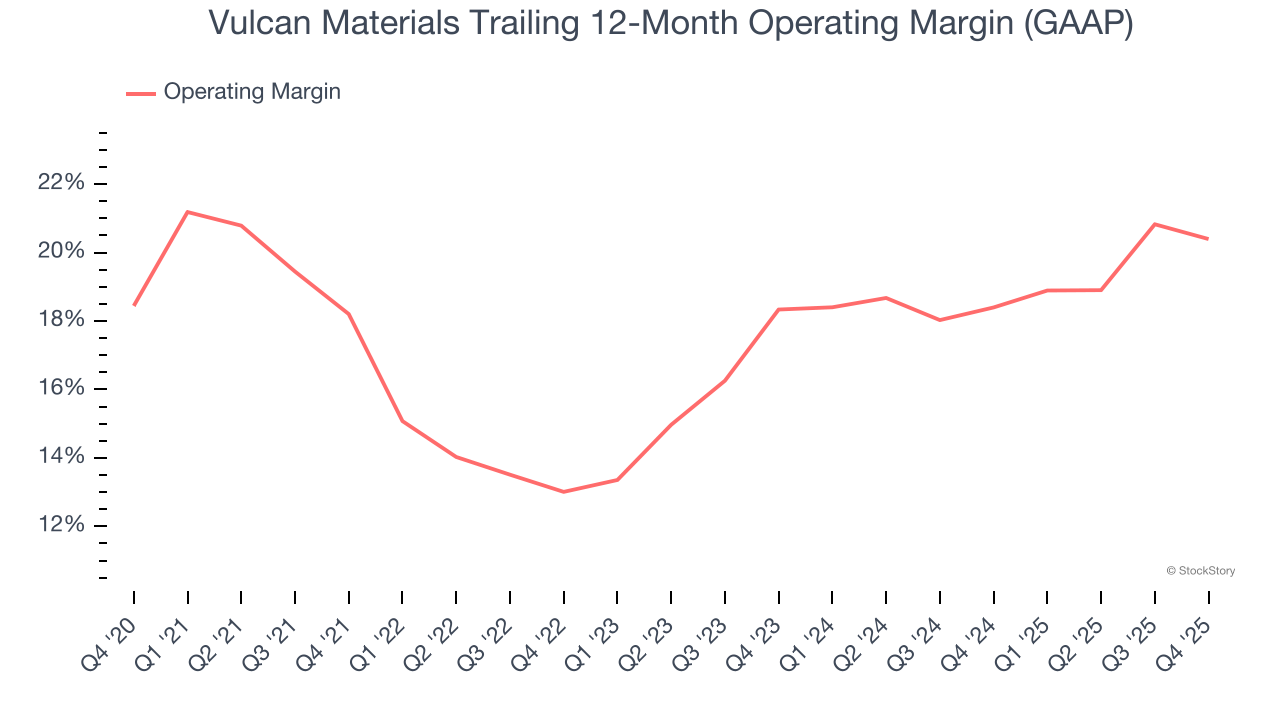
In Q4, Vulcan Materials generated an operating margin profit margin of 19.8%, down 1.8 percentage points year on year. Since Vulcan Materials’s gross margin decreased more than its operating margin, we can assume its recent inefficiencies were driven more by weaker leverage on its cost of sales rather than increased marketing, R&D, and administrative overhead expenses.
Earnings Per Share
Revenue trends explain a company’s historical growth, but the long-term change in earnings per share (EPS) points to the profitability of that growth – for example, a company could inflate its sales through excessive spending on advertising and promotions.
Vulcan Materials’s solid 11.2% annual EPS growth over the last five years aligns with its revenue performance. This tells us its incremental sales were profitable.
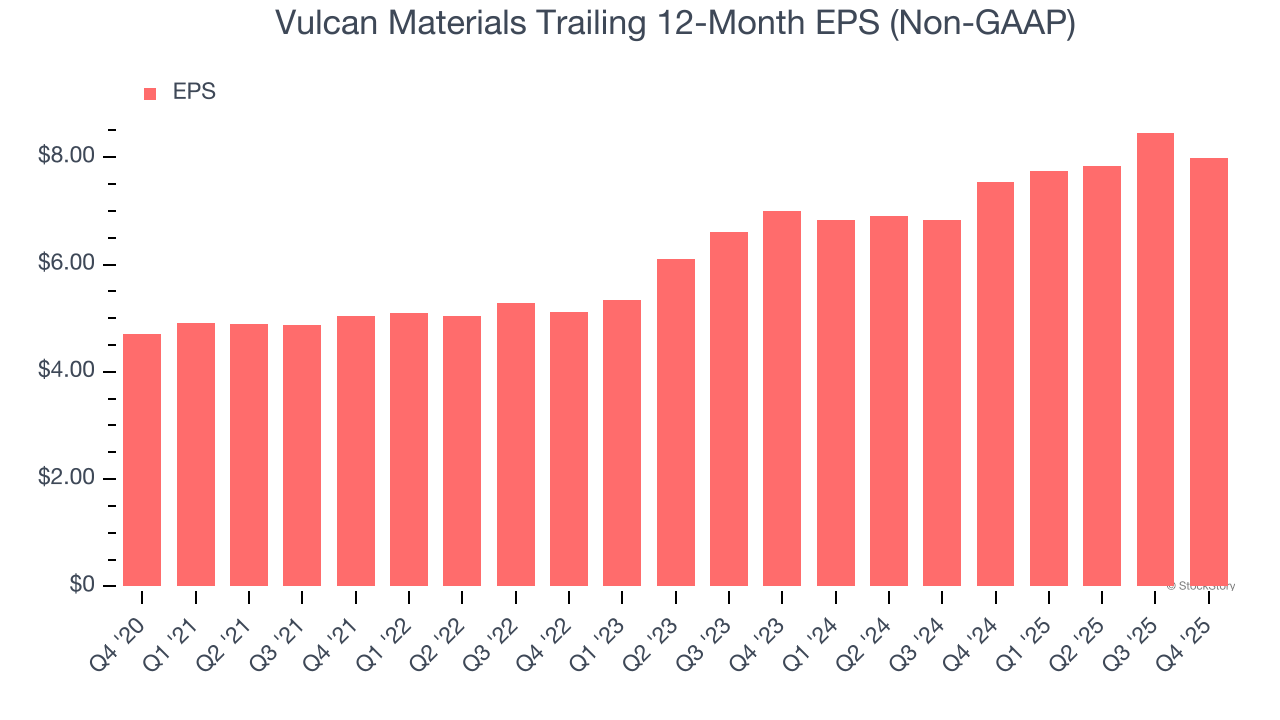
Like with revenue, we analyze EPS over a more recent period because it can provide insight into an emerging theme or development for the business.
Although it wasn’t great, Vulcan Materials’s two-year annual EPS growth of 6.9% topped its 1% two-year revenue growth.
Diving into the nuances of Vulcan Materials’s earnings can give us a better understanding of its performance. A two-year view shows that Vulcan Materials has repurchased its stock, shrinking its share count by 1%. This tells us its EPS outperformed its revenue not because of increased operational efficiency but financial engineering, as buybacks boost per share earnings. 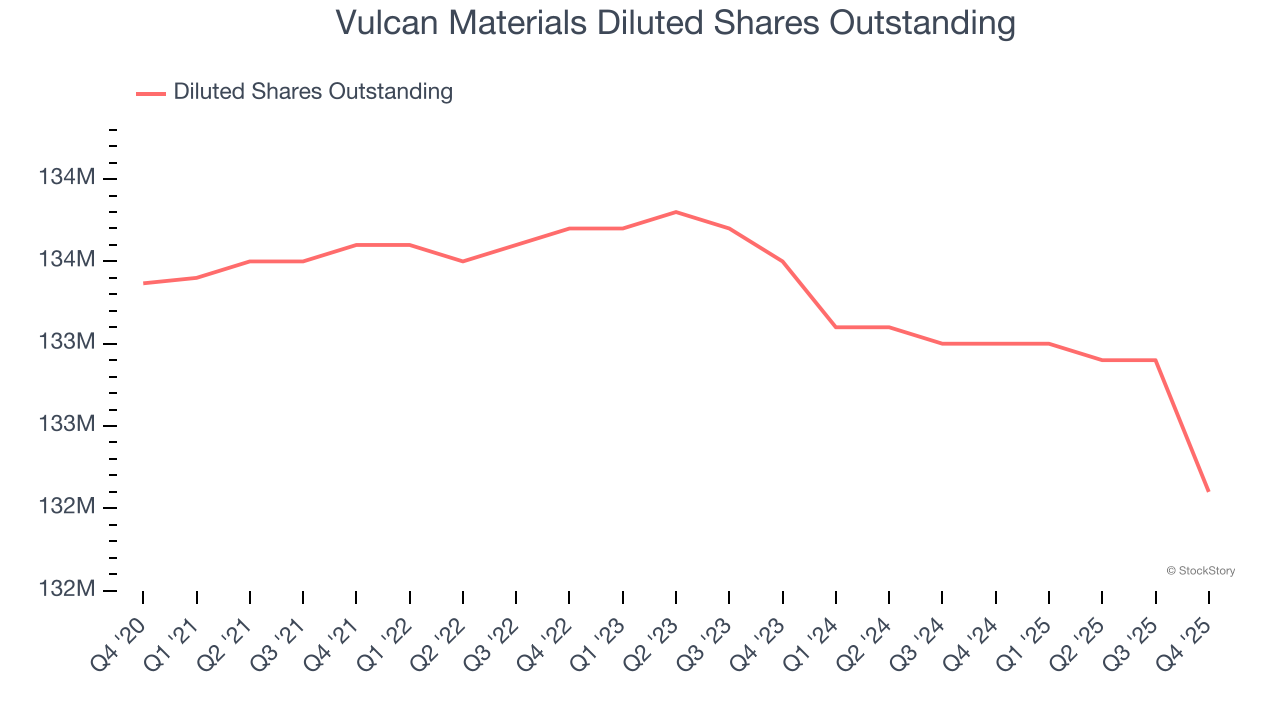
In Q4, Vulcan Materials reported adjusted EPS of $1.70, down from $2.17 in the same quarter last year. This print missed analysts’ estimates, but we care more about long-term adjusted EPS growth than short-term movements. Over the next 12 months, Wall Street expects Vulcan Materials’s full-year EPS of $7.99 to grow 22%.
Key Takeaways from Vulcan Materials’s Q4 Results
We struggled to find many positives in these results. Its full-year EBITDA guidance missed and its EBITDA fell short of Wall Street’s estimates. Overall, this quarter could have been better. The stock traded down 7.6% to $302.89 immediately following the results.
Vulcan Materials’s latest earnings report disappointed. One quarter doesn’t define a company’s quality, so let’s explore whether the stock is a buy at the current price. We think that the latest quarter is only one piece of the longer-term business quality puzzle. Quality, when combined with valuation, can help determine if the stock is a buy. We cover that in our actionable full research report which you can read here (it’s free).