GoodRx’s stock price has taken a beating over the past six months, shedding 56.5% of its value and falling to $2.23 per share. This was partly due to its softer quarterly results and may have investors wondering how to approach the situation.
Is now the time to buy GoodRx, or should you be careful about including it in your portfolio? Dive into our full research report to see our analyst team’s opinion, it’s free.
Why Do We Think GoodRx Will Underperform?
Even with the cheaper entry price, we're cautious about GoodRx. Here are three reasons we avoid GDRX and a stock we'd rather own.
1. Declining Customer Base Reflects Product and Sales Weakness
Revenue growth can be broken down into the number of customers and the average spend per customer. Both are important because an increasing customer base leads to more upselling opportunities while the revenue per customer shows how successful a company was in executing its upselling strategy.
GoodRx’s total customers came in at 5.4 million in the latest quarter, and over the last two years, their count averaged 6.1% year-on-year declines. This performance was underwhelming and shows the company lost deals and renewals. It also suggests there may be increasing competition or market saturation. 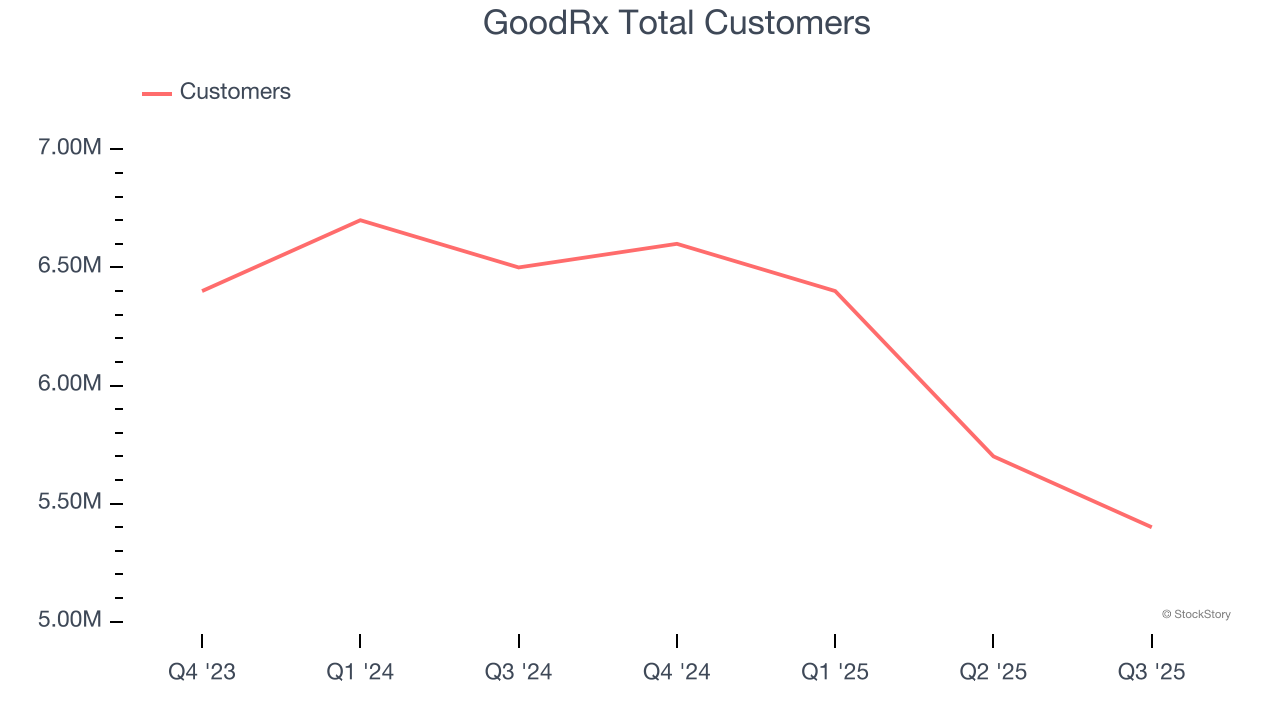
2. Fewer Distribution Channels Limit its Ceiling
Larger companies benefit from economies of scale, where fixed costs like infrastructure, technology, and administration are spread over a higher volume of goods or services, reducing the cost per unit. Scale can also lead to bargaining power with suppliers, greater brand recognition, and more investment firepower. A virtuous cycle can ensue if a scaled company plays its cards right.
With just $800.7 million in revenue over the past 12 months, GoodRx is a small company in an industry where scale matters. This makes it difficult to build trust with customers because healthcare is heavily regulated, complex, and resource-intensive.
3. Previous Growth Initiatives Have Lost Money
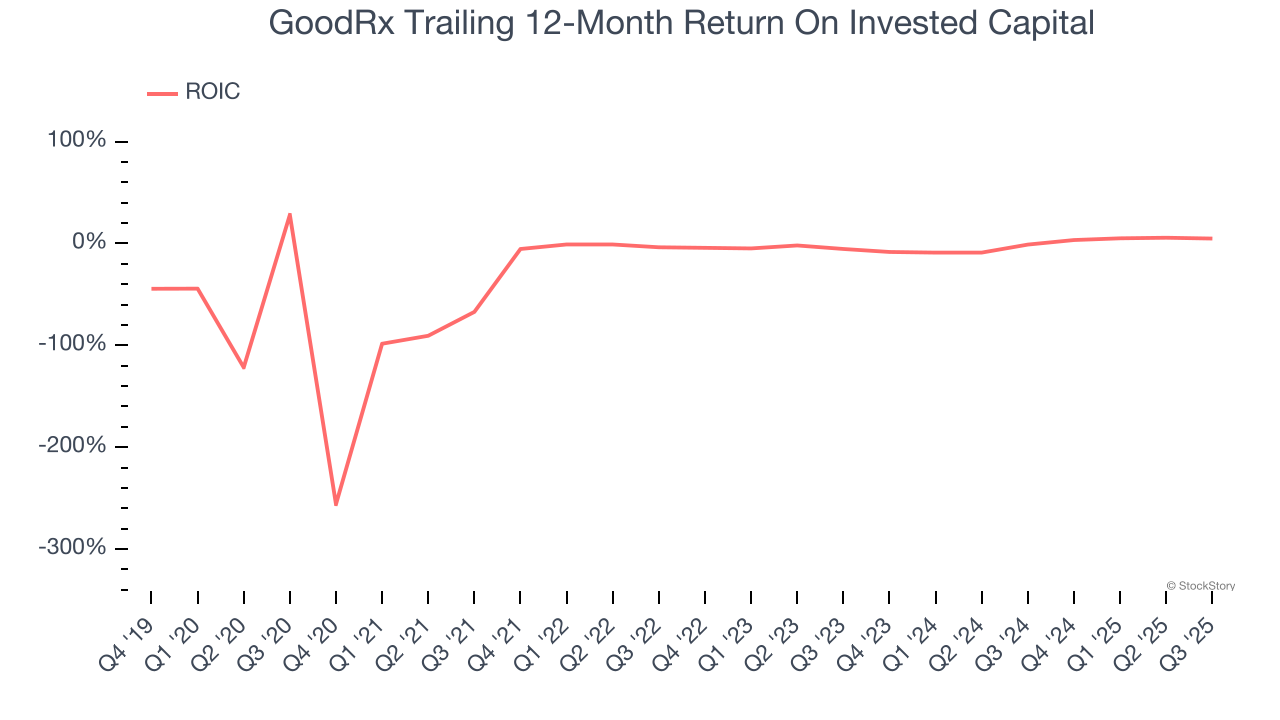
Growth gives us insight into a company’s long-term potential, but how capital-efficient was that growth? Enter ROIC, a metric showing how much operating profit a company generates relative to the money it has raised (debt and equity).
GoodRx’s five-year average ROIC was negative 14.5%, meaning management lost money while trying to expand the business. Its returns were among the worst in the healthcare sector.
Final Judgment
We see the value of companies making people healthier, but in the case of GoodRx, we’re out. Following the recent decline, the stock trades at 5.5× forward P/E (or $2.23 per share). While this valuation is optically cheap, the potential downside is huge given its shaky fundamentals. There are more exciting stocks to buy at the moment. Let us point you toward an all-weather company that owns household favorite Taco Bell.
Stocks We Would Buy Instead of GoodRx
Your portfolio can’t afford to be based on yesterday’s story. The risk in a handful of heavily crowded stocks is rising daily.
The names generating the next wave of massive growth are right here in our Top 5 Strong Momentum Stocks for this week. This is a curated list of our High Quality stocks that have generated a market-beating return of 244% over the last five years (as of June 30, 2025).
Stocks that have made our list include now familiar names such as Nvidia (+1,326% between June 2020 and June 2025) as well as under-the-radar businesses like the once-micro-cap company Tecnoglass (+1,754% five-year return). Find your next big winner with StockStory today.