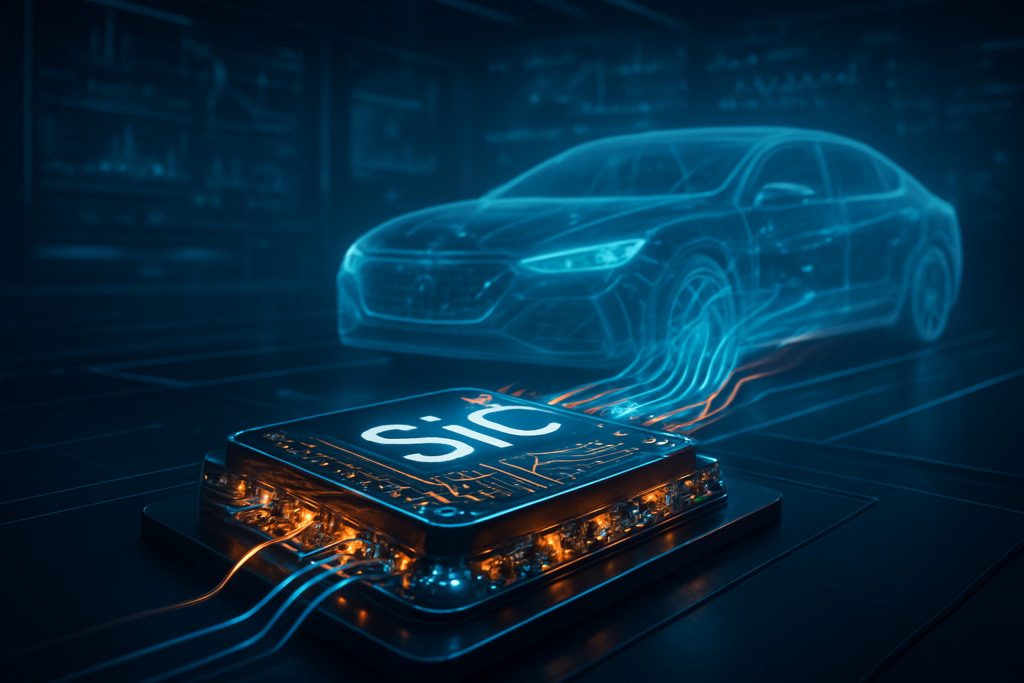
The global transition toward electric mobility has reached a critical inflection point as two of the world’s most influential engineering powerhouses, Fuji Electric Co., Ltd. (TSE: 6504), and Robert Bosch GmbH, have solidified a strategic partnership to standardize Silicon Carbide (SiC) power semiconductor modules. This collaboration, which has matured into a cornerstone of the 2025 automotive supply chain, focuses on the development of "package-compatible" modules designed to harmonize the physical and electrical interfaces of high-efficiency inverters. By aligning their manufacturing standards, the two companies are addressing one of the most significant bottlenecks in EV production: the lack of interchangeable, high-performance power components.
The immediate significance of this announcement lies in its potential to de-risk the EV supply chain while simultaneously pushing the boundaries of vehicle performance. As the industry moves toward 800-volt architectures and increasingly sophisticated AI-driven energy management systems, the ability to dual-source package-compatible SiC modules allows automakers to scale production without the fear of vendor lock-in or mechanical redesigns. This standardization is expected to be a primary catalyst for the next wave of EV adoption, offering consumers longer driving ranges and faster charging times through superior semiconductor efficiency.
The Engineering of Efficiency: Trench Gates and Package Compatibility
At the heart of the Fuji-Bosch alliance is a shared commitment to 3rd-generation Silicon Carbide technology. Unlike traditional silicon-based Insulated Gate Bipolar Transistors (IGBTs), which have dominated power electronics for decades, SiC MOSFETs offer significantly lower switching losses and higher thermal conductivity. The partnership specifically targets the 750-volt and 1,200-volt classes, utilizing advanced "trench gate" structures that allow for higher current densities in a smaller footprint. By leveraging Fuji Electric’s proprietary 3D wiring packaging and Bosch’s PM6.1 platform, the modules achieve inverter efficiencies exceeding 99%, effectively reducing energy waste by up to 80% compared to legacy silicon systems.
The "package-compatible" nature of these modules is perhaps the most disruptive technical feature. Historically, power modules have been proprietary, forcing Original Equipment Manufacturers (OEMs) to design their inverters around a specific supplier's mechanical footprint. The Fuji-Bosch standard ensures that the outer dimensions, terminal positions, and mounting points are identical. This "plug-and-play" capability for high-power semiconductors means that a single inverter design can accommodate either a Bosch or a Fuji Electric module. This level of standardization is unprecedented in the high-power semiconductor space and mirrors the early standardization of battery cell formats that helped stabilize the EV market.
Initial reactions from the semiconductor research community have been overwhelmingly positive, with experts noting that this move effectively creates a "second source" ecosystem for SiC. While competitors like STMicroelectronics (NYSE: STM) and Infineon Technologies AG (ETR: IFX) have led the market through sheer volume, the Fuji-Bosch alliance offers a unique value proposition: the reliability of two world-class manufacturers providing identical form factors. This technical synergy is viewed as a direct response to the supply chain vulnerabilities exposed in recent years, ensuring that the "brain" of the EV—the inverter—remains resilient against localized disruptions.
Redefining the Semiconductor Supply Chain and Market Dynamics
This partnership creates a formidable challenge to the current hierarchy of the power semiconductor market. By standardizing their offerings, Fuji Electric and Bosch are positioning themselves as the preferred partners for Tier 1 suppliers and major automakers like the Volkswagen Group or Toyota Motor Corporation (TSE: 7203). For Fuji Electric, the alliance provides a massive entry point into the European automotive market, where Bosch maintains a dominant footprint. Conversely, Bosch gains access to Fuji’s cutting-edge 3G SiC manufacturing capabilities, ensuring a steady supply of high-yield wafers and chips as global demand for SiC is projected to triple by 2027.
The competitive implications extend to the very top of the tech industry. As EVs become "computers on wheels," the demand for efficient power delivery to support high-performance AI chips—such as those from NVIDIA Corporation (NASDAQ: NVDA)—has skyrocketed. These AI-defined vehicles require massive amounts of power for autonomous driving sensors and real-time data processing. The efficiency gains provided by the Fuji-Bosch SiC modules ensure that this increased "compute load" does not come at the expense of the vehicle’s driving range. By optimizing the power stage, these modules allow more of the battery's energy to be diverted to the onboard AI systems that define the modern driving experience.
Furthermore, this development is likely to disrupt the pricing power of existing SiC leaders. As the Fuji-Bosch standard gains traction, it may force other players to adopt similar compatible footprints or risk being designed out of future vehicle platforms. The market positioning here is clear: Fuji and Bosch are not just selling a component; they are selling a standard. This strategic advantage is particularly potent in 2025, as automakers are under intense pressure to lower the "Total Cost of Ownership" (TCO) for EVs to achieve mass-market parity with internal combustion engines.
The Silicon Carbide Catalyst in the AI-Defined Vehicle
The broader significance of this partnership transcends simple hardware manufacturing; it is a foundational step in the evolution of the "AI-Defined Vehicle" (ADV). In the current landscape, the efficiency of the power powertrain is the primary constraint on how much intelligence a vehicle can possess. Every watt saved in the inverter is a watt that can be used for edge AI processing, high-fidelity sensor fusion, and sophisticated infotainment systems. By improving inverter efficiency, Fuji Electric and Bosch are effectively expanding the "energy budget" for AI, enabling more advanced autonomous features without requiring larger, heavier, and more expensive battery packs.
This shift fits into a wider trend of "electrification meeting automation." Just as AI has revolutionized software development, SiC is revolutionizing the physics of power. The transition to SiC is often compared to the transition from vacuum tubes to silicon transistors in the mid-20th century—a fundamental leap that enables entirely new architectures. However, the move to SiC also brings concerns regarding the raw material supply chain. The production of SiC wafers is significantly more energy-intensive and complex than traditional silicon, leading to potential bottlenecks in the availability of high-quality "boules" (the crystalline ingots from which wafers are sliced).
Despite these concerns, the Fuji-Bosch alliance is seen as a stabilizing force. By standardizing the packaging, they allow for a more efficient allocation of the global SiC supply. If one manufacturing facility faces a production delay, the "package-compatible" nature of the modules allows the industry to pivot to the other partner's supply without halting vehicle production lines. This level of systemic redundancy is a hallmark of a maturing industry and a necessary prerequisite for the widespread adoption of Level 3 and Level 4 autonomous driving systems, which require absolute reliability in power delivery.
The Road to 800-Volt Dominance and Beyond
Looking ahead, the next 24 to 36 months will likely see the rapid proliferation of 800-volt battery systems, driven in large part by the availability of these standardized SiC modules. Higher voltage systems allow for significantly faster charging—potentially adding 200 miles of range in under 15 minutes—but they require the robust thermal management and high-voltage tolerance that only SiC can provide. Experts predict that by 2026, the Fuji-Bosch standard will be the benchmark for mid-to-high-range EVs, with potential applications extending into electric heavy-duty trucking and even urban air mobility (UAM) drones.
The next technical challenge on the horizon involves the integration of "Smart Sensing" directly into the SiC modules. Future iterations of the Fuji-Bosch partnership are expected to include embedded sensors that use AI to monitor the "health" of the semiconductor in real-time, predicting failures before they occur. This "proactive maintenance" capability will be essential for fleet operators and autonomous taxi services, where vehicle uptime is the primary metric of success. As we move toward 2030, the line between power electronics and digital logic will continue to blur, with SiC modules becoming increasingly "intelligent" components of the vehicle's central nervous system.
A New Standard for the Electric Era
The partnership between Fuji Electric and Robert Bosch marks a definitive end to the "Wild West" era of proprietary EV power electronics. By prioritizing package compatibility and standardization, these two giants have provided a blueprint for how the industry can scale to meet the ambitious electrification targets of the late 2020s. The resulting improvements in inverter efficiency and driving range are not just incremental upgrades; they are the keys to unlocking the mass-market potential of electric vehicles.
As we look toward the final weeks of 2025 and into 2026, the industry will be watching closely to see how quickly other manufacturers adopt this new standard. The success of this alliance serves as a powerful reminder that in the race toward a sustainable and AI-driven future, collaboration on foundational hardware is just as important as competition in software. For the consumer, the impact will be felt in the form of more affordable, longer-range EVs that charge faster and perform better, finally bridging the gap between the internal combustion past and the electrified future.
This content is intended for informational purposes only and represents analysis of current AI and technology developments.
TokenRing AI delivers enterprise-grade solutions for multi-agent AI workflow orchestration, AI-powered development tools, and seamless remote collaboration platforms.
For more information, visit https://www.tokenring.ai/.