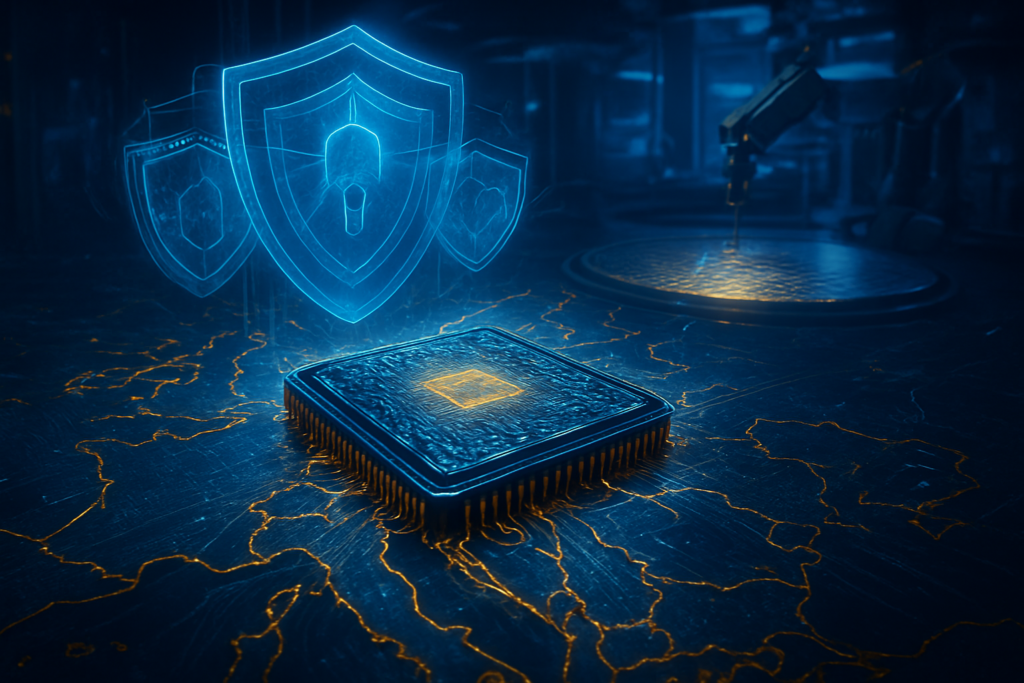
As of January 2, 2026, the global semiconductor landscape has undergone a tectonic shift, driven by the European Union’s aggressive "Silicon Sovereignty" initiative. What began as a response to pandemic-era supply chain vulnerabilities has evolved into a comprehensive security-first doctrine. By implementing the first enforcement phase of the Cyber Resilience Act (CRA) and the revamped EU Chips Act 2.0, Brussels has effectively erected a "Silicon Shield," prioritizing the security and traceability of high-tech components over the raw volume of production. This movement is not merely about manufacturing; it is a fundamental reconfiguration of the global trade landscape, mandating that any silicon entering the European market meets stringent "Security-by-Design" standards that are now setting a new global benchmark.
The immediate significance of this crackdown lies in its focus on the "hardware root of trust." Unlike previous decades where security was largely a software-level concern, the EU now legally mandates that microprocessors and sensors contain immutable security features at the silicon level. This has created a bifurcated global market: chips destined for Europe must undergo rigorous third-party assessments to earn a "CE" security mark, while less secure components are increasingly relegated to secondary markets. For the artificial intelligence industry, this means that the hardware running the next generation of LLMs and edge devices is becoming more transparent, more secure, and significantly more integrated into the European geopolitical sphere.
Technically, the push for Silicon Sovereignty is anchored by the full operational status of five major "Pilot Lines" across the continent, coordinated by the Chips for Europe initiative. The NanoIC line at imec in Belgium is now testing sub-2nm architectures, while the FAMES line at CEA-Leti in France is pioneering Fully Depleted Silicon-on-Insulator (FD-SOI) technology. These advancements differ from previous approaches by moving away from general-purpose logic and toward specialized, energy-efficient "Green AI" hardware. The focus is on low-power inference at the edge, where security is baked into the physical gate architecture to prevent side-channel attacks and unauthorized data exfiltration—a critical requirement for the EU’s strict data privacy laws.
The Cyber Resilience Act has introduced a technical mandate for "Active Vulnerability Reporting," requiring chipmakers to report exploited hardware flaws to the European Union Agency for Cybersecurity (ENISA) within 24 hours. This level of transparency is unprecedented in the semiconductor industry, which has traditionally guarded hardware errata as trade secrets. Industry experts from the AI research community have noted that these standards are forcing a shift from "black box" hardware to "verifiable silicon." By utilizing RISC-V open-source architectures for sovereign AI accelerators, European researchers are attempting to eliminate the "backdoor" risks often associated with proprietary instruction set architectures.
Initial reactions from the industry have been a mix of praise for the enhanced security and concern over the cost of compliance. While the European Design Platform has successfully onboarded over 100 startups by providing low-barrier access to Electronic Design Automation (EDA) tools, the cost of third-party security audits for "Critical Class II" products—which include most AI-capable microprocessors—has added a significant layer of overhead. Nevertheless, the consensus among security experts is that this "Iron Curtain of Silicon" is a necessary evolution in an era where hardware-level vulnerabilities can compromise entire national infrastructures.
This shift has created a new hierarchy among tech giants and specialized semiconductor firms. ASML Holding N.V. (NASDAQ: ASML) has emerged as the linchpin of this strategy, with the Dutch government fully aligning its export licenses for High-NA EUV lithography systems with the EU’s broader economic security goals. This alignment has effectively restricted the most advanced manufacturing capabilities to a "G7+ Chip Coalition," leaving competitors in non-aligned regions struggling to keep pace with the sub-2nm transition. Meanwhile, STMicroelectronics N.V. (NYSE: STM) and NXP Semiconductors N.V. (NASDAQ: NXPI) have seen their market positions bolstered as the primary providers of secure, automotive-grade AI chips that meet the new EU mandates.
Intel Corporation (NASDAQ: INTC) has faced a more complex path; while its massive "Magdeburg" project in Germany saw delays throughout 2025, its Fab 34 in Leixlip, Ireland, has become the lead European hub for high-volume 3nm production. This has allowed Intel to position itself as a "sovereign-friendly" foundry for European AI startups like Mistral AI and Aleph Alpha. Conversely, Taiwan Semiconductor Manufacturing Company (NYSE: TSM) has had to adapt its European strategy, focusing heavily on specialized 12nm and 16nm nodes for the industrial and automotive sectors in its Dresden facility to satisfy the EU’s demand for local, secure supply chains for "Smart Power" applications.
The competitive implications are profound for major AI labs. Companies that rely on highly centralized, non-transparent hardware may find themselves locked out of European government and critical infrastructure contracts. This has spurred a wave of strategic partnerships where software giants are co-designing hardware with European firms to ensure compliance. For instance, the integration of "Sovereign LLMs" directly onto NXP’s secure automotive platforms has become a blueprint for how AI companies can maintain a foothold in the European market by prioritizing local security standards over raw processing speed.
Beyond the technical and corporate spheres, the "Silicon Sovereignty" movement represents a major milestone in the history of AI and global trade. It marks the end of the "borderless silicon" era, where components were designed in one country, manufactured in another, and packaged in a third with little regard for the geopolitical implications of the underlying hardware. This new era of "Technological Statecraft" mirrors the Cold War-era export controls but with a modern focus on AI safety and cybersecurity. The EU's move is a direct challenge to the dominance of both US-centric and China-centric supply chains, attempting to carve out a third way that prioritizes democratic values and data sovereignty.
However, this fragmentation raises concerns about the "Balkanization" of the AI industry. If different regions mandate vastly different hardware security standards, the cost of developing global AI products could skyrocket. There is also the risk of a "security-performance trade-off," where the overhead required for real-time hardware monitoring and encrypted memory paths could make European-compliant chips slower or more expensive than their less-regulated counterparts. Comparisons are being made to the GDPR’s impact on the software industry; while initially seen as a burden, it eventually became a global gold standard that other regions felt compelled to emulate.
The wider significance also touches on the environmental impact of AI. By focusing on "Green AI" and energy-efficient edge computing, Europe is attempting to lead the transition to a more sustainable AI infrastructure. The EU Chips Act’s support for Wide-Bandgap semiconductors, such as Silicon Carbide and Gallium Nitride, is a crucial part of this, enabling more efficient power conversion for the massive data centers required to train and run large-scale AI models. This "Green Sovereignty" adds a moral and environmental dimension to the geopolitical struggle for chip dominance.
Looking ahead to the rest of 2026 and beyond, the next major milestone will be the full implementation of the Silicon Box (a €3.2B chiplet fab in Italy), which aims to bring advanced packaging capabilities back to European soil. This is critical because, until now, even chips designed and etched in Europe often had to be sent to Asia for the final "back-end" processing, creating a significant security gap. Once this facility is operational, the EU will possess a truly end-to-end sovereign supply chain for advanced AI chiplets.
Experts predict that the focus will soon shift from logic chips to "Photonic Integrated Circuits" (PICs). The PIXEurope pilot line is expected to yield the first commercially viable light-based AI accelerators by 2027, which could offer a 10x improvement in energy efficiency for neural network processing. The challenge will be scaling these technologies and ensuring that the European ecosystem can attract enough high-tier talent to compete with the massive R&D budgets of Silicon Valley. Furthermore, the ongoing "Lithography War" will remain a flashpoint, as China continues to invest heavily in domestic alternatives to ASML’s technology, potentially leading to a complete decoupling of the global semiconductor market.
In summary, Europe's crackdown on semiconductor security and its push for Silicon Sovereignty have fundamentally altered the trajectory of the AI industry. By mandating "Security-by-Design" and investing in a localized, secure supply chain, the EU has moved from a position of dependency to one of strategic influence. The key takeaways from this transition are the elevation of hardware security to a legal requirement, the rise of specialized "Green AI" architectures, and the emergence of a "G7+ Chip Coalition" that uses high-tech monopolies like High-NA EUV as diplomatic leverage.
This development will likely be remembered as the moment when the geopolitical reality of AI hardware finally caught up with the borderless ambitions of AI software. As we move further into 2026, the industry must watch for the first wave of CRA-related enforcement actions and the progress of the "AI Factories" being built under the EuroHPC initiative. The "Fortress of Silicon" is now under construction, and its walls are being built with the dual bricks of security and sovereignty, forever changing how the world trades in the intelligence of the future.
This content is intended for informational purposes only and represents analysis of current AI developments.
TokenRing AI delivers enterprise-grade solutions for multi-agent AI workflow orchestration, AI-powered development tools, and seamless remote collaboration platforms.
For more information, visit https://www.tokenring.ai/.