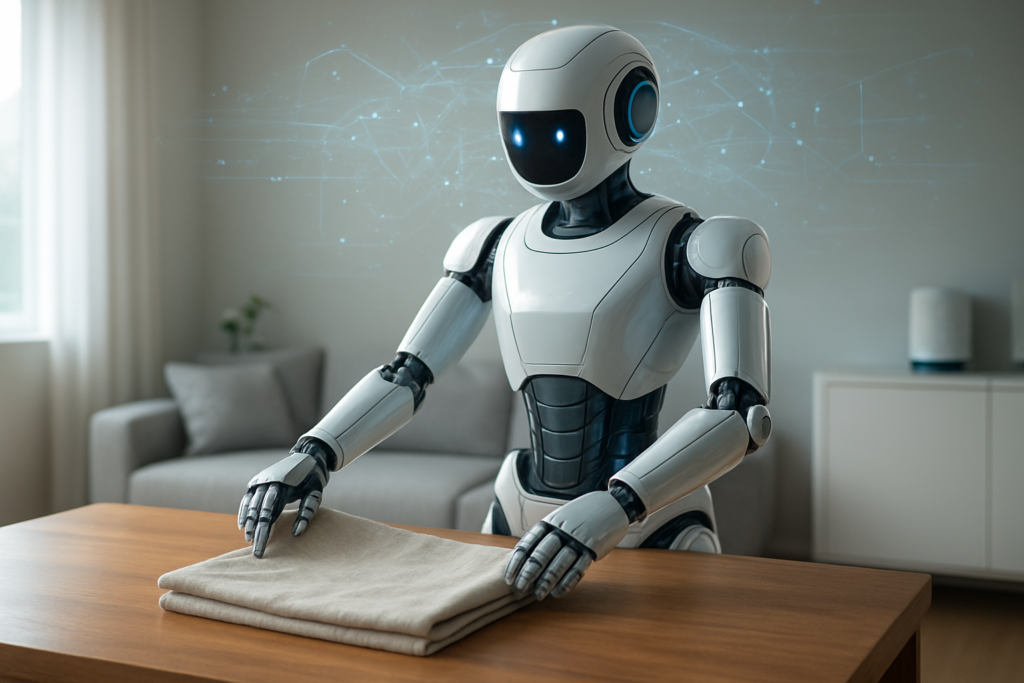
LAS VEGAS — The dream of a home where laundry folds itself and the dishwasher unloads while you sleep moved one step closer to reality today. At the 2026 Consumer Electronics Show (CES), LG Electronics (KRX: 066570) unveiled its most ambitious project to date: CLOiD, an AI-powered domestic robot designed to serve as the physical manifestation of the company’s "Zero Labor Home" vision. While previous iterations of home robots were often relegated to vacuuming floors or acting as stationary smart speakers, CLOiD represents a leap into "Physical AI," featuring human-like dexterity and the intelligence to navigate the messy, unpredictable environment of a family household.
The debut of CLOiD marks a significant pivot for the consumer electronics giant, shifting from "smart appliances" to "autonomous agents." LG’s vision is simple yet profound: to transform the home from a place of chores into a sanctuary of relaxation. By integrating advanced robotics with what LG calls "Affectionate Intelligence," CLOiD is intended to understand the context of a household—recognizing when a child has left toys on the floor or when the dryer has finished its cycle—and taking proactive action without needing a single voice command.
Technical Mastery: From Vision to Action
CLOiD is a marvel of modern engineering, standing on a stable, wheeled base but featuring a humanoid upper body with two highly articulated arms. Each arm boasts seven degrees of freedom (DOF), mimicking the full range of motion of a human limb. The true breakthrough, however, lies in its hands. Equipped with five independently actuated fingers, CLOiD demonstrated the ability to perform "fine manipulation" tasks that have long eluded domestic robots. During the CES keynote, the robot was seen delicately picking up a wine glass from a dishwasher and placing it in a high cabinet, as well as sorting and folding a basket of mixed laundry—including difficult items like hoodies and fitted sheets.
Under the hood, CLOiD is powered by the Qualcomm (NASDAQ: QCOM) Robotics RB5 Platform and utilizes Vision-Language-Action (VLA) models. Unlike traditional robots that follow pre-programmed scripts, CLOiD uses these AI models to translate visual data and natural language instructions into complex motor movements in real-time. This is supported by LG’s new proprietary "AXIUM" actuators—high-torque, lightweight robotic joints that allow for smooth, human-like motion. The robot also utilizes a suite of LiDAR sensors and 3D cameras to map homes with centimeter-level precision, ensuring it can navigate around pets and furniture without incident.
Initial reactions from the AI research community have been cautiously optimistic. Experts praised the integration of VLA models, noting that CLOiD’s ability to understand commands like "clean up the living room" requires a sophisticated level of semantic reasoning. However, many noted that the robot’s pace remains "methodical." In live demos, folding a single towel took nearly 40 seconds—a speed that, while impressive for a machine, still lags behind human efficiency. "We are seeing the 'Netscape moment' for home robotics," said one industry analyst. "It’s not perfect yet, but the foundation for a mass-market product is finally here."
The Battle for the Living Room: Competitive Implications
LG’s entrance into the humanoid space puts it on a direct collision course with Tesla (NASDAQ: TSLA) and its Optimus Gen 3 robot. While Tesla has focused on a bipedal (two-legged) design intended for both factory and home use, LG has opted for a wheeled base, prioritizing stability and battery life for the domestic environment. This strategic choice may give LG an edge in the near term, as bipedal balance remains one of the most difficult and power-hungry challenges in robotics.
The "Zero Labor Home" ecosystem also strengthens LG’s position against Samsung Electronics (KRX: 005930), which has focused more on decentralized AI hubs and smaller companion bots. By providing a robot that can physically interact with any appliance, LG is positioning itself as the primary orchestrator of the future home. This development is also a win for NVIDIA (NASDAQ: NVDA), whose Isaac and Omniverse platforms were used to train CLOiD in "digital twin" environments, allowing the robot to "practice" thousands of hours of laundry folding in a virtual space before ever touching a real garment.
The market for domestic service robots is projected to reach $17.5 billion by the end of 2026, and LG's move signals a shift away from standalone gadgets toward integrated AI services. Startups like Figure AI—backed by Microsoft (NASDAQ: MSFT) and OpenAI—are also in the race, but LG’s massive existing footprint in the appliance market (washers, dryers, and dishwashers) provides a unique "vertical integration" advantage. CLOiD doesn't just fold laundry; it communicates with the LG ThinQ dryer to know exactly when the load is ready.
A New Paradigm in Physical AI
The broader significance of CLOiD lies in the transition from "Generative AI" (text and images) to "Physical AI" (movement and labor). For the past two years, the tech world has been captivated by Large Language Models; CES 2026 is proving that the next frontier is applying that intelligence to the physical world. LG’s "Affectionate Intelligence" represents an attempt to humanize this transition, focusing on empathy and proactive care rather than just mechanical efficiency.
However, the rise of a dual-armed, camera-equipped robot in the home brings significant concerns regarding privacy and safety. CLOiD requires constant visual monitoring of its environment to function, raising questions about where that data is stored. LG has addressed this by emphasizing "Edge AI," claiming that the majority of visual processing happens locally on the robot’s internal NPU rather than in the cloud. Furthermore, safety protocols are a major talking point; the robot’s AXIUM actuators include "force-feedback" sensors that cause the robot to stop instantly if it detects unexpected resistance, such as a child’s hand.
Comparisons are already being made to the debut of the first iPhone or the first commercial PC. While CLOiD is currently a high-end luxury concept, it represents a milestone in the "democratization of leisure." Just as the washing machine liberated households from hours of manual scrubbing in the 20th century, CLOiD aims to liberate the 21st-century family from the "invisible labor" of daily tidying.
The Road Ahead: 2026 and Beyond
In the near term, LG expects to deploy CLOiD in limited "beta" trials in premium residential complexes in Seoul and Los Angeles. The primary goal is to refine the robot’s speed and its ability to handle "edge cases"—such as identifying stained clothing that needs re-washing or handling delicate silk garments. Experts predict that as VLA models continue to evolve, we will see a rapid increase in the variety of tasks these robots can perform, potentially moving into elder care and basic meal preparation by 2028.
The long-term challenge remains cost. Current estimates suggest a retail price for a robot with CLOiD’s capabilities could exceed $20,000, making it a toy for the wealthy rather than a tool for the masses. However, LG’s investment in the AXIUM actuator brand suggests they are looking to drive down component costs through mass production, potentially offering "Robot-as-a-Service" (RaaS) subscription models to make the technology more accessible.
The next few years will likely see a "Cambrian Explosion" of form factors in domestic robotics. While CLOiD is a generalist, we may see specialized versions for gardening, home security, or even dedicated "chef bots." The success of these machines will depend not just on their hardware, but on their ability to gain the trust of the families they serve.
Conclusion: A Turning Point for Home Automation
LG’s presentation at CES 2026 will likely be remembered as the moment the "Zero Labor Home" moved from science fiction to a tangible roadmap. CLOiD is more than just a laundry-folding machine; it is a sophisticated AI agent that bridges the gap between digital intelligence and physical utility. By mastering the complex motor skills required for dishwasher unloading and garment folding, LG has set a new bar for what consumers should expect from their home appliances.
As we move through 2026, the tech industry will be watching closely to see if LG can move CLOiD from the showroom floor to the living room. The significance of this development in AI history cannot be overstated—it is the beginning of the end for manual domestic labor. While there are still hurdles in speed, cost, and privacy to overcome, the vision of a home that "cares for itself" is no longer a distant dream.
This content is intended for informational purposes only and represents analysis of current AI developments.
TokenRing AI delivers enterprise-grade solutions for multi-agent AI workflow orchestration, AI-powered development tools, and seamless remote collaboration platforms.
For more information, visit https://www.tokenring.ai/.