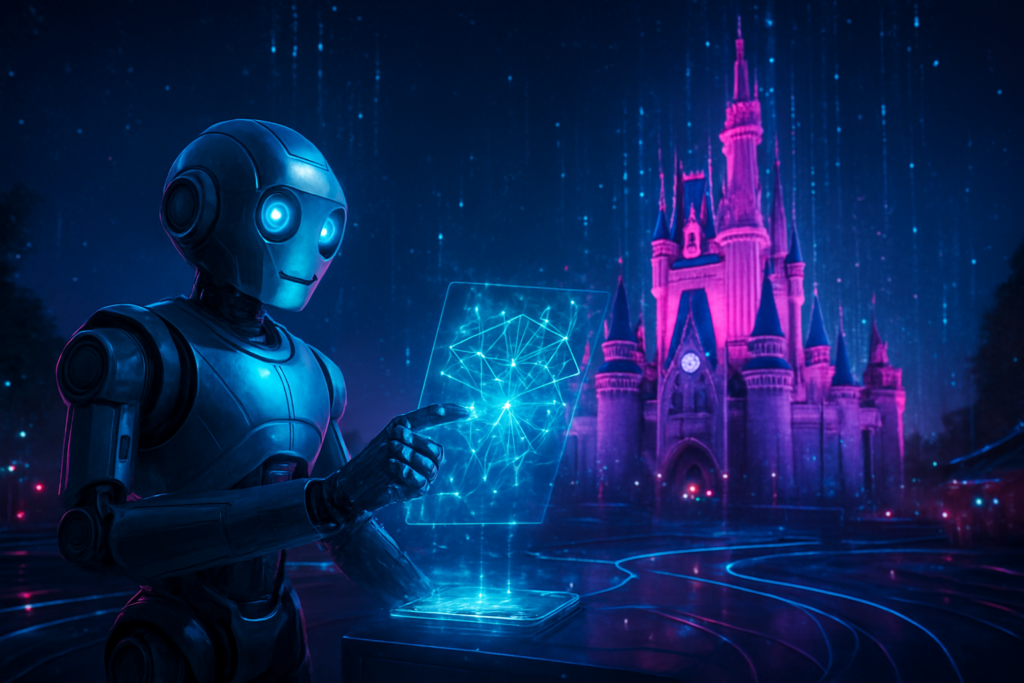
As of early 2026, The Walt Disney Company (NYSE: DIS) has completed one of the most significant structural pivots in its century-long history, transitioning from experimental AI pilots to full-scale enterprise integration. This transformation, orchestrated by the newly centralized Office of Technology Enablement (OTE), has effectively turned Disney into an AI-first entertainment powerhouse. By embedding generative AI into every facet of its business—from the brushstrokes of its animators to the roaming droids in its theme parks—Disney is attempting to solve the "mathematically unsustainable" rise in production costs while fundamentally altering how audiences interact with its stories.
The immediate significance of this shift lies in Disney’s "walled garden" strategy. Unlike many tech companies that rely on scraped public data, Disney is leveraging its 100-year archive of proprietary, "clean" content to train bespoke generative models. This approach ensures that every AI-generated frame or character interaction remains strictly within brand guidelines and legal safety zones. This "Neural Pipeline" has already begun to yield financial results, contributing to a massive turnaround in operating income and setting a new gold standard for how legacy media companies can survive the AI era.
The Neural Pipeline: Technical Mastery Behind the Magic
At the heart of Disney’s technical evolution is the Office of Technology Enablement, led by Jamie Voris. The office manages a specialized team of over 100 experts who have moved AI from a "post-production tool" to the foundational infrastructure of the company. A standout achievement in 2025 was the integration of technology from Animaj, a startup from Disney’s Accelerator program. This system utilizes "motion in-betweening" and "style protection" algorithms, allowing animators to draw only the primary key poses while the AI fills in the complex movement frames. This has reportedly slashed the production time for high-quality animated shorts from five months to just five weeks, representing a 4x increase in efficiency without sacrificing the hand-drawn aesthetic that defines the brand.
Beyond the screen, Disney has revolutionized physical guest interactions through its "Living Character Initiative." The BDX droids—bipedal, expressive robots—now roam Star Wars: Galaxy’s Edge in Florida and California as permanent fixtures. These droids utilize advanced reinforcement learning and physics engines developed in collaboration with NVIDIA (NASDAQ: NVDA). Unlike previous animatronics that followed pre-programmed loops, these droids sense guest emotions and navigate uneven terrain in real-time. Complementing this is the "HoloTile" floor, invented by Disney Imagineer Lanny Smoot. The HoloTile is the world’s first multi-person, omnidirectional treadmill, which, as of 2026, is being integrated into premium VR attractions, allowing multiple guests to "walk" through digital worlds like the streets of Coruscant without ever leaving a 10-foot square space.
A Competitive Moat Built on Data and Partnerships
Disney’s aggressive AI adoption has sent shockwaves through the media and tech sectors, positioning the company as a formidable rival to tech giants like Alphabet (NASDAQ: GOOGL) and Meta (NASDAQ: META). A landmark $1 billion alliance with OpenAI—backed heavily by Microsoft (NASDAQ: MSFT)—has granted Disney early access to advanced models like Sora 2. This partnership is unique; while Disney uses OpenAI’s infrastructure for internal production, it has also licensed a controlled roster of Marvel and Star Wars characters for a "Disney+ Creator Studio." This sandbox allows subscribers to generate their own short-form stories, effectively turning the audience into a decentralized creative force while Disney maintains strict IP control.
This strategic positioning provides Disney with a massive competitive advantage over rivals like Netflix (NASDAQ: NFLX) and Warner Bros. Discovery (NASDAQ: WBD). While other streamers are using AI primarily for recommendation algorithms, Disney is using it to vertically integrate the entire creative process. By owning the data, the models, and the distribution platform, Disney has created a "moat" that is difficult for startups to penetrate. Market analysts suggest that this AI-driven efficiency was a primary driver in the $1.3 billion turnaround in Disney's Direct-to-Consumer segment reported in late 2025, proving that AI is no longer just a buzzword but a core driver of profitability.
From Storytelling to Story-Living: The Wider Significance
The broader significance of Disney’s AI transformation lies in the shift from "storytelling" to "story-living." By integrating AI-powered personalization into its parks and streaming services, Disney is moving away from a one-size-fits-all entertainment model. For instance, the "Magic Words Live" advertising engine now uses machine learning to analyze the emotional tone of a movie or live sports broadcast on ESPN+ in real-time, serving commercials that match the viewer's current mood. This level of hyper-personalization is unprecedented in traditional media and signals a future where the "fourth wall" between the audience and the content is permanently dissolved.
However, this shift has not been without controversy. The use of generative AI in animation and scriptwriting continues to be a point of friction with creative unions, following the landmark strikes of 2023 and 2024. Disney has attempted to mitigate these concerns by positioning AI as an "augmentation tool" rather than a replacement for human talent, though critics argue that the 4x increase in production speed inevitably leads to a smaller workforce. Furthermore, the deployment of facial recognition for "AI Highlight Reels"—where the company automatically edits a family’s park visit into a professional movie—has raised ongoing discussions regarding privacy and the "commodification of memories" in the digital age.
The Horizon: Personalized Movies and the Real-Life Holodeck
Looking ahead to the remainder of 2026 and beyond, experts predict Disney will push even further into personalized, generative content. The "Disney+ Creator Studio" is expected to evolve into a platform where users can influence the plot of professional-grade shows in real-time, using AI to render unique scenes based on viewer choices. In the parks, the integration of Meta’s (NASDAQ: META) AI-enabled glasses is set to expand, offering guests a "mixed reality" layer where digital characters inhabit the physical space, providing real-time wayfinding, translation, and interactive scavenger hunts that feel indistinguishable from reality.
The ultimate goal for Disney Imagineering appears to be the creation of a true "Holodeck" experience. By combining HoloTile technology, generative environments, and BDX-style autonomous characters, Disney is working toward attractions that are entirely procedural—meaning no two guests will ever have the exact same experience. The primary challenge remains the immense computational power required to render these environments in real-time, a hurdle Disney is currently addressing through specialized edge-computing partnerships and its proprietary "Neural Pipeline."
Summary of the AI-Driven Magic
Disney’s deep integration of generative AI represents a watershed moment for the entertainment industry. By centralizing its efforts under the Office of Technology Enablement and focusing on a "walled garden" of proprietary data, the company has successfully balanced innovation with brand protection. Key takeaways include the 4x increase in animation efficiency, the deployment of autonomous "living" characters in theme parks, and a lucrative partnership with OpenAI that empowers fans to become creators.
As we move further into 2026, the significance of this development in AI history cannot be overstated. Disney has proven that legacy brands can not only survive the AI revolution but lead it. The long-term impact will likely be a complete redefinition of "The Disney Experience," moving from passive consumption to active, personalized participation. In the coming months, keep a close watch on the global rollout of BDX droids to Disneyland Paris and Tokyo Disney Resort, as well as the first user-generated shorts to emerge from the Disney+ Creator Studio, which will serve as the ultimate test of Disney’s new AI-driven magic.
This content is intended for informational purposes only and represents analysis of current AI developments.
TokenRing AI delivers enterprise-grade solutions for multi-agent AI workflow orchestration, AI-powered development tools, and seamless remote collaboration platforms.
For more information, visit https://www.tokenring.ai/.