As of February 2, 2026, the artificial intelligence landscape has reached a pivotal milestone, driven largely by the massive industrial deployment of NVIDIA’s Blackwell architecture. What began as a bold promise in late 2024 has matured into the undisputed backbone of the global AI economy. The Blackwell platform, specifically the flagship GB200 NVL72, has bridged the gap between experimental large language models and the seamless, real-time "trillion-parameter" agents that now power enterprise decision-making and autonomous systems across the globe.
The significance of the Blackwell era lies not just in its raw compute power, but in its fundamental shift from individual chips to "rack-scale" computing. By treating an entire liquid-cooled rack as a single, unified GPU, NVIDIA (NASDAQ: NVDA) has effectively bypassed the physical limits of silicon scaling. This architectural leap has provided the necessary overhead for the industry’s transition into Mixture-of-Experts (MoE) reasoning models, which require massive memory bandwidth and low-latency interconnects to function at the speeds required for human-like interaction.
Engineering the 130 Terabyte-per-Second "Giant GPU"
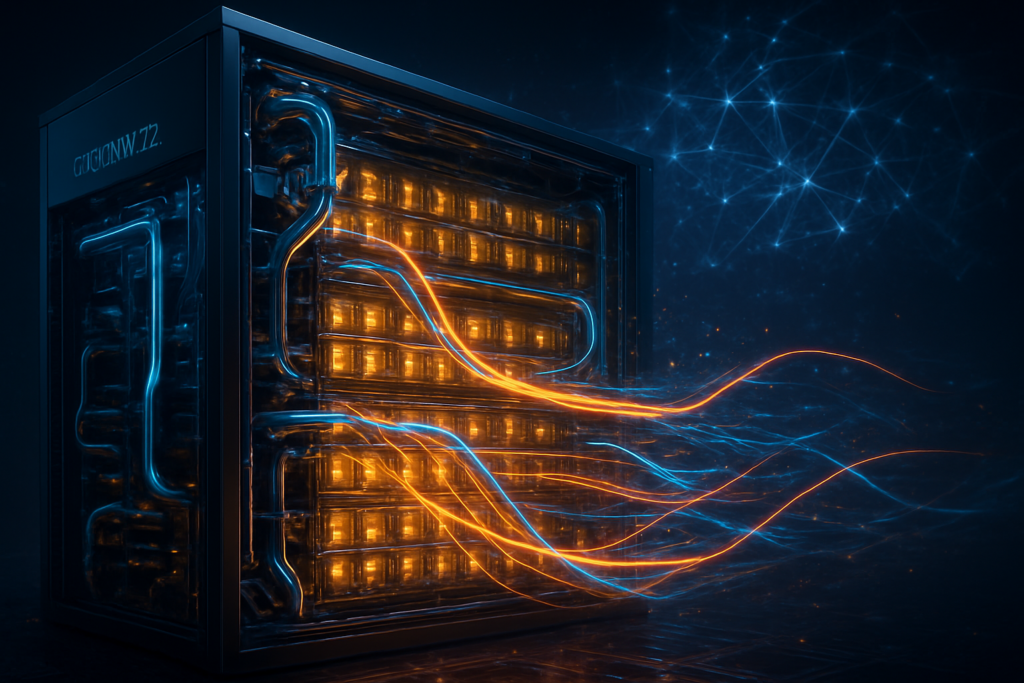
At the heart of this technological dominance is the GB200 NVL72, a liquid-cooled system that interconnects 36 Grace CPUs and 72 Blackwell GPUs. The architectural innovation starts with the Blackwell chip itself, which utilizes a dual-die design with 208 billion transistors, linked by a 10 TB/s chip-to-chip interconnect. However, the true breakthrough is the fifth-generation NVLink, which provides a staggering 1,800 GB/s (1.8 TB/s) of bidirectional bandwidth per GPU. In the NVL72 configuration, this enables all 72 GPUs to communicate as one, creating an aggregate bandwidth domain of 130 TB/s—a feat that allows models with over 27 trillion parameters to be housed and processed within a single rack.
This capability is specifically tuned for the complexities of Mixture-of-Experts (MoE) models. Unlike traditional dense models, MoE architectures rely on sparse activation, where only a subset of "experts" is triggered for any given task. The Blackwell architecture introduces a second-generation Transformer Engine and new FP4 (4-bit floating point) precision, which doubles throughput while maintaining the accuracy of larger models. Furthermore, a dedicated hardware decompression engine accelerates data movement by up to 800 GB/s, ensuring that the "experts" are swapped into memory with zero latency, resulting in a 30x improvement in real-time throughput for trillion-parameter models compared to the previous Hopper generation.
Initial reactions from the AI research community have shifted from awe to total dependency. Leading researchers at labs like OpenAI and Anthropic have noted that without the NVLink 5 interconnect's ability to minimize "tail latency" during MoE inference, the current generation of multi-modal, agentic AI would have been financially and technically impossible to deploy at scale. The transition to liquid cooling has also been hailed as a necessary evolution, as the GB200 racks now handle power densities of up to 120kW, offering 25 times the energy efficiency of the air-cooled H100 systems that preceded them.
The Hyperscaler Arms Race and Sovereign AI
The deployment of Blackwell has solidified a hierarchy among tech giants. Microsoft (NASDAQ: MSFT), Amazon (NASDAQ: AMZN), and Alphabet (NASDAQ: GOOGL) have engaged in a relentless race to secure the largest clusters of GB200 NVL72 racks. For these hyperscalers, the Blackwell architecture is more than just a performance upgrade; it is a strategic moat. By integrating Blackwell into their cloud infrastructure, these companies have been able to offer proprietary "AI Supercomputing" tiers that smaller competitors simply cannot match in terms of cost-per-token or training speed.
Meta Platforms (NASDAQ: META) has also been a primary beneficiary, utilizing Blackwell to train and serve its Llama-4 and Llama-5 series. The ability of the NVL72 platform to handle massive MoE weights in-memory has allowed Meta to keep its open-source models competitive with closed-source offerings. Meanwhile, the emergence of "Sovereign AI"—where nations build their own domestic compute clusters—has seen countries like Saudi Arabia and Japan investing billions into Blackwell-based data centers to ensure their data and intelligence remain within their borders, further driving NVIDIA’s 90% market share in the AI accelerator space.
The competitive implications extend beyond the chip makers. While Advanced Micro Devices (NASDAQ: AMD) has made significant strides with its Instinct MI400 series, NVIDIA’s "one-year cadence" strategy has kept rivals in a perpetual state of catch-up. Startups that built their software stacks on CUDA (NVIDIA’s parallel computing platform) are finding it increasingly difficult to switch to alternative hardware, as the optimizations for Blackwell’s FP4 and NVLink 5 are deeply integrated into the modern AI development lifecycle. This has created a "virtuous cycle" for NVIDIA, where its hardware dominance reinforces its software lock-in.
Beyond the Transistor: A New Era of Compute Efficiency
When viewed through the lens of the broader AI landscape, Blackwell represents the moment AI moved from "predictive text" to "active reasoning." The massive bandwidth provided by the 1,800 GB/s NVLink 5 links has solved the memory-wall problem that plagued earlier AI architectures. This has enabled the development of "agentic" systems—AI that doesn't just answer questions but can plan, execute, and monitor multi-step tasks across different software environments. The efficiency gains have also quieted some of the criticisms regarding AI's environmental impact; the 25x increase in energy efficiency means that while AI workloads have grown, the carbon footprint per inference has plummeted.
However, this concentration of power has not been without concern. The sheer cost of a single GB200 NVL72 rack—estimated in the millions of dollars—has raised questions about the democratization of AI. There is a growing divide between the "compute-rich" and the "compute-poor," where only the top-tier corporations and nation-states can afford to train the next generation of frontier models. Comparisons are often made to the early days of the Manhattan Project or the Space Race, where the sheer scale of the infrastructure required dictates who the global power players will be.
Despite these concerns, the impact of Blackwell on scientific research has been profound. In fields like drug discovery and climate modeling, the ability to run trillion-parameter simulations in real-time has accelerated breakthroughs that were previously decades away. The architecture has effectively turned the data center into a giant laboratory, capable of simulating complex molecular interactions or global weather patterns with a level of granularity that was unthinkable in the era of the H100.
The Horizon: From Blackwell to Rubin
As we look toward the latter half of 2026, the AI industry is already preparing for the next leap. NVIDIA has officially teased the "Rubin" architecture, slated for a late 2026 release. Rubin is expected to transition to a 3nm process and debut the "Vera" CPU, alongside the sixth-generation NVLink, which is rumored to double bandwidth again to 3.6 TB/s. The move to HBM4 memory will further expand the capacity of these machines to handle even more massive models, potentially pushing into the 100-trillion-parameter range.
The near-term focus, however, remains on the refinement of Blackwell. Experts predict that the next 12 months will see a surge in "Edge Blackwell" applications, where the power of the architecture is condensed into smaller form factors for autonomous vehicles and robotics. The challenge will be managing the heat and power requirements of such high-density compute in mobile environments. Furthermore, as models become even more efficient through 4-bit and even 2-bit quantization, the software layer will need to evolve to keep pace with the hardware’s ability to process data at terabyte-per-second speeds.
A Definitive Chapter in AI History
NVIDIA’s Blackwell architecture will likely be remembered as the technology that industrialized artificial intelligence. By solving the interconnection bottleneck with the 1,800 GB/s NVLink and the GB200 NVL72 platform, NVIDIA did more than just release a faster chip; they redefined the unit of compute from the GPU to the data center rack. This shift has enabled the current era of trillion-parameter MoE models, providing the raw power necessary for AI to move into its reasoning and agentic phase.
As we move further into 2026, the key developments to watch will be the first production deployments of the Rubin architecture and the continued expansion of Sovereign AI clusters. While the competition from custom hyperscaler chips and rival GPU makers continues to grow, the Blackwell platform’s integrated ecosystem of hardware, software, and networking remains the gold standard. For now, the "Blackwell Era" stands as the most significant period of compute expansion in human history, laying the foundation for whatever intelligence comes next.
This content is intended for informational purposes only and represents analysis of current AI developments.
TokenRing AI delivers enterprise-grade solutions for multi-agent AI workflow orchestration, AI-powered development tools, and seamless remote collaboration platforms.
For more information, visit https://www.tokenring.ai/.