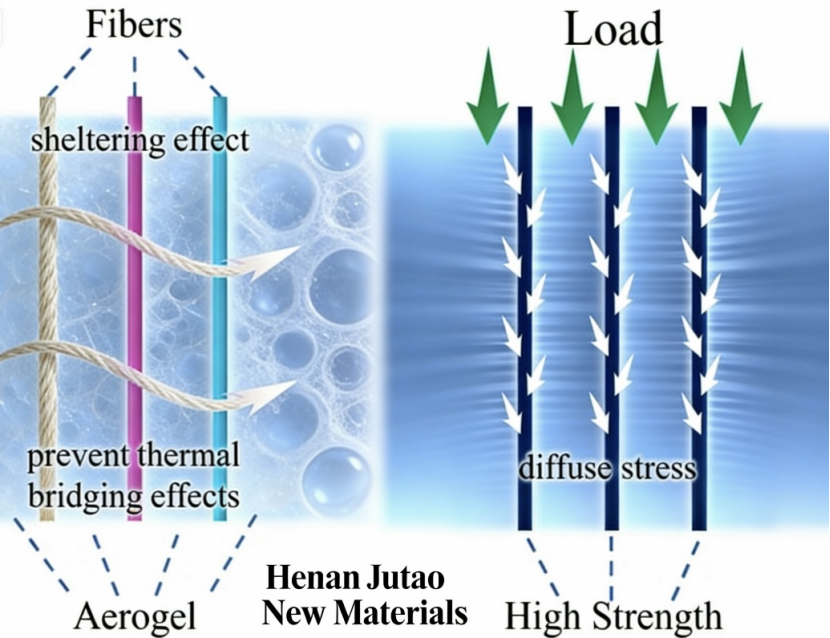
The introduction of one-dimensional reinforcing materials such as fibers or whiskers into the gel system allows them to be uniformly distributed within the porous structure, thereby providing enhanced performance for composite materials. These reinforcing fibers typically possess small diameters and large specific surface areas, enabling them to integrate well into the silica aerogel matrix. Once incorporated, they form a shielding effect within the porous structure, which can scatter and absorb infrared radiation, thus reducing radiative heat transfer.
In addition, the presence of aerogel reduces the direct contact between pure fibers, thereby decreasing solid-phase heat transfer and lowering the overall thermal conductivity of the composite material. Meanwhile, externally applied loads can be effectively distributed through fibers with high stiffness and high modulus, resulting in improved mechanical performance of the composite aerogel. A schematic illustration of the enhancement in thermal insulation and mechanical properties is shown in Figure 1.
Carbon Fiber
Carbon fibers are characterized by low density, high specific strength, and high specific stiffness. When introduced into silica aerogels, carbon fibers can provide structural support for the three-dimensional porous network.
Due to their intrinsic mechanical strength, carbon fibers can significantly improve the compressive resistance of aerogel composites when used as reinforcing materials. However, the manufacturing process of carbon fibers is relatively complex and costly. In addition, under extremely high temperatures and oxidative environments, carbon fibers may suffer performance degradation, typically above 1500 °C, which limits their application in certain high-temperature conditions.
Glass Fiber
Glass fibers offer good structural support and can effectively enhance the mechanical strength of composite materials. Their manufacturing processes are well established and relatively inexpensive.
Because of their mature production technology and favorable mechanical properties, glass fibers can significantly improve the mechanical strength of silica aerogels while simultaneously reducing thermal conductivity. However, compared with carbon fibers, their compressive performance is slightly lower. Moreover, the interfacial bonding strength between glass fibers and the silica aerogel matrix may be insufficient, which could lead to structural degradation during long-term service.
Other Inorganic Fibers
In addition to carbon and glass fibers, other inorganic nanofibers used as reinforcing materials can also provide favorable performance.
For instance, xonotlite fibers exhibit excellent high-temperature resistance, which contributes to improved thermal stability of aerogel composites. Titanium dioxide nanorods possess high rigidity and can support the aerogel network structure, maintaining the stability of the framework at elevated temperatures. Compared with carbon and glass fiber reinforced systems, these inorganic fiber–reinforced aerogels also demonstrate good mechanical properties and relatively low thermal conductivity.
However, the preparation processes for these inorganic fibers are generally more complex and expensive. Furthermore, their compatibility with the silica aerogel matrix still requires further investigation.
Organic Fibers
Compared with inorganic fibers such as carbon and glass fibers, organic fibers can significantly reduce production costs while still providing structural support for silica aerogels.
For example, the distribution morphology of aramid fibers directly influences the mechanical properties of the aerogel composite. Organic fibers can therefore enhance the structural stability of silica aerogels while reducing manufacturing costs. However, compared with inorganic fibers, organic fibers generally exhibit poorer high-temperature resistance, which limits their application in high-temperature environments.
Conclusion
Fiber-reinforced silica aerogels improve mechanical performance by introducing high-stiffness reinforcing fibers that effectively distribute the stresses applied to the aerogel structure. In addition, the presence of fibers creates a radiation shielding effect, which can partially block radiative heat transfer and thereby reduce the overall thermal conductivity of the composite material.
Jutao Environmental Technology — Specialists in Aerogel Material Solutions
Stay connected with us for the latest updates, industry insights and application solutions in the aerogel sector.
Media Contact
Company Name: HENAN JUTAO NEW MATERIAL CO., LTD
Email: Send Email
Country: China
Website: https://www.jutaoaerogel.com/