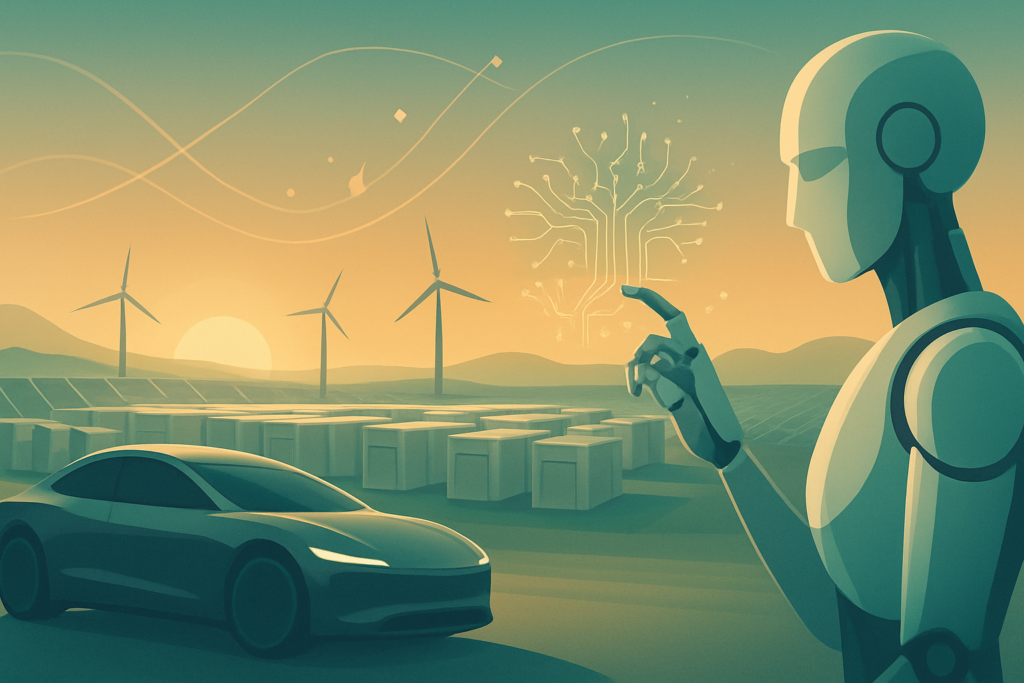
As of March 19, 2026, Tesla, Inc. (NASDAQ: TSLA) stands at the most significant strategic crossroads in its two-decade history. Long defined as the vanguard of the electric vehicle (EV) revolution, the company is currently in the midst of an aggressive metamorphosis into a "Physical AI" and robotics enterprise. While 2025 was a challenging "transition year" for the balance sheet, Tesla remains the focal point of the global technology and automotive sectors. With a market capitalization hovering around $1.2 trillion, the company continues to polarize investors, caught between the cooling demand for traditional passenger EVs and the massive, yet-to-be-realized potential of autonomous ride-hailing and humanoid labor.
Historical Background
Founded in 2003 by Martin Eberhard and Marc Tarpenning, and later steered to global prominence by Elon Musk, Tesla’s journey has been defined by "bet-the-company" moments. From the niche Roadster (2008) to the luxury Model S (2012) and the mass-market Model 3 (2017), Tesla single-handedly forced the global automotive industry toward electrification.
The period between 2020 and 2023 saw Tesla reach unprecedented heights, joining the S&P 500 and briefly touching a $1.2 trillion valuation for the first time. However, the 2024-2025 era introduced new complexities: a saturation of the premium EV market and a fierce "price war" initiated by Tesla to defend market share against emerging Chinese giants. By early 2026, the company’s narrative has shifted away from simply "selling cars" toward "solving autonomy."
Business Model
Tesla’s revenue model has diversified significantly over the last 24 months. It now operates across four primary pillars:
- Automotive: Sales and leasing of the Model 3, Y, S, X, and the Cybertruck. This remains the largest revenue driver but has seen margin compression as Tesla prioritizes volume over premium pricing.
- Energy Generation and Storage: This segment has become the company's fastest-growing vertical. Through the sale of Megapack (utility-scale) and Powerwall (residential) systems, Tesla has positioned itself as a key player in the global grid stabilization market.
- Services and Software: Includes Full Self-Driving (FSD) subscriptions, premium connectivity, and Supercharging. In 2025, software-as-a-service (SaaS) margins began to provide a critical cushion against lower hardware profits.
- Robotics and AI: While not yet a major revenue contributor, this segment includes the development of the Optimus humanoid robot and the Dojo supercomputer, which Tesla aims to monetize through internal labor savings and future external sales.
Stock Performance Overview
The performance of TSLA stock over the past decade has been a study in extreme volatility and massive growth.
- 10-Year Horizon: Investors who held through the "production hell" of 2017 have seen gains exceeding 1,500%, far outperforming the broader S&P 500.
- 5-Year Horizon: The stock remains up significantly, though it has experienced several drawdowns of 40% or more.
- 1-Year Horizon (March 2025–March 2026): After hitting a 2025 peak of $489.88 in December, the stock has corrected by approximately 18%, currently trading in the $392–$415 range. This recent dip reflects investor concern over the first annual revenue decline in Tesla's history and the expiration of key US federal tax credits.
Financial Performance
The fiscal year 2025 results, released earlier this year, highlighted the financial toll of Tesla's transition. Total revenue for FY 2025 was $94.8 billion, a 3% decline from the previous year. GAAP net income fell 46.5% to $3.79 billion.
The "story of two margins" defined the year: Automotive gross margins (excluding credits) compressed to a range of 12%–18% due to aggressive price cuts and high R&D spending on AI. Conversely, the Energy Storage segment achieved record gross margins of nearly 30%. Tesla maintains a fortress balance sheet with over $28 billion in cash, although management has indicated high capital expenditures (CapEx) through 2026 to fund the "Terafab" infrastructure for Optimus and Robotaxi production.
Leadership and Management
Elon Musk remains the central figure as CEO, though his attention is divided among SpaceX, xAI, and X (formerly Twitter). In late 2025, shareholders re-approved a massive performance-based compensation package, signaling continued institutional support despite concerns over his "key man" risk.
The internal leadership has stabilized around Vaibhav Taneja (CFO) and Ashok Elluswamy, who has taken a more public-facing role as the head of Autopilot and Robotics. To address governance concerns, the board added Jack Hartung (formerly of Chipotle) as an independent director in 2025 to bolster the audit and risk committees.
Products, Services, and Innovations
Tesla’s product pipeline is currently focused on two critical "Step-Change" innovations:
- Project Redwood (The $25,000 EV): Slated for production in late 2026, this compact crossover is expected to use the "Unboxed" manufacturing process to drastically reduce costs.
- Cybercab (Robotaxi): A dedicated autonomous vehicle without a steering wheel or pedals. Pilot production began at Giga Texas in early 2026, with mass production targeted for next month (April 2026).
- Optimus Gen 3: The latest iteration of Tesla’s humanoid robot now features 50 actuators per hand. Several hundred units are currently deployed in the Fremont and Texas factories, performing logistics tasks and handling 4680 battery cells.
Competitive Landscape
In early 2026, the competitive threat from China has reached a fever pitch. BYD (OTC: BYDDF) officially surpassed Tesla in total pure-battery EV sales during 2025, leveraging its vertical integration to offer lower-priced models.
In the Western market, legacy automakers like Ford (NYSE: F) and General Motors (NYSE: GM) have pulled back on aggressive EV targets, inadvertently giving Tesla more breathing room in the premium segment but increasing the pressure on Tesla to innovate in autonomy. In the self-driving space, Tesla faces stiff competition from Alphabet's (NASDAQ: GOOGL) Waymo, which currently leads in Level 4 commercial miles driven.
Industry and Market Trends
The "EV Hype" of the early 2020s has been replaced by "EV Realism." High interest rates and the expiration of the $7,500 US federal tax credit in September 2025 have cooled consumer demand in North America.
However, two macro trends are working in Tesla's favor:
- Grid Modernization: The global shift toward renewables has created an insatiable demand for utility-scale storage (Megapacks).
- The AI Proliferation: The market is increasingly valuing Tesla not as an automaker, but as an AI company, rewarding its massive data advantage in training neural networks for real-world applications.
Risks and Challenges
Tesla faces a unique blend of operational and systemic risks:
- Regulatory Scrutiny: The NHTSA and DOJ continue to investigate "Full Self-Driving" (Supervised) following several high-profile accidents.
- Execution Risk: The "Unboxed" manufacturing process is unproven at scale. Any delays in the $25,000 vehicle or the Cybercab could lead to further stock price erosion.
- Geopolitical Friction: Tesla’s heavy reliance on Giga Shanghai makes it vulnerable to escalating trade tensions between the US and China, including potential retaliatory tariffs.
Opportunities and Catalysts
The most significant catalysts for 2026 include:
- FSD Licensing: Any confirmed deal with a legacy OEM to license Tesla’s autonomous stack would be a massive revenue and valuation driver.
- Robotaxi Network Launch: The official launch of a Tesla-owned ride-hailing app in 2026 would signal a shift from hardware sales to recurring, high-margin software revenue.
- Energy Scaling: The new Shanghai and Houston Megafactories are expected to bring total storage capacity to over 100 GWh by 2027.
Investor Sentiment and Analyst Coverage
Wall Street remains deeply divided. "Bulls" like Dan Ives of Wedbush maintain a price target of $600, viewing the current automotive slowdown as a temporary distraction from the "AI revolution." "Bears," such as Gordon Johnson, maintain targets as low as $25, arguing that Tesla is a slowing car company trading at a tech valuation it cannot justify. Institutional ownership remains high, but retail sentiment—traditionally Tesla's "secret weapon"—has become more cautious as the stock's growth has stalled compared to other "Magnificent Seven" peers.
Regulatory, Policy, and Geopolitical Factors
The regulatory landscape is currently a headwind in the United States due to the expiration of EV incentives. However, in Europe, Tesla enjoys a competitive advantage as its Shanghai-made vehicles face a 7.8% tariff—significantly lower than the 35% tariff levied against some of its Chinese competitors. In China, Tesla achieved a breakthrough in early 2026 by securing approval for full local FSD training, allowing it to compete more effectively with local tech-heavy rivals like Xiaomi and Huawei.
Conclusion
Tesla enters the second quarter of 2026 as a company in profound transition. The financial "growing pains" of 2025 are evident in compressed margins and dipping revenues, yet the technological foundations for its next era—autonomy, energy storage, and robotics—are more robust than ever. For investors, the thesis hinges on one question: Can Tesla successfully bridge the gap between being a high-volume car manufacturer and a dominant AI platform? While the risks of regulatory hurdles and intense competition are real, Tesla’s massive data moat and manufacturing agility ensure it remains the most watched company in the global market.
This content is intended for informational purposes only and is not financial advice.