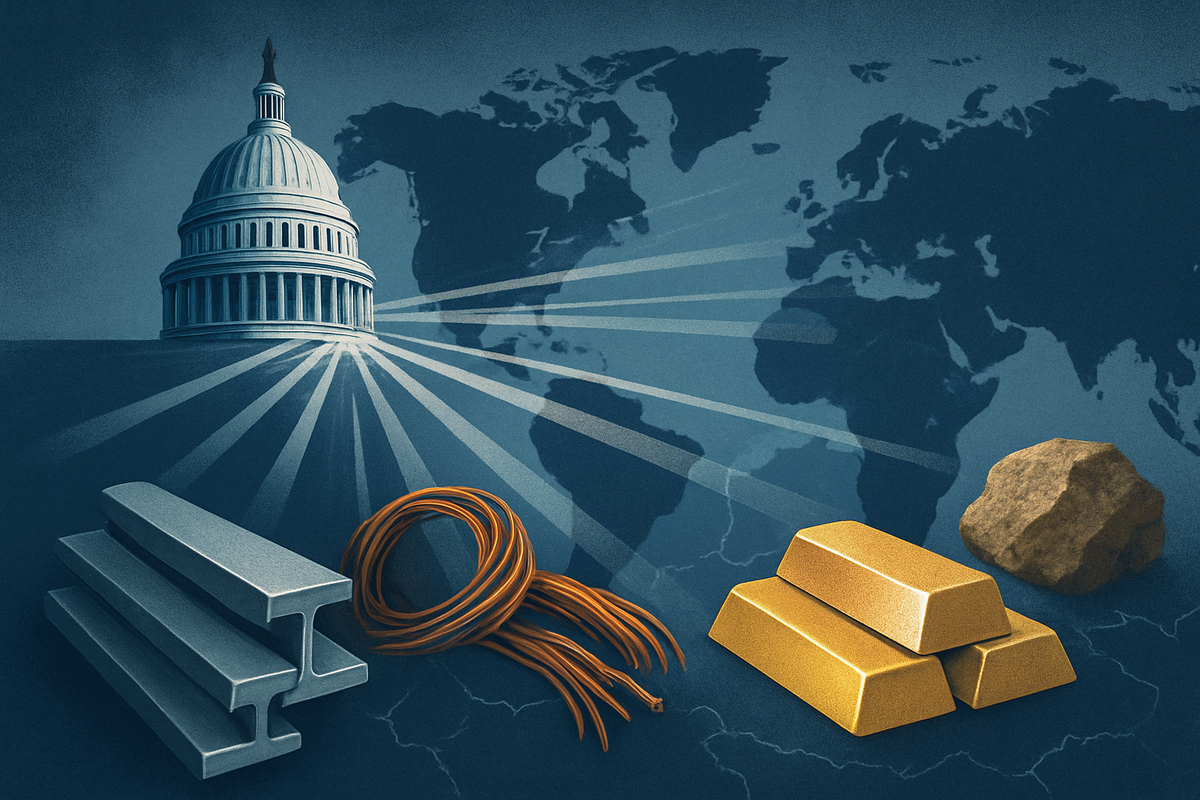
The intricate web of global metals markets is currently undergoing a profound transformation, significantly influenced by a series of assertive U.S. presidential policies. From protectionist tariffs designed to bolster domestic industries to ambitious infrastructure spending plans and targeted sanctions against geopolitical rivals, Washington's actions are sending ripple effects across continents. These strategic maneuvers are not merely tweaking market dynamics but are fundamentally reshaping supply chains, driving demand for critical minerals, and intensifying a global competition for resource dominance.
The immediate implications are clear: increased price volatility for key commodities, a reorientation of trade flows, and a heightened focus on supply chain resilience. As the U.S. leverages its economic and political power, the world's miners, refiners, and manufacturers are scrambling to adapt to a new landscape where national security and strategic autonomy often trump traditional free-market principles. This period marks a pivotal moment, signaling a long-term shift towards more localized and geopolitically aligned metals supply networks.
Washington's Iron Fist: Tariffs, Infrastructure, and Sanctions Drive Market Shifts
Recent U.S. presidential administrations have employed a diverse toolkit to exert influence over global metals markets, leading to significant and often immediate reactions. These actions span from trade protectionism to massive domestic investment and punitive measures against adversaries.
During the Trump administration, tariffs on steel and aluminum became a prominent feature of U.S. trade policy. In March 2018, a 25% tariff on steel and a 10% tariff on aluminum imports were imposed on most countries, later extending to the EU, Canada, and Mexico. By June 2025, these tariffs saw further reintroduction and escalation, with duties on foreign steel and aluminum imports doubling to 50% for most trading partners, with the UK being a notable exception at 25%. These measures, implemented under Section 232 of the Trade Expansion Act of 1962, were intended to protect domestic producers. The initial reaction saw U.S. steel and aluminum manufacturers, such as Nucor (NYSE: NUE) and U.S. Steel (NYSE: X), experience stock gains and improved pricing power. However, they also led to increased costs for U.S. industries reliant on these materials, such as automotive and construction, and triggered retaliatory tariffs from affected nations, causing global trade shifts.
The Biden administration's Infrastructure Investment and Jobs Act (IIJA), signed in November 2021, represents another monumental influence. This $1.2 trillion package, with $550 billion in new spending over five years, aims to modernize U.S. roads, bridges, public transit, and the electric grid. Crucially, the plan includes "Buy America" provisions, mandating the use of U.S.-produced iron and steel for federal projects. This initiative is a substantial driver of demand for industrial metals, particularly steel, copper, and aluminum. While the full effects on demand were anticipated to be felt 12 to 18 months post-passage, it has already spurred investment in America's metals sector and is expected to significantly boost demand for domestically produced materials over the coming decade. The plan also includes substantial funding, such as $30 million announced in August 2023, to build up the domestic supply chain for critical minerals, essential for clean energy technologies.
Furthermore, sanctions against Russia following its invasion of Ukraine have profoundly disrupted specific metal markets. In April 2024, the U.S. Department of the Treasury, in coordination with the UK, prohibited the import of Russian-origin aluminum, copper, and nickel produced on or after April 13, 2024, into the United States. This action also limited the use of these metals on global exchanges like the London Metal Exchange (LME) and Chicago Mercantile Exchange (CME). The immediate market reaction saw aluminum prices soar, with LME 3-month aluminum opening at a record high on April 15, 2024. Palladium prices had previously spiked to over $3,100 per ounce in March 2022 due to supply fears. While these sanctions aim to reduce Russia's revenue, they have led to increased price volatility and a redirection of Russian exports, often at discounted prices, to "sanction-neutral" countries like China and India, reshaping global trade flows for these commodities.
Corporate Fortunes: Winners and Losers in the Metals Arena
The U.S. presidential policies have created a clear delineation of winners and losers across the global metals industry, forcing companies to strategically adapt or face significant challenges.
U.S. domestic steel and aluminum producers have largely been beneficiaries of the protectionist measures. Companies like Cleveland-Cliffs (NYSE: CLF), Nucor (NYSE: NUE), U.S. Steel (NYSE: X), Century Aluminum (NASDAQ: CENX), and Steel Dynamics (NASDAQ: STLD) saw their stock prices rise and experienced improved pricing power due to reduced foreign competition from Trump-era tariffs. These companies are further poised to win from the "Buy America" provisions within President Biden's infrastructure plan, which guarantees increased demand for domestically produced materials for massive public works projects. Similarly, U.S. critical mineral producers are seeing a boost. MP Materials (NYSE: MP), the sole rare earth mining and processing operation in the U.S., has received significant government investment, while Lithium America (NYSE: LAC) is a key beneficiary with its Thacker Pass lithium project in Nevada, supported by a joint venture with General Motors (NYSE: GM).
Conversely, a broad spectrum of U.S. downstream manufacturers has faced increased costs, making them potential losers. Automotive giants like General Motors (NYSE: GM) and Ford Motor (NYSE: F), heavy equipment manufacturers such as Caterpillar (NYSE: CAT), and appliance makers like Whirlpool (NYSE: WHR) have all contended with higher input costs for steel and aluminum. Smaller manufacturers, in particular, have struggled, with some even facing bankruptcy due to tariff-induced expenses. Internationally, foreign metal producers and exporters to the U.S. from countries like Canada, Mexico, and the EU have seen their competitive edge eroded and market access constrained by tariffs and "Buy America" mandates.
Russian mining and metals companies have undoubtedly been the primary losers from U.S. and allied sanctions. Rusal (United Company Rusal International PJSC), Russia's top aluminum producer, has faced severe restrictions on Western markets and alumina supplies, forcing it to redirect exports to Asia. Nornickel (PJSC MMC Norilsk Nickel), a leading producer of nickel, palladium, and copper, has seen North American export revenues plummet, with plans to relocate copper production to China. While "sanction-neutral" countries like China and India have increased their imports of discounted Russian metals, benefiting their domestic industries, the Russian producers themselves are experiencing significant operational and financial challenges due to limited access to Western financing, equipment, and key markets.
Broader Significance: Geopolitics, Green Transition, and a New Trade Order
The influence of U.S. presidential deals on global metals markets extends far beyond immediate price fluctuations, embedding itself within broader industry trends, reshaping international relations, and setting new regulatory precedents.
At the core of these developments is geopolitical competition and resource nationalism. The strategic rivalry between the U.S. and China has elevated metals and critical minerals to strategic assets, driving a global pivot from efficiency-focused supply chains to security-oriented regional systems. This fundamental restructuring prioritizes control over essential resources for national security, leading to a resurgence of resource nationalism where governments actively intervene to secure domestic or allied supply chains. This trend is further fueled by the energy transition, which is creating unprecedented demand for "green metals" like lithium, copper, and nickel for electric vehicles and renewable energy infrastructure. Simultaneously, increased global defense spending is creating sustained demand for high-performance alloys, reinforcing the strategic importance of metals production.
The ripple effects on competitors and partners are substantial. Tariffs, such as the 25-50% duties on steel and aluminum, not only raise prices but also force trade diversion, compelling importers to seek alternative sources and increasing global price volatility. Countries heavily reliant on exporting metals or metal-containing goods to the U.S., like Canada and Mexico, face eroded competitiveness and disrupted supply chains. This has spurred investment shifts, with the U.S. actively fostering strategic alliances with nations like Australia, Malaysia, and Japan to build trusted critical mineral supply networks, reducing reliance on Chinese export controls. Furthermore, geopolitical tensions and economic uncertainty arising from U.S. trade policies consistently drive investors towards precious metals like gold and silver as safe-haven assets, leading to price surges as seen during periods of heightened trade friction.
From a regulatory and policy perspective, presidential deals are shaping a new landscape. The ability of a president to implement or modify tariffs (e.g., Section 232 and 301) directly impacts trade flows. More broadly, the U.S. is developing a comprehensive critical minerals strategy, streamlining permitting processes, and providing legislative support and direct investments in domestic mining and processing companies. This reflects a broader trend of economic nationalism and industrial policy, where governments actively use incentives and regulations to boost domestic production and reduce foreign reliance. Historically, U.S. presidential decisions have always influenced metal markets, from the Gold Standard era to modern times where policies under Presidents Trump and Biden have demonstrably impacted gold prices amid trade wars and global instability. The current era, with its renewed and potentially broader scope of tariffs on industrial metals, intensifies these protectionist measures, signaling a strategic pivot towards independence in critical markets.
What Comes Next: A Future Defined by Resilience and Redirection
The path forward for global metals markets, heavily influenced by U.S. presidential deals, promises continued dynamism, marked by both short-term volatility and long-term structural realignments. Stakeholders must prepare for an environment where strategic autonomy and supply chain resilience are paramount.
In the short term (next 1-4 years), the trajectory of U.S. trade policy will be a critical determinant. Should a protectionist stance intensify, widespread tariffs, potentially including a 10-20% across-the-board tariff on all imports and a 60% tariff on Chinese goods, are anticipated. Proposed tariffs on copper (50% by summer 2025) highlight this trend. These measures are likely to elevate domestic U.S. prices for base metals like steel, aluminum, copper, and zinc, benefiting U.S. producers but increasing costs for downstream manufacturers. This could also contribute to global economic slowdowns and inflation in the U.S., potentially bringing the economy close to a recession. Precious metals, particularly gold and silver, are expected to maintain their appeal as safe-haven assets amidst this uncertainty, potentially seeing further price surges. Critical minerals, while often excluded from universal tariffs, could be indirectly affected by higher EV component costs, impacting demand. Retaliatory tariffs from U.S. trading partners are a strong possibility, further fragmenting global supply chains.
The long-term (5+ years) outlook points towards a fundamental restructuring of global metals supply chains. The "America First" policies are accelerating trends in reshoring, nearshoring, and friend-shoring, prioritizing resilience over pure cost efficiency. The U.S. aims to significantly reduce its dependence on critical mineral imports, especially from China, through substantial investment in domestic mining and processing, complemented by international partnerships. The Inflation Reduction Act (IRA) will continue to drive demand for lithium, cobalt, nickel, and copper for energy transition technologies, with tax credits favoring materials sourced from the U.S. or FTA countries. This period will likely see new geopolitical alliances forming around critical mineral supply, leading to a more fragmented global trade landscape.
Strategic pivots and adaptations will be crucial for all players. The U.S. government needs a balanced strategy that integrates domestic mining and processing with diversified international supply chains. This requires a comprehensive industrial policy for critical minerals, including investments in technology and logistics. For other countries and corporations, supply chain diversification (reshoring, nearshoring to Canada and Mexico, or friend-shoring) will be essential to mitigate risks. Companies will need to manage increased costs, potentially passing them on to consumers, or actively seeking tariff exemptions. Leveraging digital technologies for market prediction and fostering international cooperation to bolster domestic industries will also be key. Market opportunities will emerge for domestic U.S. producers of steel, aluminum, and green metals, as well as for investors in safe-haven assets. However, challenges include increased costs, supply chain disruptions, demand volatility from global slowdowns, and the persistent issue of under-investment in new mining projects.
Navigating the New Metals Landscape: A Comprehensive Wrap-Up
The influence of U.S. presidential deals on global metals markets has ushered in a new era, defined by strategic competition, a re-evaluation of supply chain vulnerabilities, and the accelerating demand for critical minerals in the green energy transition. The lasting impact will be a fundamentally reshaped global metals landscape.
Key takeaways underscore a shift from purely cost-driven global supply chains to those prioritizing national security and resilience. Trump-era tariffs, and their recent reintroduction, have undeniably boosted U.S. domestic steel and aluminum producers in the short term, albeit at the cost of higher input prices for downstream industries and international trade friction. Biden's infrastructure plan provides a sustained demand stimulus for industrial metals, while his administration's critical minerals strategy, amplified by the Inflation Reduction Act, is aggressively pushing for the reshoring and friend-shoring of vital battery and rare earth materials to lessen reliance on China. Sanctions against Russia have further demonstrated how geopolitical actions can swiftly disrupt specific commodity markets and redirect trade flows.
Assessing the market moving forward, it is clear that protectionist tendencies and a focus on domestic supply chain security will persist, regardless of the administration. This implies ongoing support for domestic mining and processing, coupled with a sustained surge in demand for "green metals" like lithium, copper, and nickel due to the energy transition. Infrastructure-driven demand for traditional metals will provide a baseline, but geopolitical tensions, particularly U.S.-China relations, will remain a critical factor influencing commodity prices. The market will continue to grapple with the challenge of balancing domestic production goals with the complexities of global supply, environmental concerns, and permitting hurdles.
The lasting impact will be profound: permanently reshaped global supply chains with a greater emphasis on diversification and localization for critical minerals, leading to new mining and processing hubs in North America and allied nations. This will drive accelerated investment in green technologies, making specific metals strategic commodities for decades. While protectionist policies may endure, the long-term success hinges on their ability to foster genuine competitiveness without unduly burdening downstream industries or triggering prolonged trade wars.
For investors in coming months, vigilance is key. Closely monitor the evolution of U.S. trade policy, particularly any changes to existing tariffs or new actions targeting "foreign entities of concern." Track the implementation of critical minerals policies, including funding allocations and progress on domestic mining projects, as these will directly impact the supply outlook for battery metals. The rollout of infrastructure spending will indicate steady demand for traditional industrial metals. Furthermore, keep a keen eye on geopolitical events and the strength of the U.S. dollar, as these factors will continue to influence safe-haven assets like gold and silver, and overall commodity prices. Finally, stay abreast of technological advancements in battery chemistry, which could alter demand dynamics for specific critical minerals.
This content is intended for informational purposes only and is not financial advice