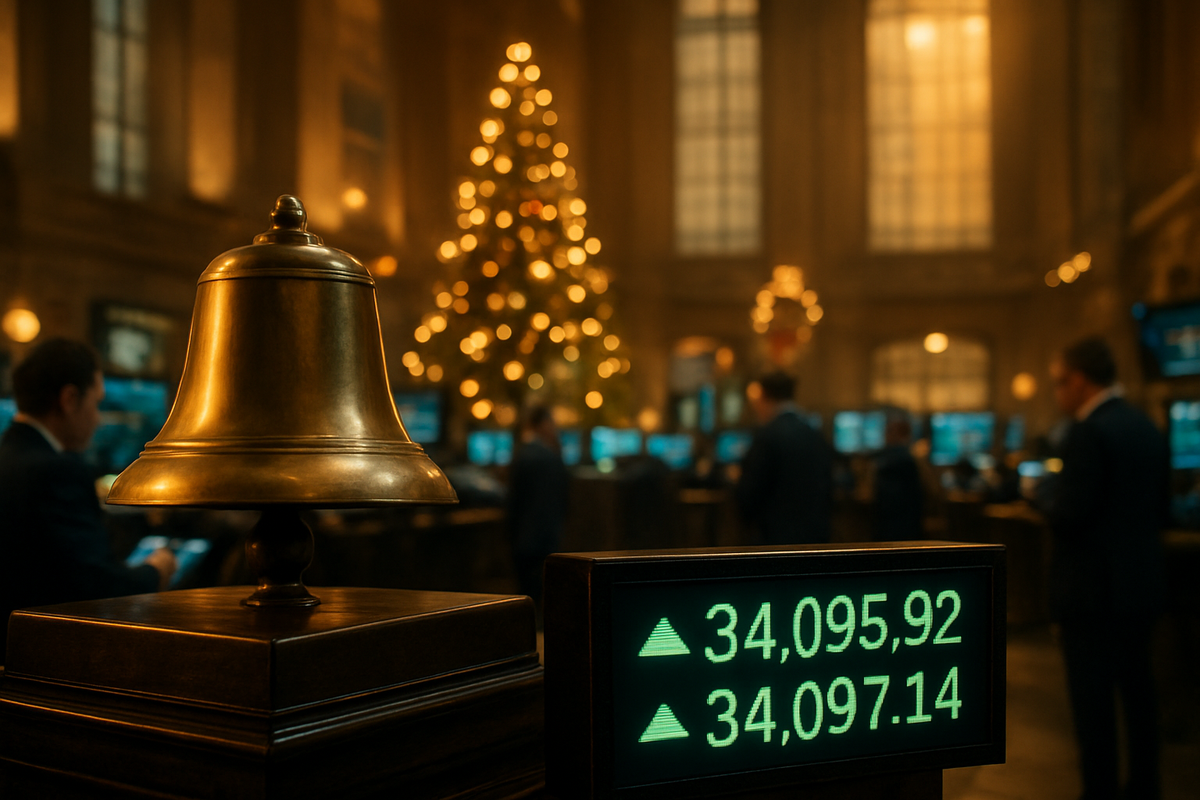
As the clock strikes 1:00 p.m. ET today, December 24, 2025, the New York Stock Exchange and the Nasdaq will fall silent, marking the end of a truncated Christmas Eve trading session. This traditional early close comes at a moment of profound transition for the U.S. financial markets, which are currently riding a wave of year-end optimism despite a year defined by sharp volatility and significant structural shifts. With the S&P 500 sitting at a record-breaking 6,909.79 as of yesterday’s close, the atmosphere on trading floors is one of cautious celebration, as the "Santa Claus Rally" appears to be in full swing.
The immediate implications of today’s thin trading volume are twofold: while price movements may be exaggerated by the lack of liquidity, the underlying trend remains overwhelmingly bullish. Investors are increasingly looking past the localized disruptions of 2025—including a historic tariff shock in April and a 43-day government shutdown in the autumn—to focus on a 2026 landscape that promises lower interest rates and a more mature artificial intelligence economy. For many on Wall Street, today’s early exit is not just a holiday break, but a brief pause before what many analysts predict will be a sprint toward even higher valuations in the new year.
A Year of Resilience: From Tariff Shocks to Record Highs
The path to this afternoon’s early close has been anything but linear. The 2025 calendar year began with a massive "tariff shock" in April that saw nearly $6.6 trillion in market value evaporate in a matter of weeks. However, the market’s recovery has been nothing short of remarkable, with the S&P 500 on track to post a 17% gain for the year. This resilience was further tested in October and November when a 43-day government shutdown delayed critical economic data releases, leaving investors to fly blind through much of the fourth quarter. Despite these hurdles, a blockbuster Q3 GDP report showing 4.3% annualized growth provided the necessary fuel for the current record-setting run.
The Federal Reserve has played a central role in stabilizing the ship. At its final meeting on December 10, the central bank issued its third consecutive 25-basis-point rate cut, bringing the federal funds rate down to a range of 3.50%–3.75%. This easing cycle has provided a much-needed tailwind for equities, particularly in the technology and housing sectors. Fed Chair Jerome Powell’s shift from a "higher for longer" stance to a "pause and assess" strategy for early 2026 has given the market confidence that the elusive "soft landing" has finally been achieved.
Trading today is expected to follow the typical holiday pattern: low volume and high sensitivity. Historically, the "Santa Claus Rally"—the period encompassing the last five trading days of December and the first two of January—sees the market rise 79% of the time. With major indices at all-time highs, the institutional "window dressing" typically seen at year-end is largely complete, leaving retail investors and automated algorithms to dictate the direction of today’s shortened session.
Winners and Losers in the First Trillion-Dollar Holiday
The 2025 holiday season is projected to be the first in U.S. history to surpass $1 trillion in total retail sales, but the rewards have not been distributed evenly. Amazon (NASDAQ: AMZN) has emerged as a clear winner, capitalizing on a record-breaking Cyber Week that saw $44.2 billion in sales. The e-commerce giant’s stock is trading near all-time peaks, bolstered by its logistics efficiency and the continued integration of AI into its consumer recommendation engines. Similarly, Walmart (NYSE: WMT) has seen its shares trade at a premium, as value-conscious consumers flocked to its stores to combat the lingering effects of sticky service-sector inflation.
In the technology sector, the narrative remains dominated by the "AI Engines." Nvidia (NASDAQ: NVDA) made history this year by becoming the first company to surpass a $5 trillion market capitalization, acting as the primary engine for the S&P 500's record run. Apple (NASDAQ: AAPL) has also seen a dramatic reversal of fortune; after a sluggish start to 2025, the stock rallied 35% in the second half of the year as its personal AI roadmap began to show tangible results in iPhone sales. Alphabet (NASDAQ: GOOGL) has also been a standout, rising over 60% this year on the back of Gemini 3’s success and milestones in its Waymo autonomous driving division.
However, the "K-shaped" recovery has left some legacy players behind. Target (NYSE: TGT) and Nike (NYSE: NKE) have struggled to keep pace, with the latter weighed down by trade tensions and soft demand in international markets. In the travel sector, the picture is brighter. Delta Air Lines (NYSE: DAL) and American Airlines (NASDAQ: AAL) are reporting record-breaking passenger volumes, with Delta posting its most profitable December quarter in history. Booking Holdings (NASDAQ: BKNG) has also benefited from a surge in international leisure travel, with its stock hitting local highs just yesterday.
The Broader Significance: AI Maturity and Policy Pivots
The current market environment reflects a significant evolution in the "AI trade." In 2023 and 2024, the market was driven by pure speculation and hardware demand. In late 2025, we are seeing a shift toward software and industrial application. Companies like Microsoft (NASDAQ: MSFT) are now being judged not just on their cloud infrastructure, but on how effectively their AI "Copilots" are driving productivity in the broader workforce. This transition from hardware to software is expected to be the defining theme of 2026, as investors look for "AI-enabled" gains in non-tech sectors like healthcare and manufacturing.
Furthermore, the market's performance this Christmas Eve is a testament to the diminishing impact of political volatility. Despite the chaos of the autumn government shutdown, the underlying strength of the U.S. consumer and the stability of the banking sector have kept the "fear index" (VIX) relatively low. The market has essentially "priced in" political gridlock, focusing instead on the Fed's easing cycle and the potential for a neutral interest rate near 3.125% by the end of next year.
The historical precedent for today’s session is also encouraging. Since 1950, the S&P 500 has averaged a 1.3% gain during the seven-day holiday window. While today’s session is short, it serves as a psychological anchor for the year ahead. The fact that the market is closing at or near record highs suggests that the "momentum trade" is still the dominant force on Wall Street, overshadowing concerns about "frothy" valuations in the tech sector.
What Comes Next: The Road to 2026
As we look toward the first quarter of 2026, the primary question for investors is whether the Fed will follow through with its "pause and assess" strategy. While inflation has cooled to 2.7%, any resurgence in energy prices or further trade disruptions could force a hawkish pivot. Investors will be closely watching the January labor reports for signs that the cooling economy is not sliding toward a recession, but rather stabilizing at a sustainable growth rate.
Strategically, we expect a rotation into "AI-adjacent" sectors. While the chipmakers have led the charge, the next wave of growth is likely to come from energy companies providing power to massive data centers and cybersecurity firms protecting the new AI infrastructure. Companies like Nvidia (NASDAQ: NVDA) will likely maintain their dominance, but the "Magnificent Seven" trade may broaden out as smaller, agile players begin to monetize AI-native software.
The short-term outlook remains positive, with the session on December 26th historically being one of the most consistently green days of the year. Investors should, however, remain wary of the low-volume volatility that often accompanies the final days of December. Large institutional moves can move the needle significantly in a thin market, creating "bull traps" or sudden dips that may not reflect long-term fundamentals.
Closing the Books on a Historic 2025
The early close of the markets today marks the end of a year that defied expectations. From the depths of the April tariff scare to the heights of a $70 trillion total market capitalization, 2025 has been a year of extreme resilience. The "Santa Claus Rally" currently underway is a fitting conclusion to a year where the U.S. economy proved it could handle both high interest rates and significant geopolitical friction.
Moving forward, the market’s focus will shift from "inflation fighting" to "growth sustaining." The Fed’s success in bringing inflation down to the 2% range without triggering a recession—the elusive soft landing—will be the benchmark by which 2025 is remembered. For investors, the takeaway is clear: the AI revolution is no longer a future prospect but a present reality, and the "new normal" for interest rates is likely to be significantly higher than the zero-bound era of the previous decade.
As the trading floor lights dim this afternoon, the eyes of the financial world are already fixed on January. Watch for the "January Effect," where small-cap stocks historically outperform, and keep a close eye on the Fed’s first communications of the new year. For today, however, the bulls are in control, and Wall Street is heading into the holiday with its head held high.
This content is intended for informational purposes only and is not financial advice